By Sarah NEGEDU
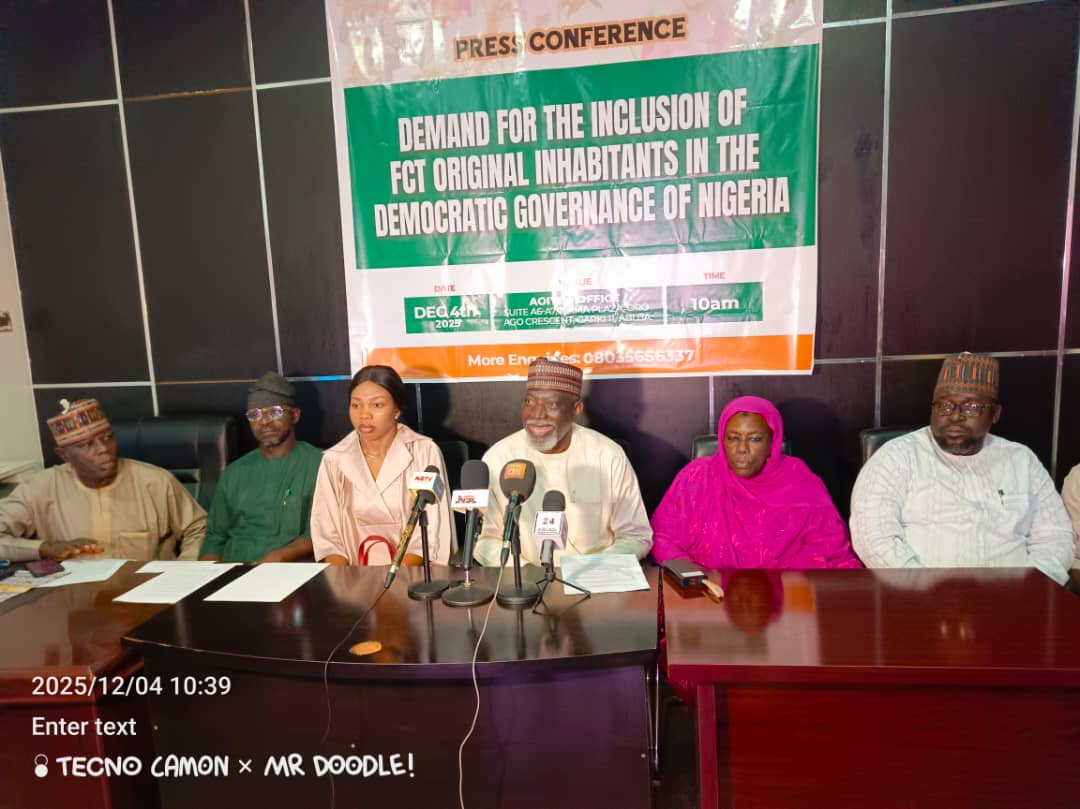
The clamour for national inclusion by indigenous groups in the Federal Capital Territory took a new turn on Thursday, as leaders warned that they may reconsider their support for President Bola Tinubu in future elections, if the administration continues to exclude them from national appointments.
The warning was issued by the FCT Stakeholders’ Assembly, who warned that the persistent exclusion of Abuja natives from federal decision-making has reached an unacceptable point.
President of the Assembly, Dr. Aliyu Daniel Kwali, who spoke on behalf of the group, maintained that the latest list of 35 ambassadorial nominees submitted to the Senate, with no representative of the FCT, was further proof of a “deliberate and calculated” pattern of exclusion.
Kwali said the omission violates the constitutional and human rights of over six million original inhabitants and residents of the territory, adding that the president’s action reinforces a longstanding feeling that the FCT is treated as “a territory to be administered, not a people to be represented.”
He recalled that Abuja natives were similarly excluded from the Governing Board of the North Central Development Commission, NCDC, earlier in June 2025, despite clear provisions in the NCDC Establishment Act that should guarantee their representation.
He said patience within the community has now reached its limit ahead of the coming elections. “As we approach the 2026 Area Council elections and the 2027 general elections, we strongly advise that government actions reflect fairness, inclusion, and respect for constitutional provisions, not exclusion or marginalization,” he said.
The Assembly presented two immediate demands to President Tinubu: the inclusion of at least one FCT native in the ambassadorial list and the appointment of not less than two indigenes to the NCDC Board.
Kwali warned that unless these demands are met, Abuja natives would be left with no choice but to rethink their political alliances. “If the government of President Bola Tinubu continues to exclude us from democratic governance, of course at the time of the election we will have to review our relationship with him and his political party.
“Beginning from the local government election that is coming up in 2026, it doesn’t make sense to continue to support somebody who does not recognise you as a citizen. We will support somebody who recognises us,” he said.
He aligned their new political criteria strictly with promise-keeping and accountability. “We will support a party or a candidate that recognizes the FCT original inhabitants as full-fledged citizens of Nigeria. Our support will also be guided by the promises that the candidate makes.
“If you make us a promise, we will trust your promises. When you come into power and you fail us, we will review. That’s the beauty of democracy. It is during the election that we will show whether you have fulfilled your promises, whether you are trustworthy or not trustworthy,” he said.
Kwali also addressed questions on why FCT natives are not staging mass protests despite their grievances.
He said the decision was one of respect, not fear, particularly respect for the FCT Minister, Nyesom Wike, who he credited with creating new administrative structures that benefit both indigenes and residents.
“Let me answer your question. It is not out of fear but respect for the FCT Minister, Nyesom Wike, who has created additional Secretariats to cater for specific needs of the FCT indigenes and even residents. Before the minister we didn’t have certain Secretariats like Women Affairs, Youth Development. Since the minister came, we now have all that and even had the first female head of service. The minister has shown tremendous respect for Abuja indigenes and we all know that respect is reciprocal.”
Despite the commendation, Kwali noted that indigenes expect the minister to use his authority as Governor of the Territory to press their case before the presidency.
“We are watching him carefully. If he does not reciprocate our respect, of course, we will also change. Respect is reciprocal,” he said.
The Stakeholders’ Assembly maintained that the issue has moved beyond mere appointments and now touches on recognition, equity, and political dignity. They insist that no administration can continue to ignore the people on whose land the nation’s capital was built.