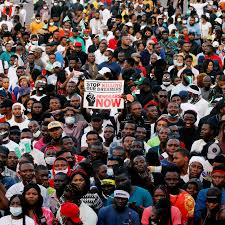
Angry Nigerians have been on the streets since Thursday, August 1, demanding the reversal of some government policies they believe, are responsible for the current economic hardship in the country.
Major among their requests is the reversal of the removal of subsidy on petroleum.
One of President Tinubu’s most notable policy actions was the removal of the long-standing fuel subsidy and the floating of the naira. Government said both actions are aimed at reducing government expenditure and encouraging economic efficiency.
The action sparked widespread public discontent due to the immediate spike in fuel prices, exacerbating the cost of living for many Nigerians
These two key policies have caused tremendous hardship on Nigerians, with prices of basic food items soaring beyond the reach of the ordinary citizen, even as cost of transportation more than tripled across the country.
The National Bureau of Statistics, had pegged the inflation rate at 33.95% in May 2024, with food inflation exceeding 40%. The liberalization of the foreign exchange market has led to a more volatile naira, moving from ₦460 to a dollar to the current rate of ₦1501 —a 226.48% increase within a year.
The impact of these indexes is felt through the length and breadth of the country, and so it was not surprising that the #Endbadgovernance protest garnered public support even when the organisers of the protest were mostly unknown throughout the build up to the protest.
Despite the desperate attempts by the political class to scuttle the protest, Nigerians trooped to the streets in their thousands, demanding an end to the harsh economic situation where heads of households can no longer guarantee daily meals for their families.
The federal government had feared that the protest could be hijacked by hoodlums. At every given opportunity, government officials took to media to denounce the planned protest as a recipe for anarchy and a ploy by political opponents to scuttle the government.
These fears are however, valid considering the recent happening in Kenya where similar protest turned violent and the of the #EndSARS experience in 2020.
It was, therefore, relieving when President Tinubu agreed to a national broadcast to address the grievances of the protesters.
The president in his speech acknowledged that the protesters were “young Nigerians who desired a better and more progressive country where their dreams, hopes, and personal aspirations would be fulfilled.
The president explained that the economy had reached a point where it could no longer stand the use of temporary solutions to solve long-term problems.
“I therefore took the painful yet necessary decision to remove fuel subsidies and abolish multiple foreign exchange systems which had constituted a noose around the economic jugular of our Nation and impeded our economic development and progress.
“These actions blocked the greed and the profits that smugglers and rent-seekers made. They also blocked the undue subsidies we had extended to our neighbouring countries to the detriment of our people, rendering our economy prostrate. These decisions I made were necessary if we must reverse the decades of economic mismanagement that didn’t serve us well. Yes, I agree, the buck stops on my table. But I can assure you that I am focused fully on delivering the governance to the people – good governance for that matter.”
While the speech outlineed some of the successes and future plans of the Tinubu-led administration, it however failed to address the pressing concerns of Nigerians.
For instance, he failed to mention the government’s plans to streamline the size and expenditure of the ministerial and legislative bodies, including the House of Representatives, Special Advisers, and other officials. This has raised concerns about the government’s commitment to reducing unnecessary spending.
Though many may argue that the #Endbadgovernance protest has failed to achieve its objectives since most of their demands were not addressed in the president’s address on Sunday, we must however appreciate the fact that the protest contributes to a broader conversation about governance and accountability in Nigeria.
Like the #EndSARS protest, the #Endbadgovernance protest sought to get government to addressing burning national issues.
Government’s immediate response to both agitations have been basically the same. Initially, the government promised reforms and disbanded SARS. However, there was significant criticism of the government’s response, including alleged violence against protesters, with the Lekki Toll Gate incident becoming a focal point.
Incidents of police attack on unarmed protesters have also been reported in parts of the country during the ongoing #Endbadgovernance protest, leading to violent clashes in some states.
Already, about 12 persons have lost their lives in the first 24 hours of the protest. Government’s response to the #EndBadgovernance agitations has been mostly defensive. From describing the planned protest as attempt to scuttle the government, to deploying every tool in its arsenal to stop the protest.
Government must understand that protest are the citizens’ right to express their dissatisfaction with governance or certain policies of government and not necessarily an attempt to undermine the government of the day.
The citizens must also learn to carry out such demonstrations in the most organised and civil way without endangering the very lives and properties of the same people they claim to be protesting for.