By Godfrey AKON
Poised to restore normalcy to Nigerian markets, the Federal Competitions and Consumer Protection Commission, FCCPC, has given one month moratorium to errant traders to stop exploitative pricing such as price gouging and price fixing or risk prosecution and fine.
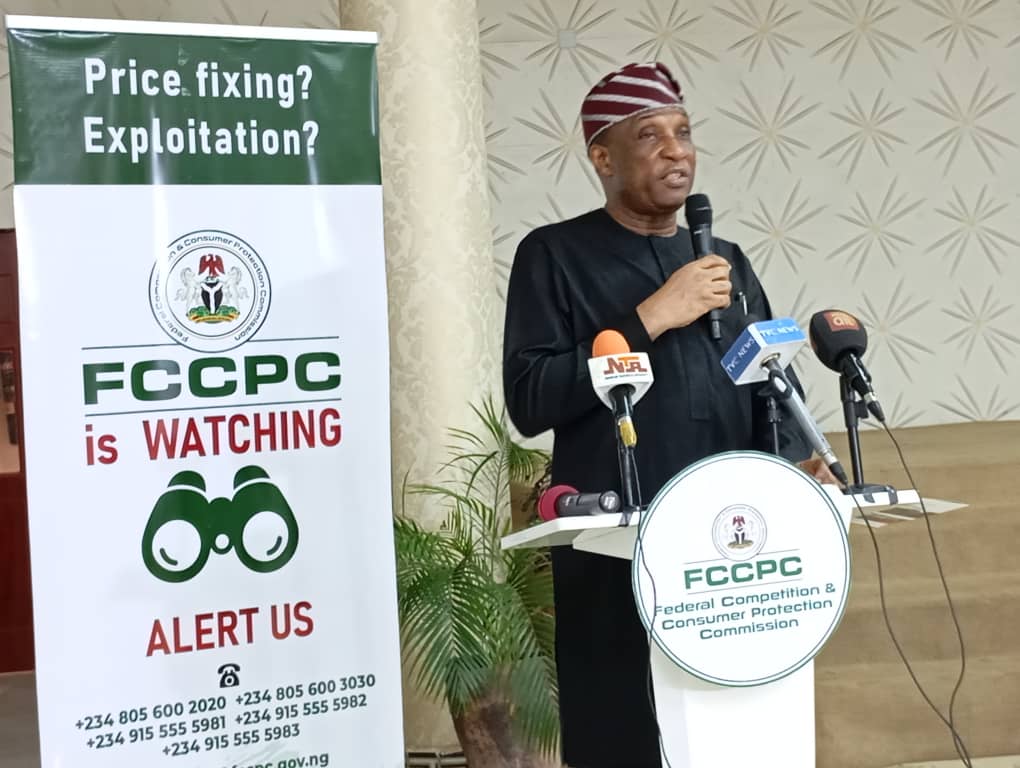
Executive Vice Chairman of FCCPC, Mr Tunji Bello, who issued the warning at a One-day Stakeholders’ Engagement on Exploitative Pricing on Thursday in Abuja, condemned the practice of price gouging and price fixing by traders as not only unethical, but patently illegal under the law establishing the commission.
Bello noted that Section 17 of the FCCP Act empowers the Commission to eliminate anti-competitive practices, misleading, unfair, deceptive, or unconscionable marketing, trading, and business practices.
Price gouging occurs when sellers significantly increase the price of goods or services during a crisis or a period of economic challenge.
The FCCPC boss warned that the law empowers the commission to impose heavy fine for breaches and also prosecute offenders which could lead to jail terms.
“For instance, Section 107 (4a.) of FCCPA clearly states that, “Where the undertaking is a natural person, is liable on conviction to imprisonment for a term not exceeding three years or to payment of a fine not exceeding N10,000,000.00 (N10m) or to both the fine and imprisonment.”
“Section 107 (4b.) also states that, “Where the undertaking is a body corporate, is liable on conviction to a fine not exceeding 10% of its turnover in the preceding business year,” he said.
He however noted that in the spirit of democracy, the commission is first exploring the option of dialogue and giving a moratorium of one month it before it starts firm enforcement.
He also warned that the commission has the will and the capacity to invoke the full weight of the law against those found culpable of exploiting consumers for undue profit.
“Under Section 155, violators whether individuals or corporate entities face severe penalties, including substantial fines and imprisonment if found guilty by the court. This is intended to deter all parties involved in such illicit activities,” he said.
According to him, the commission’s current approach is not punitive or adversarial, adding that this approach is borne out of the conviction that dialogue and collaboration are equally important tools in fostering a fair marketplace.
Bello disclosed that the purpose of the stakeholders meeting was to engage with market leaders and key players in the supply and distribution chains, to chart a path forward that balances the need for business profitability with the imperative of consumer protection.
“We believe that through constructive engagement, we can establish a framework for reasonable pricing that benefits all stakeholders, particularly the consumers who are the backbone of our economy.
“Please note that this new initiative by the FCCPC aligns with the renewed hope agenda of President Bola Tinubu, which prioritises the welfare of the Nigerian people in all economic activities.
“We are determined to uphold this agenda by ensuring that market practices do not exacerbate the economic challenges faced by our citizens at this time,” he said.
While acknowledging that an unfavorable exchange rate has negatively impacted the cost of production in local currency, he however, noted that the margin in pricing of goods and services is rather unreasonable or excessive in not a few cases.
He maintained that as a statutory body whose mandate is to cater to consumer rights, the commission cannot allow this unhealthy trend to continue.
“We have observed, for instance, that the margin in the prices of imported goods are very disproportionate in many cases; and in the case of locally produced goods, excessively inflated.
“This is an untenable situation, particularly in the retail segment, where we have identified patterns of price fixing perpetrated by some market associations, price gouging, and other anti-consumer practices,” he said.
Earlier, FCCPC’s Executive Commissioner of Operations, Dr Abdullahi Adamu, clarified that the commission is not a price-fixing agency, but is free to engage with stakeholders or take punitive measures against violators where necessary.
Bello said the commission was passionate about the consumption of goods and services but the way market forces are working in the country is not acceptable.
He added that price fixing, price gouging and exploitative pricing were unfortunate developments that should be brought to a halt.