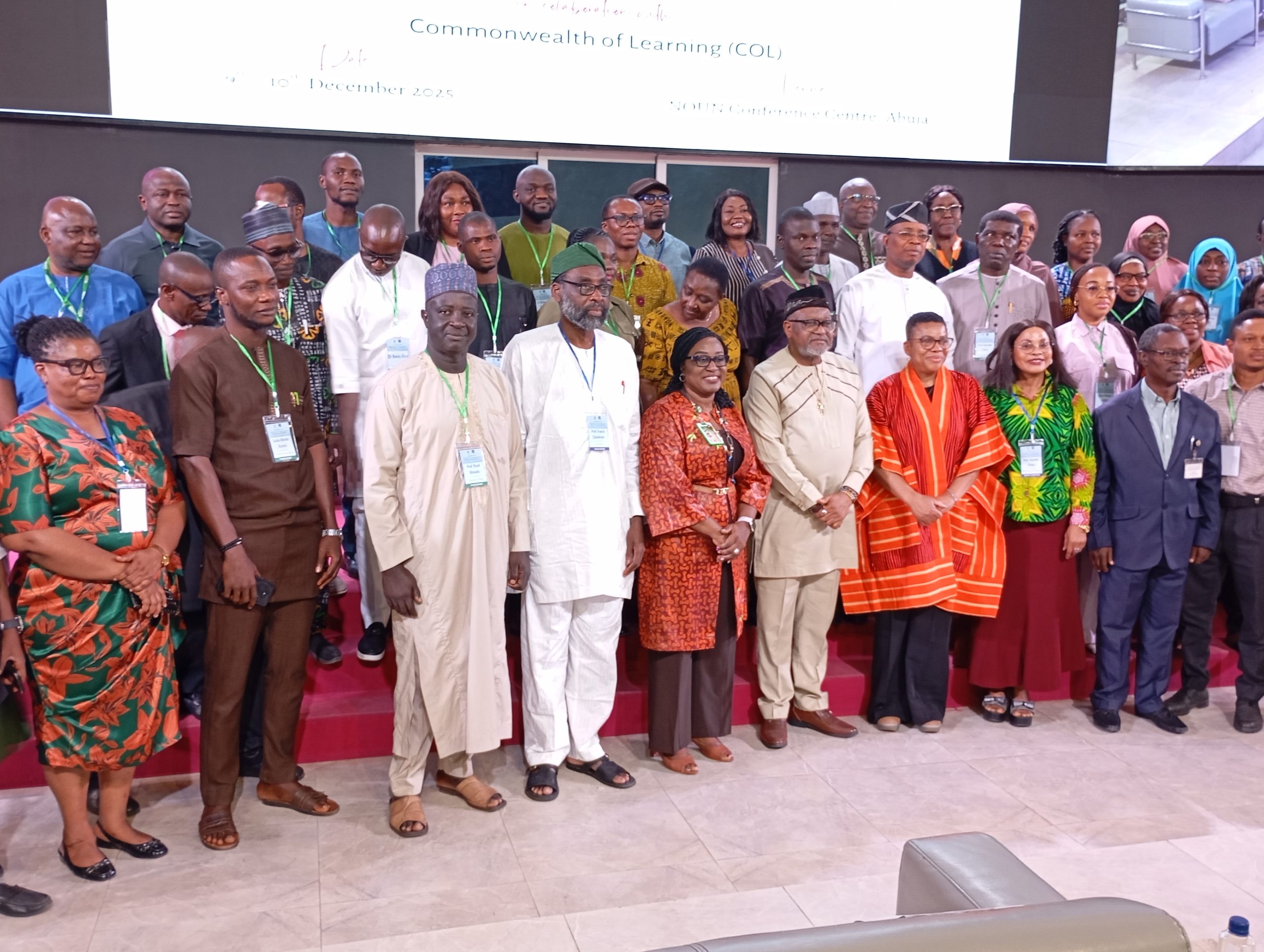
The Commonwealth of Learning, COL, has said the future of open education in West Africa depends on how effectively countries adapt Open Educational Resources, OER, practices for the Artificial Intelligence, AI, era.
COL Adviser on Higher Education, Prof. Jane-Frances Agbu, stated this at a high-level regional workshop on OER Practices in the Age of AI facilitated by COL in collaboration with the Regional Training and Research Institute for Distance and Open Learning, RETRIDOL, on Tuesday in Abuja.
Agbu noted that AI is rapidly reshaping how knowledge is created, shared and verified, urging countries to build AI-literate systems, protect digital rights and treat OER as trusted digital public goods in line with the 2024 Dubai OER Recommendations.
She commended the strong representation from Togo, Sierra Leone, Nigeria, Ghana, The Gambia and Cameroon, noting that regional collaboration is crucial for an inclusive and future-ready learning ecosystem.
“On behalf of the Commonwealth of Learning (COL) in Vancouver, Canada, I am delighted to welcome our colleagues and partners from across six (6) Commonwealth West African countries Togo, Sierra Leone, Nigeria, Ghana, The Gambia, and Cameroon.
“We are meeting at a particularly important moment. Artificial intelligence is rapidly changing the way knowledge is created, shared, and used. At the same time, the open education movement is evolving to respond to these changes.
“This workshop is aligned with the Dubai OER Recommendations of 2024, which refreshes UNESCO’s OER agenda for the Al era. The Dubai recommendations encourage us among many, to build Al-literate, rights-based capacity; to update licensing and attribution norms; to support sustainable and green OER ecosystems; and to strengthen international cooperation.
“COL significantly contributes to the OER movement not only through its long-standing work and mandate, but also as a strong collaborative leader. It has consistently advanced OER by working side-by-side with governments, institutions, and regional networks to co-design solutions rather than pushing a one-size-fits-all model. COL also partners closely with UNESCO and other international OER organisations such as jointly convening key events like the World OER Congresses,” she said.
According to her, over the next two days, senior academics, policymakers, distance-learning directors and regulators will interrogate emerging AI-OER practices, share experiences and co-develop actionable frameworks tailored to West African needs.
She noted that with distinguished resource persons including Prof. Francis Evokare and Prof. Juliette Inevedo, the workshop aims to align innovation with cultural integrity.
Agbu encouraged delegates to engage boldly, reminding them that decisions made today will shape the equity and quality of learning across the region.
“By coming together as a regional community. we can harness the power of openness and AI to expand access, strengthen teaching and enhance learner engagement,” she said.
Also speaking, the Vice Chancellor of NOUN, Prof. Olufemi Peters, who was represented by the Deputy Vice-Chancellor, Academics, Prof. Chiedu Mafiana, said the convening comes at a decisive moment for Africa.
Peters noted that while AI has the potential to revolutionise the development of digital learning resources, it also poses risks to cultural identity and knowledge sovereignty.
He reaffirmed NOUN’s commitment to ensuring that innovations serve communities, respect diversity and elevate African knowledge systems.
On her part, the Deputy Director of RETRIDOL, Prof. Dorothy Ofoha, stressed that AI is opening new possibilities for producing high-quality, learner-responsive OER.
Ofoha, however, emphasised that institutions must integrate AI in ways that uphold African values and educational philosophies.
She highlighted RETRIDOL’s two decades of regional capacity building across Nigeria, Ghana, The Gambia, Sierra Leone, Cameroon, Togo and Gabon, reflected in the diversity of participants at the workshop.