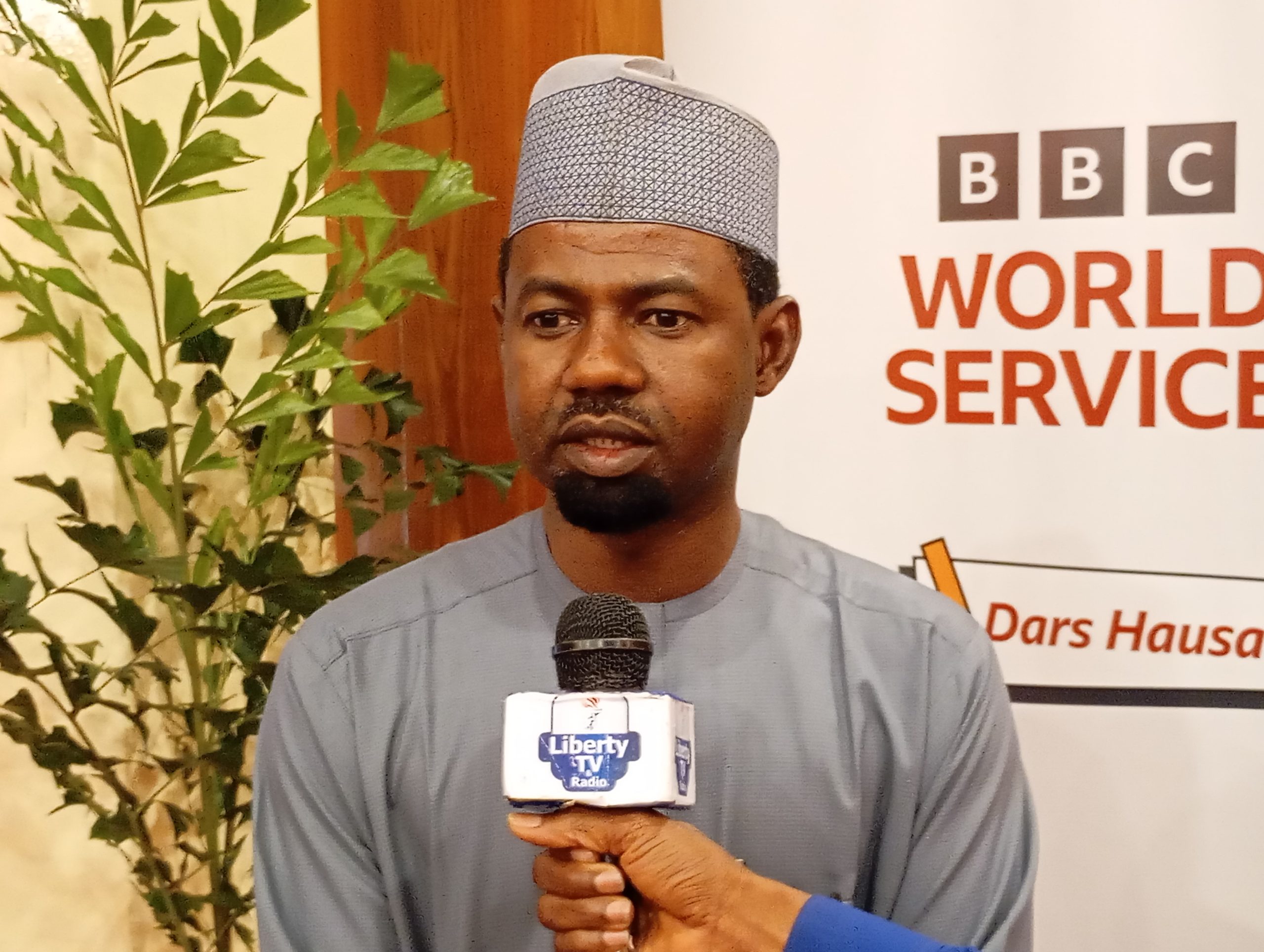
There have been several Hausa-language programmes over the years. What does Dars Hausa intend to achieve, and what makes it different?
I think there is a gap in the availability of educational content in the Hausa language. If you consider Northern Nigeria, the number of out-of-school children is alarming. According to the United Nations, there are more than 19 million out-of-school children in the region.
The BBC, through Dars Hausa, decided to address this gap by introducing educational content delivered in Hausa. We provide lessons in subjects such as English, Mathematics, Science and mental health. We also feature inspirational stories that can empower children.
Our ultimate objective is to bridge the educational gap in Northern Nigeria and make learning accessible to children through a language they understand.
You have built a career in journalism over the years. Could you take us through your professional journey?
I am currently a Senior Journalist and Team Manager with Dars Hausa. However, I started my career as a broadcast journalist, producing and presenting news for the BBC Hausa Service.
Before joining the BBC, I worked with Radio France Internationale as a digital team leader. I was involved in establishing its website and social media platforms. I later joined the BBC as a digital journalist and became part of the pioneering team that drove its digital transformation.
When the opportunity to work on Dars came, I took up the position of Senior Journalist and Team Manager. I have always had a passion for education and using the media to educate children.
Personally, I have produced content on Hausa orthography because I believe the ability to write the language correctly is important. Hausa is a widely spoken language, but many native speakers struggle with writing it accurately.
It is quite unfortunate that someone can speak Hausa fluently but find it difficult to write it correctly. That inspired me to create content to help people understand Hausa spelling, grammar and orthography.
I studied Hausa at Bayero University, Kano, and orthography became an area of particular interest to me. So, when the BBC introduced Dars, it was an opportunity to combine my passion for education and language development with my professional experience.
What would you describe as the most defining moments of your career?
I would certainly count the Dars project as one of the defining moments of my career. Another significant experience was my involvement in a BBC Africa Eye documentary on banditry. I was among the journalists involved in identifying and recommending a suitable journalist to undertake the assignment in Zamfara State.
The journalist I recommended went on to produce an award-winning documentary. I am particularly happy about that achievement because I helped create an opportunity that eventually became a major success for him.
He sees me as a role model because I played a part in bringing that opportunity his way. Seeing someone succeed through an opportunity you helped facilitate is very fulfilling.
How has your experience at the BBC shaped your understanding and practice of journalism?
If you are looking for an organisation where you can gain extensive experience in journalism, the BBC is one of the best places to be.
There are numerous opportunities for training, and even now, I have several trainees under my supervision.
The most important values I have learnt are accuracy, trust and impartiality. These are fundamental to the BBC’s journalism.
BBC Hausa has been broadcasting for more than 70 years, and its reputation is built on credibility and public trust. These are values I have come to appreciate and practise throughout my career.
As I mentioned earlier, I started my professional journey with Radio France Internationale, and I value the experience I gained there. However, in terms of the depth of journalistic training and the standards of professional journalism, my experience at the BBC has been particularly remarkable.
What do you consider the biggest challenges confronting Hausa-language journalism in Africa today?
One major challenge is the limited availability of educational and informative content in Hausa. That is one of the gaps Dars is trying to address.
For instance, this project is breaking new ground by teaching subjects such as Mathematics in Hausa. It demonstrates how the media can be used not only to inform and entertain but also to educate.
Another major challenge is the difficulty many people have with writing Hausa correctly. You may find journalists who speak the language fluently but struggle when asked to produce a properly written script.
There is also the challenge of untrained individuals who identify themselves as citizen journalists simply because they can speak Hausa, own cameras and other recording equipment.
Many of them lack the professional training required to gather, verify and disseminate information responsibly. This contributes to the spread of misinformation and disinformation within the Hausa-speaking community.
It is a serious concern, particularly because Hausa audiences are very interested in politics and political developments. Without proper training and professional standards, the consequences of inaccurate reporting can be damaging.
I believe the relevant authorities and media organisations should invest more in training people who want to practise journalism.
We have many media organisations operating in Hausa, but the BBC occupies a special position in terms of language standards and professional credibility. Even universities sometimes refer to the BBC to establish the correct spelling of Hausa words.
For instance, when there is uncertainty about how a particular Hausa word should be written, people consult the BBC. That tells you the level of authority and responsibility we carry in promoting the language.
Where do you see yourself and the Dars Hausa project in the next three to five years?
At the moment, I am leading the launch and implementation of the project, and I strongly believe Dars is here to stay.
We have seen the impact of similar initiatives elsewhere. For instance, the Dars programme in Afghanistan, which initially started as a one-year project, has continued for more than five years because of its impact.
As of now, I understand that more than 14.5 million people have watched Dars lessons in Afghanistan. That demonstrates the potential of this kind of educational intervention.
My hope is that Dars Hausa will achieve similar success and become a sustainable initiative that continues to make a meaningful difference in the lives of children.
Considering the number of out-of-school children in Northern Nigeria, there is an urgent need for interventions that can expand access to education. I believe Dars Hausa can play a significant role in addressing that challenge.