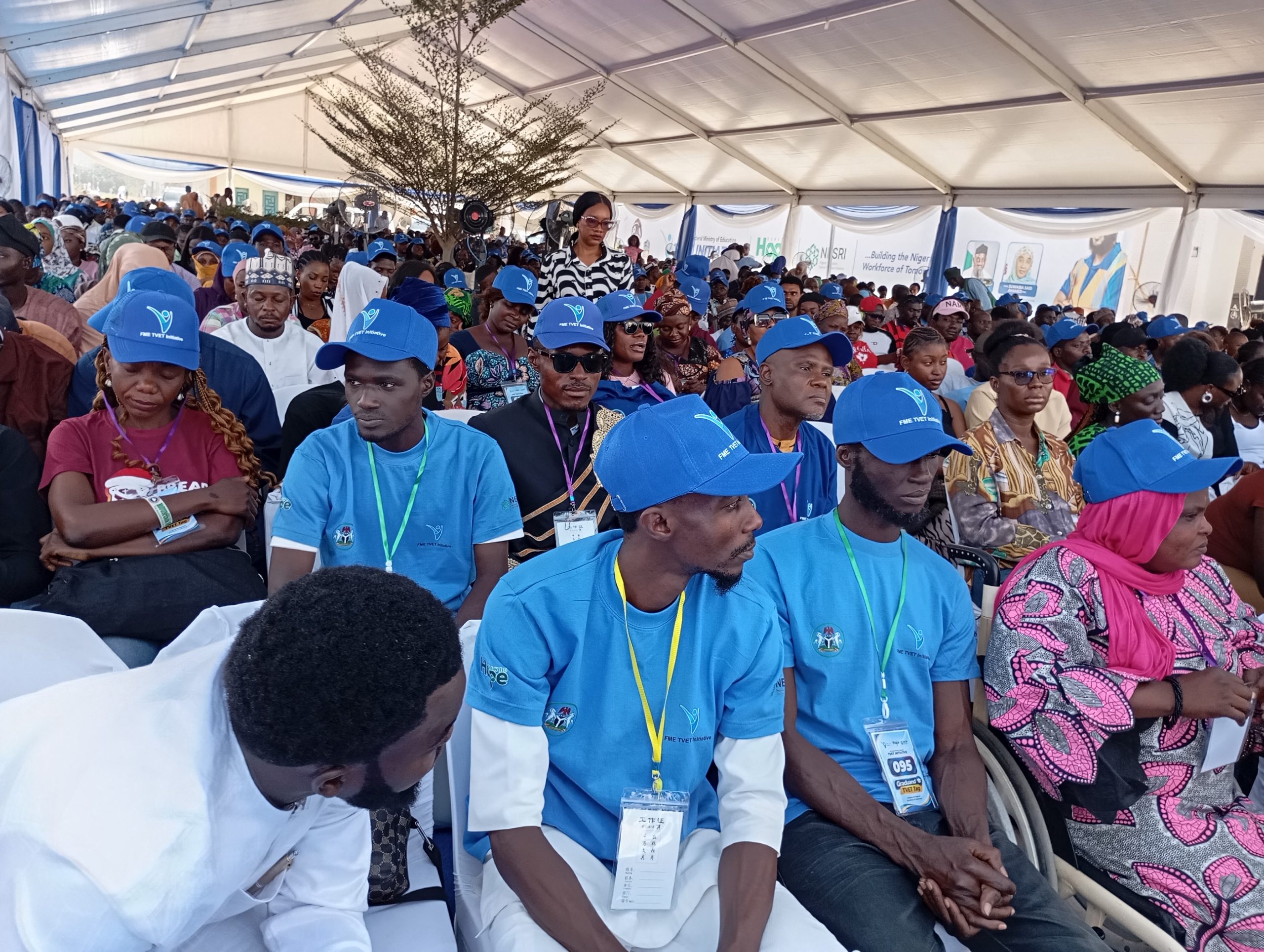
The Federal Government has graduated 87,701 beneficiaries of its first Technical and Vocational Education and Training, TVET, programme and commenced the distribution of starter kits to successful trainees.
Minister of Education, Dr Tunji Alausa, disclosed this in Abuja at the graduation and starter kit handover ceremony, said the programme has received 1.49 million applications for the second cohort.
Alausa described the initiative as a strategic intervention to address unemployment, promote entrepreneurship and develop a skilled workforce capable of driving economic growth.
The Minister said 150,000 applicants had already been admitted into accredited training centres nationwide for the second cohort, following the overwhelming response to the programme.
He explained that the initiative, implemented under President Bola Tinubu’s Renewed Hope Agenda, was designed to bridge the gap between skills acquisition and economic empowerment by providing beneficiaries with practical training and the necessary equipment to establish businesses or secure employment.
He said the graduation marked a significant milestone in the government’s efforts to reposition technical and vocational education as a viable pathway to sustainable livelihoods.
“Today brings together two essential parts of our commitment: equipping Nigerians with practical skills and supporting them with the tools to put those skills to work,” the minister said.
According to him, the first cohort’s 87,701 graduates received training in various trades, including welding and fabrication, electrical installation, automobile mechanics, solar photovoltaic installation, fashion design, hospitality, information and communication technology, agriculture and beauty therapy.
He added that competency-based assessments and certification were ongoing to ensure that beneficiaries obtained nationally recognised qualifications under the National Skills Qualification Framework.
The minister said the 1.49 million applications received for the second cohort reflected growing public interest in vocational education and the increasing recognition of practical skills as a means of improving economic opportunities.
He stressed that Nigeria’s industrial development and productivity depended largely on a competent workforce, noting that the country needed skilled technicians, artisans, electricians and entrepreneurs to support economic expansion.
Alausa said the distribution of starter kits was a critical component of the programme, as training without access to the necessary equipment could limit beneficiaries’ ability to translate acquired skills into productive ventures.
He explained that the kits were designed to provide graduates with the essential tools to commence operations, serve customers and build sustainable businesses.
“The provision of starter kits is an integral part of this initiative. These are productive assets intended to help beneficiaries begin work, serve customers and build viable enterprises,” he said.
He assured that the distribution would continue in phases, subject to the completion of assessment, certification and verification processes, adding that measures had been put in place to ensure transparency and accountability.
The minister clarified that completing training, obtaining certification and qualifying for starter kits were distinct stages of the programme, each requiring appropriate verification.
He urged the graduates to demonstrate professionalism, integrity and commitment to quality in their respective trades, while continually upgrading their skills to keep pace with technological advancements and changing industry requirements.
He also encouraged them to seek mentorship, establish professional networks and deploy the starter kits strictly for productive purposes, expressing confidence that some of their businesses would eventually expand and create employment opportunities for others.
According to him, the success of the initiative would ultimately be measured by the number of beneficiaries who secure jobs, establish viable enterprises, improve their incomes and employ additional workers.
Alausa commended the National Board for Technical Education, National Business and Technical Examinations Board, Nigerian Education Loan Fund, training institutions, instructors, assessors and other implementation partners for their contributions.
He also urged state governments, community leaders and private-sector organisations to support the graduates through apprenticeship opportunities, industry exposure and employment partnerships.
Earlier, the Minister of State for Education, Prof. Suwaiba Said Ahmad, described the graduation as a major milestone in the government’s efforts to reposition technical and vocational education and bridge the gap between education and employment.
She said the programme had demonstrated that vocational training could provide young Nigerians with practical, market-relevant skills and open up opportunities for self-employment and enterprise development.
Ahmad observed that technical and vocational education had traditionally been regarded as a second-choice option, but insisted that the perception must change.
“Technical and vocational education was seen as a second option. That era is over. Today, it is a first option,” she said.
She added that the success of the first cohort provided strong evidence of the programme’s potential to transform skills development and contribute to national economic growth.
The minister noted that successful economies relied heavily on the expertise of technicians, artisans and craftsmen, stressing that Nigeria must equally recognise and invest in the contribution of skilled workers.
She said the initiative’s combination of accredited training centres, industry-relevant curricula, recognised certification and starter kits was intended to ensure that graduates could move directly from training into productive economic activities.
Ahmad further disclosed that lessons from the first cohort, particularly in the application of digital technology, biometric verification and structured monitoring, would be used to improve subsequent phases of implementation.
She urged the graduates to regard the starter kits as instruments for building sustainable livelihoods rather than mere rewards for completing their training.
The minister encouraged them to maintain high standards of workmanship, embrace continuous learning and pass on their knowledge by mentoring and training other young Nigerians.
She commended Alausa for his leadership and acknowledged the contributions of development partners, government agencies, training institutions and instructors towards the successful implementation of the programme.
Ahmad reaffirmed the Federal Government’s commitment to expanding access to vocational education, strengthening industry partnerships and creating sustainable career opportunities for Nigerians.