… 18.5% of Nigeria’s 2024 Budget – Oxfam
A newly released Oxfam report says tax deductions for Dangote Sino Trucks West Africa Limited, Lafarge Africa Plc, Honeywell Flour Mills Plc, Jigawa Rice Limited and Stallion Motors Limited, has reached N5 trillion, accounting for 18.5percent of Nigeria’s 2024 budget.
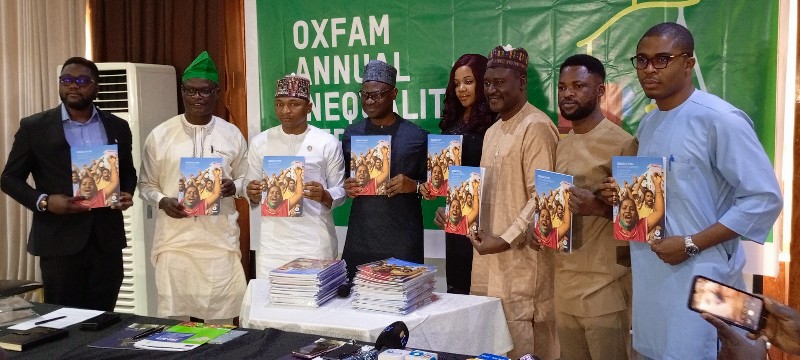
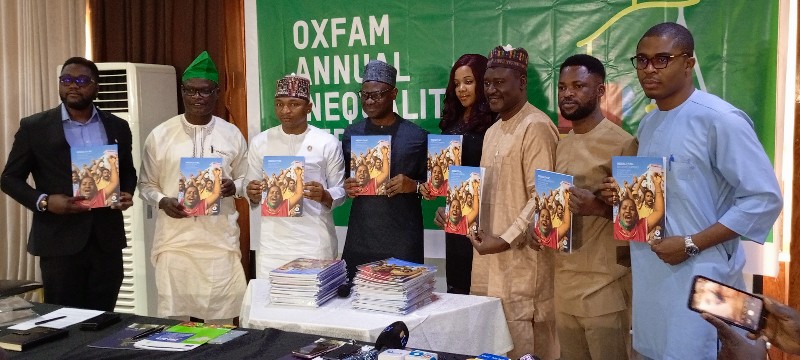
OXFAM Country Director in Nigeria, Hamza Ahmed, who disclosed this during its annual press conference on World Economic Forum inequality report in Abuja, said In December 2023, the Nigerian Investment Promotion Commission revealed it approved tax holidays for 34 companies seeking tax incentives and waivers under the Industrial Development Income Tax Act of 2023.
According to him among the beneficiaries are Dangote Sino Trucks West Africa Limited, Lafarge Africa Plc, Honeywell Flour Mills Nigeria Plc, Jigawa Rice Limited, and Stallion Motors Limited.
The organization’s report said “these companies benefit from tax breaks under the pioneer status regime, aiming to incentivize and stimulate their growth. This arrangement allows them to enjoy three to five years without paying corporate income taxes.
“Over the years, this policy has resulted in a cumulative total of approximately five trillion naira, constituting 18.519percent of Nigeria’s 2024 federal government budget as passed into law.
“In 2023, the National Bureau of Statistics reviewed its methodology for calculating the rate of unemployment based on the Nigeria Labour Force Survey, NLFS, leading to a crash in the rate of unemployment from 33.3 percent in 2020 to 5.3 percent (Q4 2022) and 4.1 percent (Q1 2023).
It noted that economic disparity in Africa has seven richest individuals possessing more wealth than the poorest half of the continent’s population, making the wealthiest 1 percent in Africa to command nearly half of the total financial wealth.
Oxfam’s report, released as business elites gather in Davos, Switzerland, further exposes a global trend. Seven out of ten of the world’s largest corporations, some with a significant presence in Africa, have a billionaire as CEO or principal shareholder.
Ahmed said “The bedrock of poverty is not in the lack of resources, but in the fact that the top 1percent has hijacked the available resources. Additionally, the government has not deliberately invested in critical sectors to bridge the inequality gap. Consequently, this situation has led to increased poverty and inequality.”
Oxfam, therefore, called on governments to rapidly and radically reduce the gap between the super-rich and the rest of society by “Sustained effort by the Nigeria Senate to amend the Federal Inland Revenue Service, FIRS, Act towards regulating the processes of granting corporate tax holidays, import duty waivers and investment incentives to investors and businesses in Nigeria in a bid to cut down revenue loss to corporate incentives.
“The process of granting incentives must be transparent, fostering public discourse on opportunity cost elements. Tax expenditures should undergo parliamentary oversight and public debate.
He added, “We urge the government to establish a dashboard for public access to data on tax incentives, enhancing awareness and trust.
“The National Assembly should promptly call on the Federal Government to publish the Tax Expenditure Report, showcasing a commitment to transparency and accountability in incentive management.”
On his part, Chief Executive Officer of Connected Development, Hamzat Lawal, warned that if inequality persists, “what we’ll have is anarchy. Today the Nigerian people cannot enjoy service delivery or social amenities. over 5 trillion Naira was given tax heaven. This is unacceptable when the federal government is saying they cannot meet budget demand.
“We’re going to borrow knowing that Nigeria is currently in debt. And yet we’re giving an incentive for people who are profiting in billions of dollars within our economy. No, this is unacceptable. We need a new era of tax regime that ensures fairness”
Also speaking, CISLAC Executive Director, Ibrahim Rafsanjani, noted that the absence of a proper taxation system in the country is also one of the very reasons why the government is losing a lot of money.
“You will agree with me on this fraudulent tax holiday that they do give to corporate agencies. If only they are using that money, they would have been able to address some fundamental developmental challenges that we have in Nigeria. There is no reason because you have interest in a company, you will go and give a five year tax holiday. And there is no monitoring of the commitments that is supposed to come along with it. Which is to say that if we give you tax holiday for five years, you should use the social corporate responsibility to help in terms of argumenting in education”, he said.
Rafisanjani said, “Our system and infrastructure, nobody monitors whatever those corporate agencies or entities or companies are doing with that. So we are losing huge amounts of money simply because of corruption because the people approving this tax holiday, they have a share in those companies and that is why we have been pushing for beneficial ownership because with beneficial ownership we’ll be able to identify and know who owns what who is director.”