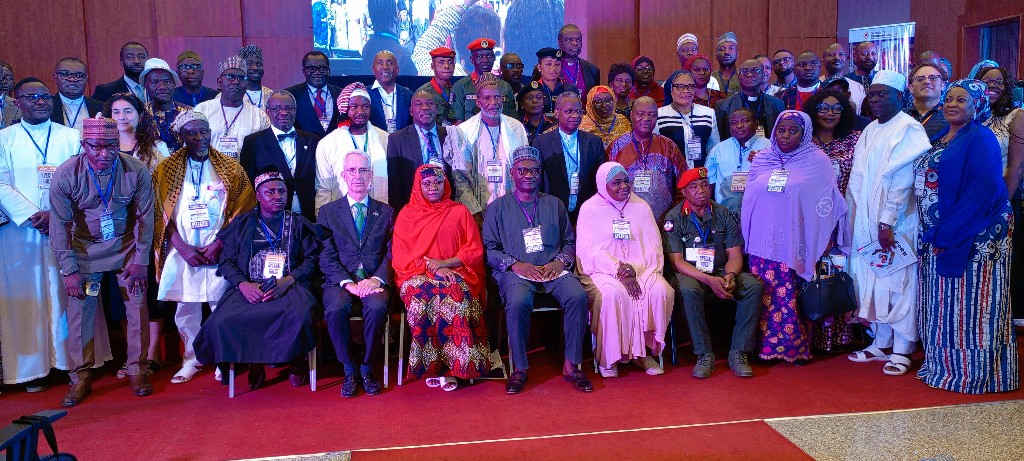
In a significant step towards combating religious bias and promoting freedom of religion in Nigeria, a non-governmental organization, Search for Common Ground Nigeria, has unveiled a toll-free line dedicated to supporting victims of religious discrimination.
Country Director of Search for Common Ground, Fatima Abubakar, who announced the initiative during the maiden National Conference on Freedom of Religion or Belief in Nigeria, on Wednesday in Abuja said, the line is designed to provide support and assistance to individuals who have faced discrimination or persecution due to their religious affiliation.
Abubakar noted that the toll-free line is aimed at implementing Early Warning/Early Response mechanisms to tackle religious-based violations and violence as a component of the
“Protecting and Promoting Freedom of Religion and Belief in Nigeria” project, funded by the Embassy of the Kingdom of Netherlands.
According to Abubakar, “We have been doing the talking all this while, this is time to walk the talk as we hit the road today with our toll-free lines, meant to track violations and abuses based on religion and belief in all the geo-political zones of Nigeria
She noted that the toll-free line, 08000002233, dedicated to freedom of religion or belief, is intended to be utilized by individuals who have experienced violations of freedom of religion or belief, or by someone who knows such individuals, to speak up and have their voices heard.
She said, “The theme of this conference, “Building a Community of Practice on Freedom of Religion or Beliefs,” encapsulates our collective vision of fostering a society where individuals from all faiths and beliefs can coexist harmoniously, embracing diversity and respecting each other’s rights to religious freedom.
“This gathering serves as a platform to share experiences, best practices, and innovative strategies for advancing FoRB in Nigeria.
“Our journey in programming on FoRB at Search for Common Ground has been marked by both challenges and achievements. We began our programming on FoRB with a project in 2018 which advocated for the protection of Holy Sites, where religious buildings were protected and projected as sacred and should be preserved.
“Search also led the implementation of the advancing religious tolerance project which supported religious actors across 17 states in Northern Nigeria to lead targeted actions aimed at promoting religious tolerance.
“Today, as we stand at this juncture, we acknowledge the strides we have made but also recognize the distance we are yet to travel. Our objectives for this conference are multifaceted. Firstly, we aim to deepen our understanding of the complexities surrounding FoRB in Nigeria, identifying key issues and obstacles that hinder its realization.
“Secondly, we seek to strengthen partnerships and collaborations among stakeholders – government entities, civil society organizations, religious leaders, and the international community – to amplify our collective impact.”
Also speaking, Ambassador of the Kingdom of Netherlands in Nigeria, Wouter Plomp, harped on the importance of safeguarding one of the fundamental rights of humanity, the freedom to believe to worship and to express one’s faith without fear or constraints.
According to him, “Diversity is what makes society flourish, and companies with diverse workforces perform better economically.
“We must reflect on and address religious discrimination and violence, learning from each other’s practices and traditions for a more inclusive society.”
“Let us seize this moment to make steps together towards a future where no one faces religious discrimination and violence,”Netherlands Ambassador said.
On his part, “The Director-General of the Institute for Peace and Conflict Resolution, Dr. Joseph Ochogwu, emphasizing the relevance of the conference, underscored the urgency of addressing religious intolerance and discrimination in a diverse and pluralistic society like Nigeria.
He said, “Nigeria is a diverse and pluralistic country, with over 250 ethnic groups and various religions, such as Christianity, Islam, African Traditional Religion, and others. This diversity is a source of strength and richness, but also a potential cause of conflict and violence, as we have witnessed in recent years.”
“The escalation of religious intolerance, hatred, and discrimination has resulted in the violation of human rights, the disruption of social cohesion, and the threat to peace and security. In a nation as diverse and culturally rich as ours, the principles of tolerance, understanding, and respect for varying beliefs are not just ideals but fundamental pillars upon which our society stands,” he said.