The Federal Capital Territory Administration said it achieved an additional 216 percent coverage in the FCT Fadama CARES programme within the first year of the current administration.
The FCT COVID-19 Action Recovery and Economic Stimulus, FCT CARES programme, is a World Bank support to the FCTA for non-discretionary expenditure which is targeted at supporting existing and newly emerging vulnerable and poor households, agricultural value chains, and Micro and Small Enterprises, MSEs, that have been negatively impacted by the COVID-19 pandemic.
FCT Minister of State, Dr. Mariya Mahmoud, said the administration has successfully disbursed grants to a total of 9,170 beneficiaries under the programme.
The minister, who made this declaration at the flag off ceremony for the disbursement of project grants to fourth batch of beneficiaries, revealed that 3,150 benefited under the third batch, while an additional 6,020 new beneficiaries were being provided grants under the fourth batch.
This, she noted, indicates an achievement of 216 percent when compared to the disbursement figure of 4,233 recorded by the programme in about 2 years prior to the coming of this administration.
Speaking on the objective of the programme, Mahmoud, said that the FCT Fadama CARES was designed to increase food security and safe functioning of food supply chain in the FCT.
She said, “The programme is deliberately designed to support the recovery of livelihood activities of poor and vulnerable persons engaged in agricultural value chains with special consideration to women and unemployed youth.
“Its implementation will be anchored on the World Bank community driven development approach for deployment of programme investments at the community level.”
She further noted that the programme is another significant indicator of the unflinching commitment of President Bola Ahmed Tinubu towards ensuring sustainable food production through his administration’s Renewed Hope Agenda.
“It is in line with Mr. President’s strategic vision that the FCT Administration under the leadership of the Hon. Minister, Barrister Nyesom Wike, is committing significant resources towards ensuring sustainable agricultural production as a panacea for poverty reduction and improvement of livelihoods for poor and vulnerable agricultural households in the FCT through the FCT Fadama CARES programme.
“This indeed is a clear indication of our administration’s commitment towards ensuring sustainable agricultural production for the attainment of food and nutritional security, poverty reduction, and improved livelihoods,” she added.
Mahmoud also emphasised that as part of the youth empowerment component of the Fadama CARES programme, the Agriculture and Rural Development Secretariat is leveraging the programme to provide starter packs to 94 trainees of FCT – Leventis Foundation School of Agriculture, Yaba for years 2022 and 2023 to enable them put into practice what they studied in school.
Earlier, the Mandate Secretary Agriculture and Rural Development Secretariat, Lawan Geidam, informed the minister that under the fourth batch of disbursement of grants to FCT Fadama CARES, 82 farmers community associations across the 6 area councils have been selected to benefit.
He, further said that within the period of one year, 12,436 bags of NPK, 6218 bags of Urea, 18,654 litres of agro chemicals, 43,526 kg of assorted seeds, 55,400 day old chicks and 7,756 bags of poultry feeds and 81,800 Juveniles (cat fish) and 2,045 bags of fish feed have been disbursed under Disbursement Linked Indicator 2.1.
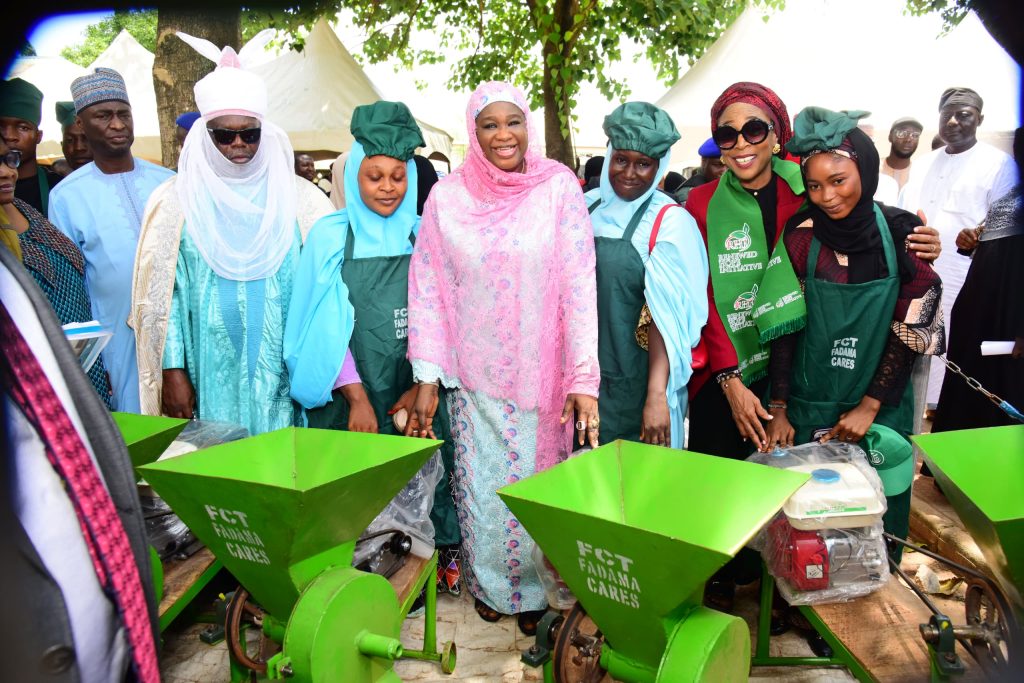
“Under DLI 2.3, 3690 Goats, 3212 sets of Farm Assets (Sprayers, Personal Protective Equipment, and Water Pumps and Accessories), 1006 Grinding Machines and 22 units of 2MT/hour multipurpose threshers were disbursed, while water and sanitation facilities have been provided in 10 Wet Markets across the 6 Area Councils,” he affirmed.
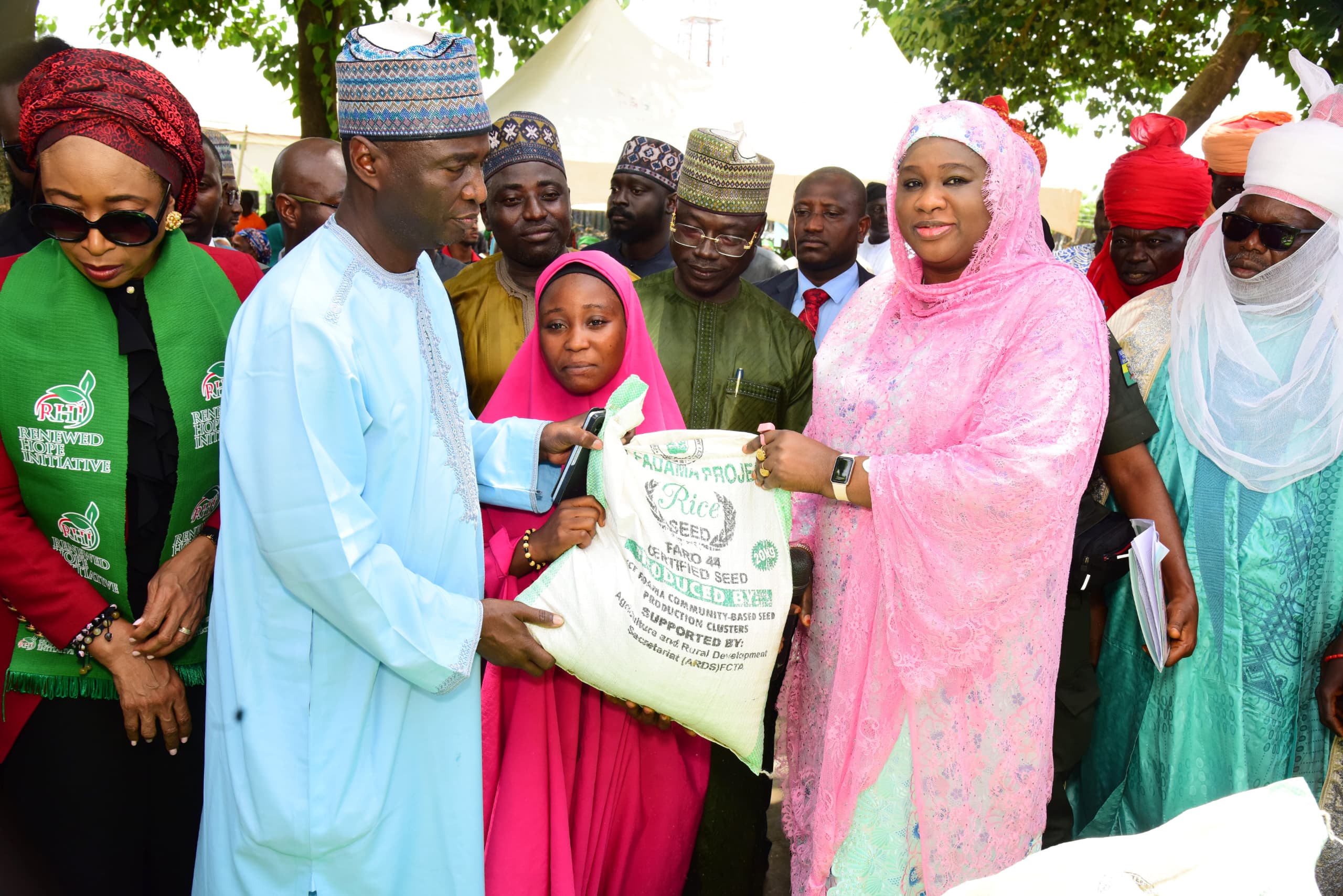
The high point of the event was the distribution of items, which include fertilizers, seeds and agrochemicals, sprayers, and personal protective equipment for crop farmers.
Day-old chicks and feeds were also distributed to poultry farmers, juveniles and feeds for fish farmers, goats for livestock farmers, and grinding machines for women processors.