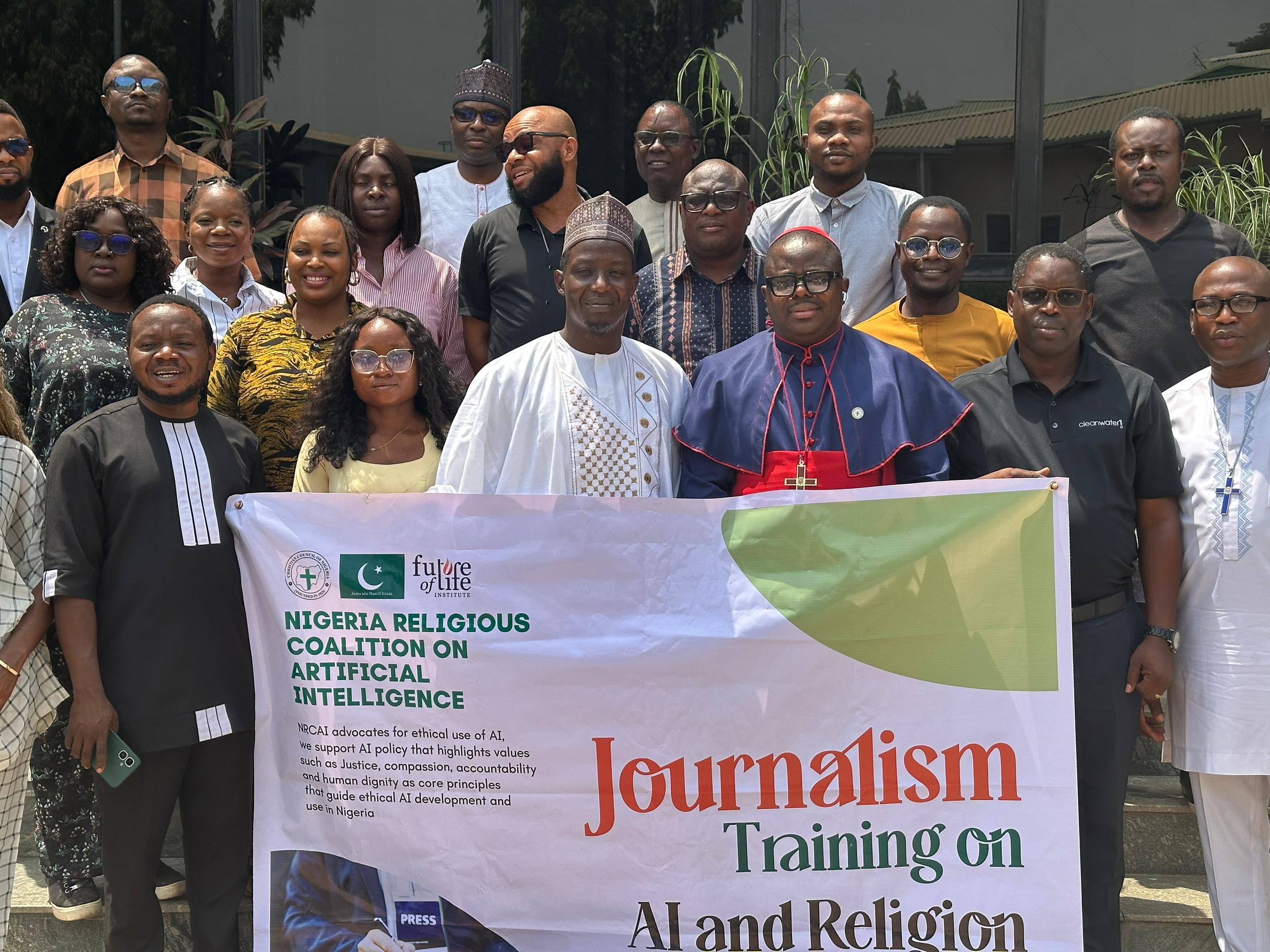
The Nigeria Religious Coalition on Artificial Intelligence has called for ethical regulation of Artificial Intelligence in Nigeria, warning against the misuse of the technology.
The coalition made the call during a training for journalists on Artificial Intelligence and religion held in Abuja, where religious leaders and experts discussed the ethical implications of emerging technologies and the role of the media in shaping responsible public discourse on AI.
The initiative is a collaboration between the Christian Council of Nigeria and Jama’atu Nasril Islam, bringing together Christian and Muslim leaders to contribute faith-based perspectives to Nigeria’s evolving Artificial Intelligence policy framework.
Speaking during the event, the General Secretary of the Christian Council of Nigeria, Evans Onyemara, stressed that while artificial intelligence offers enormous opportunities for development, its use must be guided by ethical principles that prioritise the welfare of humanity.
According to him, human beings occupy a central place in creation and must remain at the centre of technological advancement.
He said, “Human beings are made in the image of God, and apart from humanity there is no other creation that God has given prominence. That is why the Bible teaches that human beings should have dominion over other creations and ensure orderliness in the universe.
“Therefore, technologies such as artificial intelligence must be deployed in ways that enhance the common good and strengthen our existence rather than put humanity in harm’s way.”
Onyemara warned that without proper regulatory frameworks, Nigeria could become vulnerable to technologies developed in other countries without consideration for local realities.
“It is important that the country adopts strategies and regulations that will ensure that the use of AI in Nigeria is properly guided.
“From the training today, it is clear that Nigerians can demand laws that regulate the use of artificial intelligence instead of allowing every new form of AI developed elsewhere to be introduced into the country without proper scrutiny,” he said.
He added that Nigerians should not merely consume technologies produced abroad but should also participate in shaping the country’s technological future.
“We can regulate what we use in Nigeria and we can also help co-create the kind of artificial intelligence that we require for our national development,” he said.
Also speaking at the training, the Administrative Secretary of Jama’atu Nasril Islam, Yusuf Ahmed Bida, explained that Islamic teachings emphasise ethical responsibility and accountability in the use of technology.
He said ethical engagement with technology must be guided by principles of mercy, justice and benefit to humanity.
“In engaging with anything that is ethical, it should not be harmful but should bring benefit and mercy to humanity. Anything that brings hardship to mankind cannot be considered ethical.
“Even in religion, we are taught that God does not intend to cause hardship for people in the course of serving Him. Therefore, AI usage from the Islamic perspective should guide people toward responsibility and lawful conduct,” Bida said.
He explained that Islamic scholars evaluate emerging technologies based on their benefits and potential harms, a principle known in Islamic jurisprudence as maslaha (benefit) and mafsada (harm).
“What are the benefits derived from this technology and what are the harms associated with it? Once these are understood, the benefits should be embraced while the harms must be avoided,” he said.
Bida further noted that Islamic jurisprudence emphasises accountability and stewardship, adding that human beings will ultimately be responsible for how they deploy technology.
“In Islam, humans are regarded as stewards on earth and every individual will account for what is under his or her care. This means that technology must be used with moderation and responsibility,” he said.
He explained that Islamic ethical principles focus on protecting essential aspects of human life including religion, life, intellect, lineage and wealth.
According to him, anything that threatens human life, intellect or dignity cannot be considered acceptable from an Islamic perspective.
Earlier in his remarks, the Director of the Institute of Church and Society, Ibadan, Kolade Fadahunsi, said the Nigeria Religious Coalition on Artificial Intelligence was established to ensure that ethical and faith-based perspectives are incorporated into Nigeria’s national artificial intelligence strategy.
He explained that the initiative began in 2024 through consultations between the Christian Council of Nigeria and Jama’atu Nasril Islam to examine the implications of artificial intelligence for Nigerian society and explore how faith communities could contribute to shaping responsible policies.
“We started this journey together in 2024 through consultations to look at the development of artificial intelligence and what faith communities can contribute to strengthening the national AI strategy,” he said.
Fadahunsi said the coalition had since organised consultations, workshops and trainings aimed at encouraging ethical engagement with artificial intelligence in Nigeria.
According to him, the training for journalists was designed to help media practitioners understand the country’s National Artificial Intelligence Strategy and critically examine aspects relating to ethical and responsible deployment of the technology.
“The media is a key stakeholder in this conversation. Journalists play an important role in shaping public understanding of emerging technologies and ensuring that ethical considerations are not ignored in national policy discussions,” he said.
He also warned that rapid technological development could gradually erode cultural identity if societies fail to engage with it critically.
“For example, many technologies we use today are developed in other countries and often reflect the language, culture and values of those societies. When we adopt them without adapting them to our own realities, there is the risk of gradually losing our cultural identity,” he said.
Fadahunsi stressed the need for wider stakeholder engagement in shaping Nigeria’s approach to artificial intelligence.
“If you are not part of the conversation, you cannot contribute to the decisions that will eventually shape the future of technology in our society. That is why we are bringing together faith leaders, journalists and other stakeholders to participate in this dialogue,” he added.
Also speaking, an AI Safety Researcher, Godwin Faruna, described artificial intelligence as a tool built through machine learning and large datasets to assist humans in performing various tasks.
He warned that while AI can drive innovation, it can also be misused if countries fail to develop proper policies and regulatory frameworks.
Faruna noted that most advanced AI systems are developed by foreign companies whose safety instructions are largely designed in English.
According to him, Nigeria must develop its own policies to reflect its languages, cultural values and national priorities.
“If we do not build our own frameworks and include our languages and value systems, people could misuse these technologies within our environment,” he said.
Participants at the training also examined broader social implications of artificial intelligence including misinformation, deepfakes and the potential misuse of AI technologies in ways that could harm individuals or communities.
They stressed the need for strong ethical frameworks and policies to ensure that artificial intelligence is developed and deployed in ways that promote justice, accountability, compassion and respect for human dignity in Nigeria.