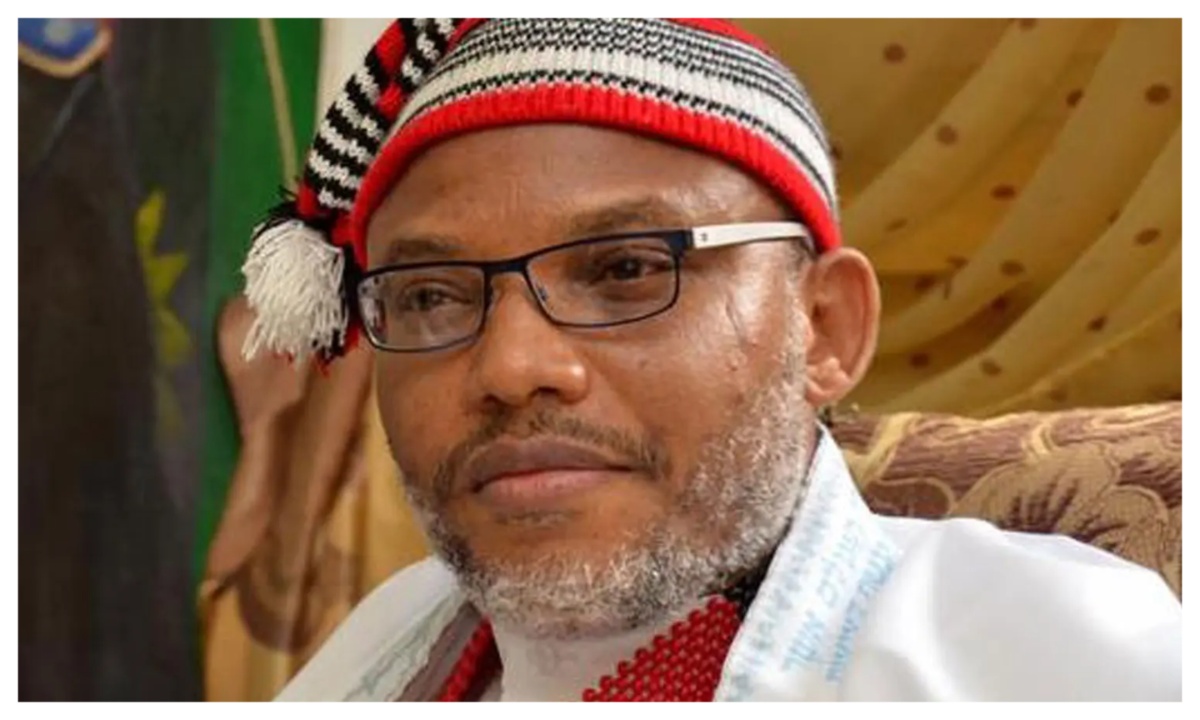
A human rights lawyer, Christopher Chidera, has faulted the Nigerian Bar Association over what he described as its silence on the continued detention of the leader of the Indigenous People of Biafra, Nnamdi Kanu.
Chidera, a member of the Mazi Nnamdi Kanu Global Defence Consortium, made the allegation in an open letter addressed to the NBA and copied to the International Bar Association.
Kanu was convicted of treason-related charges by the Federal High Court in Abuja in 2025. He has denied the allegations and appealed the conviction, which he said remains pending before the Court of Appeal and Supreme Court.
However, Chidera alleged that the Court of Appeal had discharged Kanu and quashed the charges against him on October 13, 2022, but that eight days later, a civil stay of execution was obtained against the criminal discharge.
He questioned the legal basis for using a civil stay to suspend an order relating to a person’s liberty.
“The judgment being stayed was not a money judgment. It was not a commercial judgment. It was not an order for payment. It was not an order concerning property.
“Liberty is not a debt,” he said.
The lawyer recalled that Kanu had previously spent about 14 months in detention without charge following his extraordinary rendition to Nigeria, adding that the State continued to detain him despite the Court of Appeal’s alleged discharge order.
He said the continued detention subsequently led to contempt proceedings against the Department of State Services and the then Attorney-General of the Federation, Abubakar Malami.
“The State knew what the Court of Appeal had ordered. The State knew Kanu had been discharged. The State continued to keep him in detention,” Chidera said.
Citing the Supreme Court decision in Lawal-Osula v. Lawal-Osula (1995), he argued that a person who continues to disobey a court order should not be entitled to the court’s discretion while the disobedience persists.
He also questioned the jurisdiction of the Court of Appeal to entertain a subsequent civil procedure after, according to him, it had finally determined the criminal appeal.
“A court cannot acquire jurisdiction simply because the State needs a procedural route around an inconvenient judgment,” he said.
Chidera rejected suggestions that the issues were mere legal technicalities, arguing that jurisdiction, legality and personal liberty were fundamental principles of criminal justice.
He also criticised what he described as the NBA’s failure to speak out, contrasting its current posture with the activism of the late human rights lawyer, Gani Fawehinmi.
“The watchdog has become a lapdog,” he said.
The lawyer said his concerns were not about whether Kanu should be supported but whether the law was being applied equally to the government.
He questioned whether the government could disobey a court order and subsequently obtain judicial protection from the consequences of that disobedience.
Chidera said the open letter was the first in a three-part series on Kanu’s case.
According to him, the second part will examine the Supreme Court’s remittal of the case for “continuation” after the Court of Appeal allegedly quashed the charges against Kanu, while the third will address the use of the repealed Terrorism Prevention Act 2013 and constitutional provisions relating to written criminal laws.
He urged the NBA to respond to the legal questions raised in his letter.
“Where is the law? Where is the jurisdiction? Where is the precedent? Where is the constitutional authority? And above all, where is the Nigerian Bar Association?” he asked.