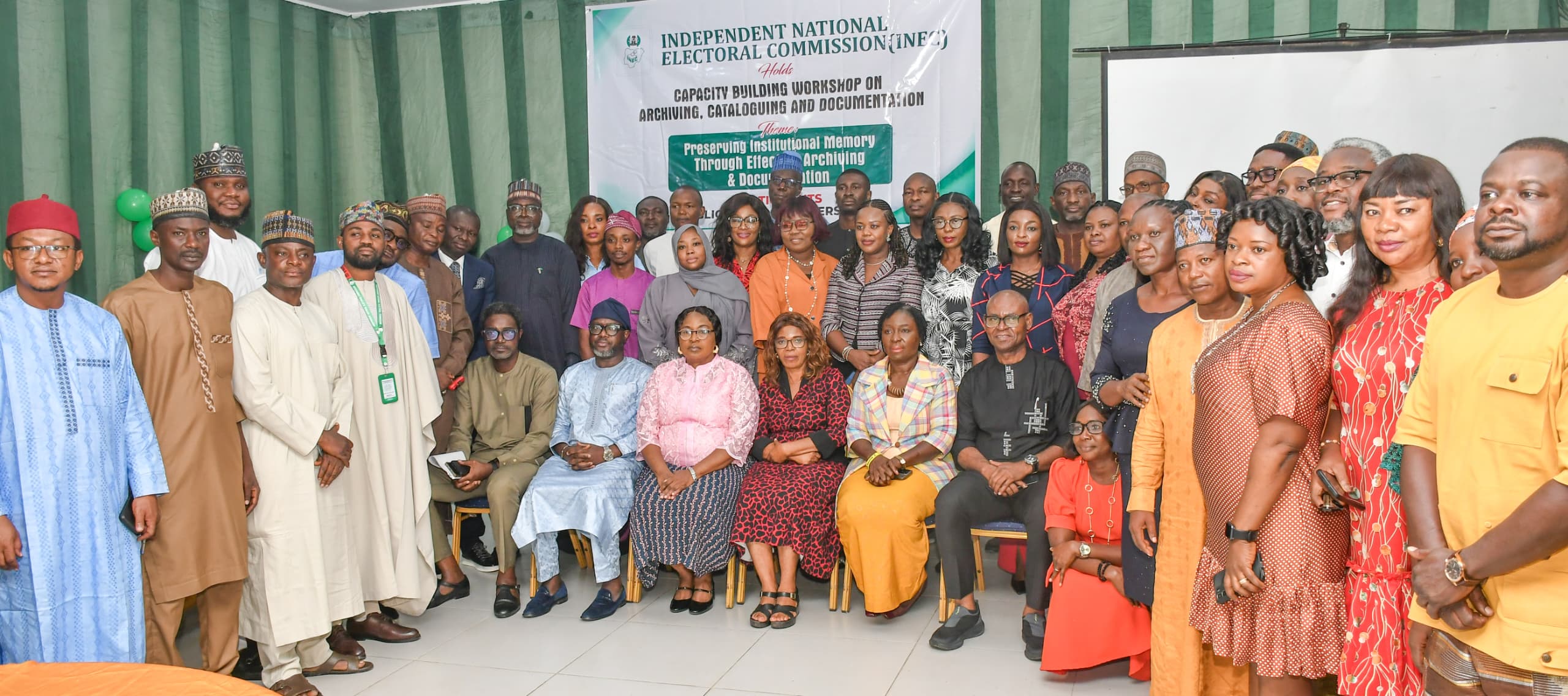
The Independent National Electoral Commission, INEC, has begun a fresh drive to preserve its institutional memory by training Public Affairs Officers, PAOs, from the 36 states and the Federal Capital Territory on modern archiving, cataloguing and documentation practices ahead of the 2027 general elections.
The two-day workshop, organised by the Commission’s Voter Education and Publicity Department, had as its theme: “Preserving Institutional Memory Through Effective Archiving and Documentation.”
Declaring the workshop open, Chairman of the Information and Voter Education Committee Mohammed Kudu Haruna, represented by the Director of Voter Education and Publicity, Victoria Eta-Messi, described proper archiving as a critical but often overlooked function of the Commission.
Haruna said preserving records of previous elections was essential for posterity, reference and institutional learning, noting that materials from past election cycles were sometimes left unpreserved in state offices.
“It is a key leg in the department that we have our archiving done properly, for posterity, for reference, for lesson learning,” he said.
He explained that the newly established Graphics, Library and Documentation, GLD, Division was created to close the gap, urging the PAOs to take the training seriously as they would also serve as GLD Desk Officers in their respective states.
“I want to enjoin us to please take this engagement and interaction seriously, so that by the time we go back to our respective states, we will be better prepared and positioned to begin to do the work of GLD,” Haruna said.
Also speaking, the Chief Press Secretary to the INEC Chairman, Mr. Adedayo Oketola, said the initiative was particularly important as the Commission intensified preparations for the 2027 general elections.
Oketola urged the participants to transfer the knowledge acquired during the workshop to their respective states and become active implementers of the Commission’s plan to systematically preserve its records and institutional memory.
On her part, the Deputy Director of Graphics, Library and Documentation, Mrs Perpetual Aligwara, said the training represented a long-overdue return to standard records-management practice within the Commission.
Aligwara noted that some state offices were unable to readily produce documented records of previous Commission activities, warning that the gap could undermine the effectiveness and institutional authority of information officers.
“The Commission’s credibility rests as much on its memory as on its neutrality. You cannot defend a decision you can no longer explain,” she said.
According to her, inadequate documentation could result in inconsistent application of guidelines across state and local offices, while also exposing the Commission to avoidable litigation and public-trust challenges.
She told participants that “what you don’t put down doesn’t exist,” stressing that documentation provides the evidence required to defend the Commission’s decisions, processes and history.
Aligwara disclosed that INEC would establish a central and secure archive covering election guidelines, results documentation, litigation records, post-election reviews and pictorial materials from its activities nationwide.
She said, the archive would form an important part of the Commission’s preparations for the 2027 general elections by ensuring that institutional records are preserved, accessible and available for future reference.
Participants are expected to undertake practical sessions on digital documentation as part of the second day of the workshop, while further engagements will be conducted to monitor implementation of the new archiving standards across the states.