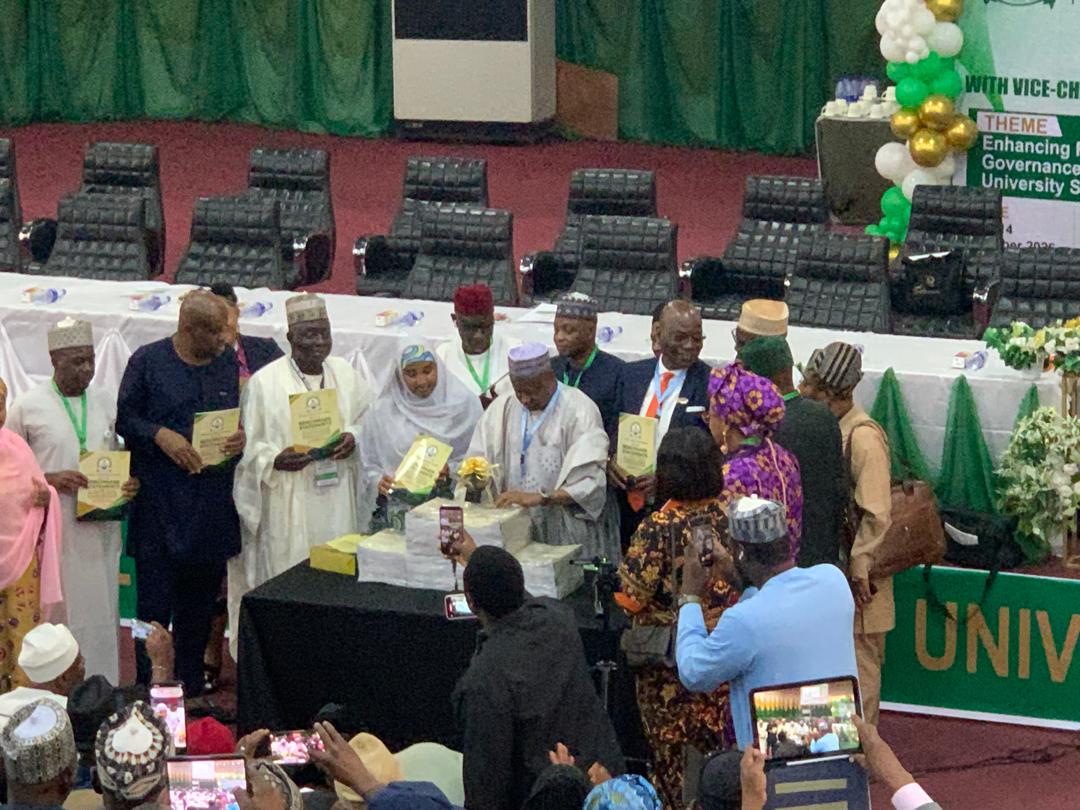
The National Universities Commission, NUC, has signalled a tougher regulatory era for Nigerian universities with the introduction of post-accreditation monitoring visits and sanctions for institutions that abuse honorary doctorate degrees.
Executive Secretary of NUC, Prof. Abdullahi Ribadu, made the announcement at the 2026 NUC Retreat with Vice-Chancellors of all Nigerian universities on Tuesday in Abuja.
Ribadu said the Commission is “at the cusp” of instituting the monitoring visits, which are meant to strengthen programme accreditation by checking that universities keep up standards after accreditation is granted.
He noted that the Commission has also issued new guidelines on the award and use of honorary doctorates, with penalties for defaulting universities.
According to him, to check the admissions process, NUC has introduced post-matriculation monitoring and carrying-capacity visits, and these will run alongside existing programme accreditation and resource verification exercises.
The NUC boss told the vice-chancellors that quality assurance is driven both internally and externally, and that as chairmen of their senates they are the Commission’s “frontliners” in that effort.
He urged them to ensure decisions follow due process and institutional priorities.
Ribadu said it has deployed e-NUC, a platform to automate its entire workflow, and is developing accreditation software to improve transparency and data management.
He warned that digital transformation “must go beyond acquiring hardware and software” and requires institutional readiness, cybersecurity and capacity building.
On research, he said the NUC will set up a Division for Research Commercialisation and plans a study tour of European and Asian universities for selected vice-chancellors.
He also announced a Blueprint 2.0 for the revitalisation of university education and a 21st Century Strategic Plan, and urged universities to revive institutional strategic planning.
On funding, he acknowledged that “the challenges of inadequate resources are real” and urged universities to seek partnerships with the private sector, alumni and development partners.
He noted the Commission’s ties with the World Bank, the French Development Agency, AFD,and the African Development Bank,AfDB.
While declaring the retreat open, the Minister of State for Education, Prof. Suwaiba Ahmad, said AI adoption must come with attention to academic integrity, ethics and data protection.
Ahmad called for stronger compliance with regulatory directives, saying the challenges facing higher education cannot be solved by isolated institutional efforts or regulatory directives alone.
She said vice-chancellors, as chief accounting officers of their universities, must operate within established governance structures and prioritise transparency and accountability in finance, procurement, recruitment, promotion, admissions and examinations.
The Minister urged them to set clear institutional visions and measurable performance targets, stating that the retreat’s emphasis was on moving from discussion to implementation.
Ahmad welcomed the proposal that it end with a communiqué containing agreed policy actions and institutional commitments, backed by a post-retreat monitoring and feedback mechanism, which she described as a practical roadmap for measurable improvement across the university system.
Also speaking, the Registrar of the Joint Admissions and Matriculation Board, JAMB, Prof Segun Aina, urged vice-chancellors to fully adopt and consistently use the Central Admissions Processing System, CAPS, describing it as a safeguard for transparency, accountability and the protection of candidates.
Aina warned that admissions done outside approved procedures could leave candidates with offers that are not recognised, stranding them after they have invested time, resources and hope.
He said the issue was not simply regulatory compliance but “fairness, institutional credibility” and responsibility to young people.
The JAMB boss also acknowledged the recent downtime of CAPS and apologised for the disruption and anxiety it caused candidates, parents and institutions at a critical point in the admission cycle.
He said the platform has been restored but that “restoration alone is not enough,” promising medium- and long-term measures, including redundancy and business-continuity arrangements, to improve reliability.
He asked universities to work with JAMB to recover lost time, expedite outstanding admissions and keep to approved timelines.
On his part, the Retreat chairman L.M. Faruk said the two-day event, themed “Enhancing Regulatory Compliance, Partnership, Governance, and Leadership in the Nigerian University System,” will feature paper presentations and discussions.