By Ipole Amajama
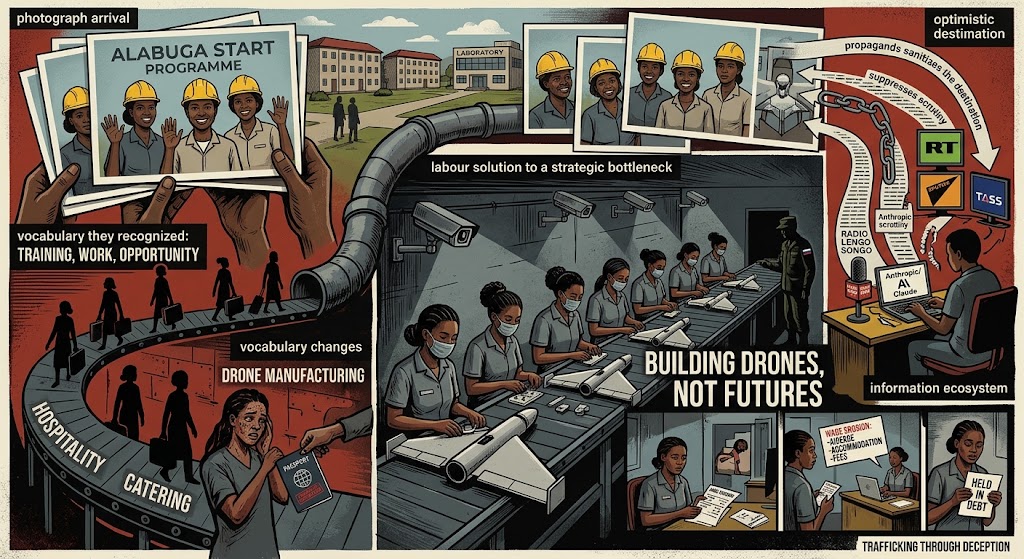
The photographs arrived first, as they always do. Young women in hard hats, smiling against a backdrop of laboratories and dormitories, holding diplomas not yet earned. The captions spoke of opportunity, mobility and a new technical elite drawn from the Global South.
For African women facing contracted economies at home, the Alabuga Start programme offered a vocabulary they recognised: training, language lessons, salaried work in Russia. What awaited them in Yelabuga, in Tatarstan’s Special Economic Zone, was not hospitality or logistics. A May 2025 investigation by the Global Initiative Against Transnational Organized Crime, drawing on interviews with participants and officials from Kenya, Uganda, Tanzania, Burkina Faso and Rwanda, found that the programme fulfils several conditions of human trafficking, through deceptive recruitment and exploitative working conditions.
The deception begins with disclosure. Recruits were not told they would be making weapons. Alabuga Start advertises four anodyne categories, catering, production, service and hospitality, language generic enough to invite optimism and obscure reality. Applicants are aged 18 to 22, a group that combines economic precarity with administrative pliability. The offer includes free flights, subsidised housing at $44 a month, health insurance, Russian lessons and wages of $500 to more than $1,000. Applying requires little more than a video introduction, a valid passport and a 100-word Russian vocabulary test.
After arrival, the vocabulary changes. Women who chose hospitality or catering were largely assigned to drone manufacturing without consent; about 90% are sent to assembly, according to a CSIS assessment. The work is building the Geran-2, Russia’s designation for the Iranian-designed Shahed-136 attack drone used against Ukraine.
Testimonies gathered by the BBC, the Associated Press and African investigative networks converge on shifts of up to 12 hours under constant surveillance, exposure to caustic coating chemicals that one participant said caused facial lesions, and steady wage erosion. Initial offers of $700 were reportedly revised to just over $500, then reduced further by deductions for airfare, accommodation, language lessons and medical costs. Passports were confiscated. Some workers ended the month in debt. As a 23-year-old from South Sudan told reporters: “We got our uniforms, not even knowing exactly what we were going to do.”
It is tempting to file this under opportunistic fraud. It is not. It is a labour solution to a strategic bottleneck. As Russian nationals were conscripted for frontline service, factories needed hands, and the answer was externalised recruitment through legitimate-seeming educational portals. By early 2025, estimates suggested more than 1,000 women had been recruited from across Africa, with parallel expansion into Latin America and Southeast Asia.
“It is a labour solution to a strategic bottleneck.”
Here the second strand begins, because Alabuga cannot be understood as a labour violation alone. It is sustained by an information ecosystem cultivated across the continent. The delivery mechanism has evolved from paid influencers, fake grassroots organisations and radio into something closer to an assembly line. An Anthropic threat intelligence report from September 2026 disclosed that a Russian-speaking operator in Bangui used Claude to produce daily content for Radio Lengo Songo on 98.9 FM, coordinated with RT, Sputnik Afrique, TASS and the Russian House in Bangui. The operator instructed the model to make the content read like ordinary journalism rather than AI-generated material. The report describes a wider pattern of information laundering: content fabricated by a foreign power is presented as independent reporting, amplified by local media and perceived as genuine public opinion.
Why does this matter for Alabuga? Because the propaganda performs three functions for the labour programme.
First, it sanitises the destination. Advertisements showing young African women thriving in Russia are not incidental. They circulate through the same networks that promote the Africa Corps as a stabilising force, in an environment already conditioned to read Russian offers as anti-colonial solidarity.
Second, it suppresses scrutiny. Russian embassy accounts in Kenya and South Africa have reportedly portrayed Ukraine as Nazi-controlled and Russia as a victim, while stressing its historical support for African liberation. In that narrative, a woman who complains of exploitation risks being cast as ungrateful or pro-Western, a powerful silencing tool where remittances are survival.
Third, it exploits the conditions it helps perpetuate. Poverty, unemployment and limited opportunity let deceptive recruiters prey on hope, as ActionAid Nigeria noted in its statement on the programme. Propaganda that frames the West as the source of African immiseration, while presenting Russia as a partner without conditions, makes the Alabuga pitch structurally persuasive.
To dismiss Russian information operations as clumsy memes or marginal radio is to misunderstand their design. They aim less to convince a population of a single falsehood than to breed cynicism about all truth. In that cynicism, exploitation becomes harder to name, and the line between scholarship and shift work, between career development and munitions assembly, blurs.
The women of Alabuga are not collateral damage of a distant war. They are the point where material and informational strategies converge. Their hands assemble the drones that strike Ukrainian cities; their images assemble the narrative that Russia is investing in African futures.
The GI-TOC finding is legally precise and morally unadorned: failing to tell recruits they were going to Russia to make drones is, in the report’s assessment, a core element of trafficking. The case for taking Russian propaganda in Africa seriously is not that Africa is vulnerable. It is that the campaign is sophisticated, well-resourced and linked to tangible harm. It uses AI to mimic local voices, diplomatic channels to launder recruitment and economic despair as leverage.
The corrective is not counter-propaganda but infrastructural honesty: transparent recruitment registries enforced by agencies such as Nigeria’s NAPTIP, independent investigation of recruiters and their digital assets, consular access without employer mediation, and media literacy that teaches people not only to spot a fake but to trace an ecosystem.
The consequences of Alabuga are counted in burned skin, withheld passports and months lost in a factory never named in the advertisement. Those women went seeking a profession. They were given a production line.
Ipole Amajama is a social and policy analyst who writes from Abuja and can be reached via amajamaip@gmail.com