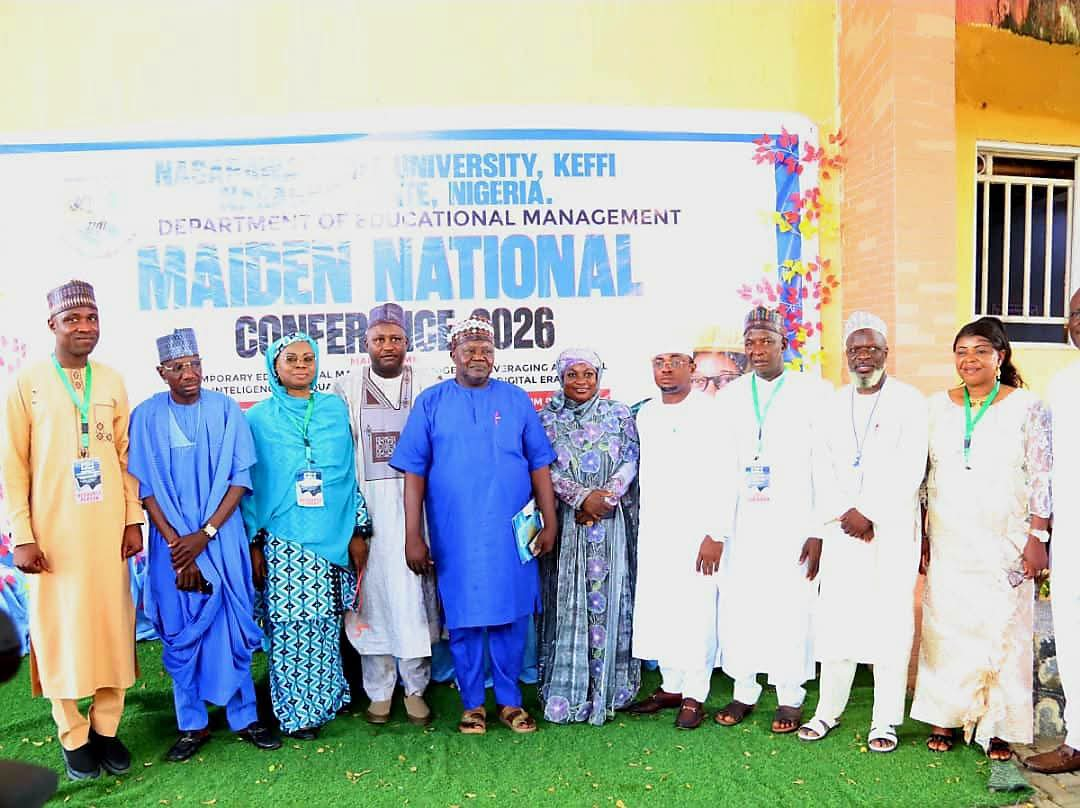
Nasarawa State University, Keffi, NSUK, has identified digital inequality, inadequate staff capacity and cybersecurity concerns as major obstacles to integrating artificial intelligence, AI, into Nigeria’s educational management system.
The university urged institutions to strengthen their capacity for responsible technology adoption.
NSUK made the submission at the maiden national conference organised by its Faculty of Education through the Department of Educational Management, where education experts called for effective governance frameworks, improved digital skills and stronger institutional partnerships to maximise AI’s benefits in the sector.
The conference, held on Monday, October 26, 2026, at the S. B. Muhammad Auditorium, School of Postgraduate Studies, had as its theme, “Contemporary Educational Management in Nigeria: Leveraging Artificial Intelligence for Quality Service Delivery in the Digital Era.”
Delivering the keynote presentation, Professor Hauwa Imam described AI as a catalyst for improving educational service delivery through evidence-based planning, stakeholder engagement and technology-supported learning.
She, however, warned that digital inequality, inadequate staff capacity, institutional limitations, accountability gaps, fragmented data systems and cybersecurity concerns could undermine efforts to transform educational management through AI.
Imam’s presentation highlighted the need for educational institutions to address these challenges to ensure that the adoption of emerging technologies translates into improved efficiency, accountability and quality service delivery.
In his lead presentation, Professor Dlama Zira Joseph said rapid digital transformation was creating new opportunities for the education sector but also introducing ethical and operational challenges that required careful management.
He stressed that AI should complement, rather than replace, human capabilities, insisting that educational leaders must retain responsibility for decision-making and professional judgement.
Joseph identified sound governance frameworks, staff capacity development, phased pilot projects and stronger institutional partnerships as essential measures for ensuring effective AI integration in educational administration.
Declaring the conference open on behalf of the Vice-Chancellor, Professor Sa’adatu Hassan Liman, the Dean of the Faculty of Administration, Professor Abdullahi D. Zubairu, commended the Faculty of Education for initiating the conference.
Zubairu described the theme as timely, given the growing relevance of digital technology to contemporary educational challenges, and urged participants to translate the knowledge gained into practical strategies for educational development and national progress.
Earlier, the Head of the Department of Educational Management, Professor Hauwa’u Muhammad Mainoma, said AI had significant potential to improve administrative efficiency, strengthen accountability, enhance research output and support evidence-based policymaking.
She also highlighted its capacity to improve teaching and learning, urging stakeholders to embrace the technology responsibly to address persistent challenges in the education sector.
Goodwill messages from the Nasarawa State Commissioner for Education, Dr. John D. Mamman, represented by Mr. Idris Audu; the Chairman of the Nasarawa State Universal Basic Education Board, Dr. Kasim Muhammad Kasim; the President of the National Association for Educational Administration and Planning, Professor Chinedu Aguba; and Professor Ngozi P. Nwosu congratulated the faculty on the initiative.
They underscored the importance of digital innovation in strengthening educational institutions, improving service delivery and promoting sustainable national development.
A major highlight of the conference was the presentation of Awards of Excellence to distinguished personalities in recognition of their contributions to the growth and development of the education sector.
The conference brought together academics, policymakers, education administrators, staff, students and other stakeholders to examine practical approaches to integrating AI into educational management, with discussions emphasising the need to balance technological innovation with institutional preparedness, accountability and human oversight.