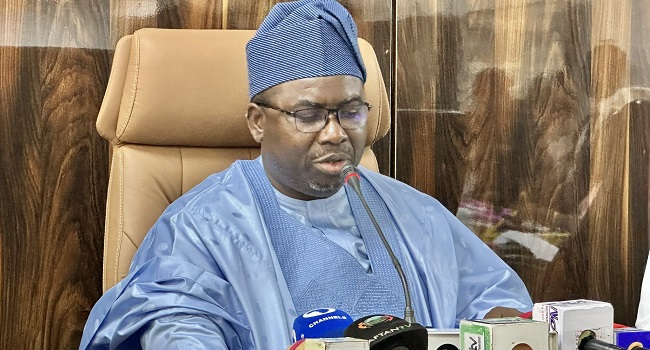
The Chairman of the Independent National Electoral Commission, INEC, Prof. Joash Amupitan, SAN, has charged members of the 2027 Election Petition Tribunals to avoid technicalities that defeat substantive justice, maintain firm control of their courtrooms and allow the truth of the ballot to prevail.
Amupitan gave the charge on Monday 9th November, 2026, in Abuja while delivering the Commission’s opening remarks at the three-day workshop for Justices of the Court of Appeal and members of the Election Petition Tribunals, held at the Body of Benchers Complex.
The workshop, organised by the Court of Appeal, is themed “Election Tribunal as a Tool for Political Stability.”
Addressing the Tribunal members, the INEC Chairman urged them to let their decisions be characterised by deep fidelity to the law, uncompromising integrity and a clear recognition that justice must be seen to be done.
He told them that as they take their oaths, they carry the democratic aspirations of over 200 million Nigerians, describing the courtroom to which they are deployed as the altar upon which public confidence in constitutional governance is preserved.
According to him, the political stability of the nation in 2027 will depend not only on how efficiently INEC conducts elections, but also on how courageously, transparently and justly the Tribunals adjudicate the disputes that follow.
The Chairman noted that the workshop was taking place at a pivotal juncture in Nigeria’s democratic journey, with the 2027 General Election scheduled to commence on 16th January 2027.
He explained that the Presidential and National Assembly elections would hold on 16th January 2027, followed by the Governorship and State Houses of Assembly elections on 6th February 2027.
Prof. Amupitan said the legitimacy of the country’s constitutional democracy rests on two indispensable pillars, namely impartial electoral administration and fearless judicial adjudication.
He described the Election Petition Tribunal as a constitutional valve that releases political pressure and prevents electoral friction from degenerating into civil disruption, adding that a Tribunal that acts with procedural speed, evidentiary rigour and absolute impartiality assures aggrieved parties that a credible platform exists for the evaluation of their complaints on merit.
The INEC Chairman said electoral adjudication is fundamentally evidence-driven, stressing that allegations of irregularities, non-compliance or manipulation of results must be established through credible and legally admissible evidence.
He observed that electoral litigation had become increasingly complex, with disputes now touching on voter accreditation, electronic transmission of results, technological failures and the integrity of digital records.
On the deployment of the Bimodal Voter Accreditation System (BVAS) and the INEC Result Viewing Portal (IReV), Prof. Amupitan said technology should neither be treated as infallible nor discounted simply because the evidence is electronic.
He added that the Commission had issued the Regulations and Guidelines for the Conduct of Elections, 2026, to provide clearer operational standards against which allegations of non-compliance may be evaluated in electoral proceedings.
Warning of emerging threats, the Chairman said the electoral environment now faces digital disinformation driven by artificial intelligence, audio cloning and deepfake videos, which he noted would inevitably spill into the courtrooms.
He therefore urged the Tribunals to apply rigorous evidentiary standards under Section 84 of the Evidence Act on electronic evidence, noting that digital provenance, forensic chain of custody and reliance on certified data from INEC would be vital in preventing synthetic fabrications from misleading the courts.
Amupitan commended the Court of Appeal, the National Judicial Institute and the legal experts who produced the Second Edition of the Judicial Electoral Manual (JEM), 2026, describing it as an indispensable compass for consistency in judicial reasoning.
He said consistency of judicial precedent is a vital prerequisite for political stability, as conflicting decisions on similar facts create legal uncertainty and undermine public confidence.
The Chairman stressed that engagement between INEC and the Judiciary must remain within constitutional limits, adding that it must not be an avenue to influence judicial decisions or discuss the merits of pending proceedings.
He assured the Judiciary that the Commission respects constitutional boundaries and remains committed to compliance with valid judicial decisions.
Amupitan said no institution can secure electoral integrity alone, noting that credible elections require an impartial electoral management body, responsible political parties, informed citizens, professional security agencies and an independent, effective judiciary.
He reaffirmed INEC’s commitment to conducting elections that are credible, transparent, inclusive and consistent with the law.
The event featured the swearing-in of the Chairmen and Members of the 2027 Election Petition Tribunals and the unveiling of the Second Edition of the Judicial Electoral Manual (JEM), 2026, by the Chief Justice of Nigeria, Hon. Justice Kudirat M. O. Kekere-Ekun, GCON.
In her address, the President of the Court of Appeal, Hon. Justice M. B. Dongban-Mensem, CFR, disclosed that 375 judicial officers had been nominated to serve on the 2027 Tribunals, comprising 138 returning members with previous Tribunal experience and 237 newly nominated members.
She urged the nominees to remain steadfast in judicial independence, resist every form of improper influence and discourage unnecessary adjournments, stressing that expedition must never undermine fairness.
2027 GENERAL ELECTION: INEC WARNS “RIG AND DIE” SLOGAN ENDANGERS ELECTION OFFICIALS, URGES MEDIA NOT TO AMPLIFY IT
The Independent National Electoral Commission (INEC) has described the slogan “Rig and Die” as dangerous, warning that it puts the lives of electoral officials, voters, party agents and observers at risk ahead of the 2027 General Election.
National Commissioner and Chairman of the Information and Voter Education Committee (IVEC), Mohammed Kudu Haruna, said this on Monday 7th November, 2026, in Enugu at the Commission’s forum for members of the Nigeria Union of Journalists (NUJ), the Nigerian Institute of Social Media Analysts (NISMA), the Newspaper Proprietors Association of Nigeria (NPAN) and media executives. He was represented by the Resident Electoral Commissioner (REC) for Enugu State, Dr. Chukwuemeka J. Chukwu.
Speaking on the theme “Ethical and Professional Standards in Election Reporting Ahead of the 2027 General Election,” Commissioner Haruna said that whatever the intention of its originators, and some insist it targets only those who rig, “a slogan that links an electoral offence to death is dangerous.”
He noted that the people most exposed at the polling unit are not powerful politicians but ordinary Nigerians serving as presiding officers, assistant presiding officers, collation officers and other ad hoc staff.
“A charged crowd can easily mistake a delayed result, a technical challenge or a rumor for rigging, and a mistake of that kind can never be undone,” he said.
The National Commissioner stressed that rigging is a crime for which the Electoral Act 2026 prescribes penalties, and that the remedy lies in the law, through vigilant observation, transparent results on the INEC Result Viewing Portal (IReV), formal complaints to the Commission and security agencies, and, where necessary, the courts.
He also reminded Nigerians that “the right to life is guaranteed by Section 33 of the Constitution, and no one may take it on suspicion.”
“I therefore appeal to political leaders to retire such language, and to you in the media not to amplify it as a headline or hashtag,” he said.
The National Commissioner urged journalists to report the phrase responsibly, “with its context, the legal position and the safety of electoral officials in view.”
He said the media’s role in the electoral process is central, noting that most Nigerians will never see a polling unit being set up, a BVAS device at work or a result sheet being signed. “Public confidence in our elections rests on the credibility of your reporting,” he said.
He urged journalists to verify information before publication, however tempting it is to be first, and to label projections and unofficial tallies for what they are, since results are declared only by the Commission through its Returning Officers. He also called for conflict-sensitive election-day reporting, fair space for all candidates and parties, and prompt correction of errors.
Citing recent off-cycle elections, he said vote buying was the most troubling feature of the Ekiti poll in June, while in Osun in August, false claims of ghost and hired voters and AI-generated content circulated on social media during collation. Yet independent observers, found the declared results consistent with polling unit tallies. “Where accurate information travels as fast as falsehood, public trust is protected,” he said.
He called on the media to support the Commission in sustaining voter education, especially on Permanent Voter Card (PVC) collection and turnout, noting that only 26.72 per cent of registered voters voted in the 2023 presidential election. He also urged them to investigate and expose vote buying and help debunk disinformation, including deepfakes and fake accounts, which are offences under the Cybercrimes Act.
Commissioner Haruna said the Commission remains open to the media and urged journalists to verify claims about INEC through its official channels, including the Citizens Contact Centre on 0700-CALL-INEC (0700-2255-4632), short code 4632, and its verified handles @inecnigeria. “We would rather you ask us now than speculate later,” he said.
He reaffirmed that any staff or ad hoc official who compromises an election will face the full weight of the law. He added that the Commission is working to have officials and materials at polling units by about 7:30 a.m. on election day, “because delays breed suspicion.”
He called for more inclusive coverage of women, young people and persons with disabilities, whose experiences deserve a place in election reporting beyond statistics.
Earlier, the REC, Dr. Chukwu, urged media practitioners to uphold professionalism, accuracy, fairness and objectivity. He warned that “a single unverified report can create unnecessary tension, undermine public confidence, discourage voter participation and potentially threaten peaceful coexistence.”
The Chairman of the NUJ, Enugu State Council, Comr. Obinna Ogbuka, commended the Commission for choosing Enugu as host and called for sustained training of journalists, saying “as media, we need to support INEC in pushing out the right narratives.”
The Director, Voter Education and Publicity, Mrs. Victoria Eta-Messi, represented by Mr. Wilfred Ifogah, Deputy Director, Information and Publicity, said the forum aims to strengthen collaboration between INEC and the media, with sessions on ethical reporting, the Electoral Act 2026, INEC’s technological innovations and voting procedures. Participants were urged to await the formal declaration of results by Returning Officers and to strengthen their election desks and fact-checking arrangements ahead of the election.