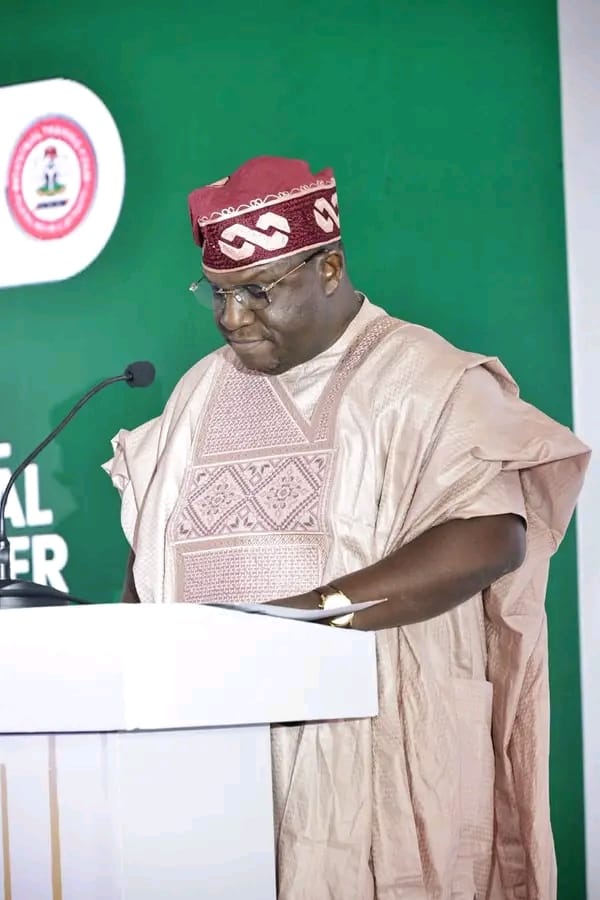
The Industrial Training Fund, ITF, has commenced the City & Guilds International Certification Examination for beneficiaries of its Skill-Up Artisans, SUPA, Programme across the six geopolitical zones of the country, in a move aimed at equipping Nigerian artisans with globally recognised professional qualifications.
The examination, which commenced on Monday, November 23, 2026, will run until Sunday, November 29, according to the Director-General of the ITF, Dr Afiz Oluwatoyin Ogun.
Ogun said the initiative was in fulfilment of President Bola Tinubu’s commitment to securing international certification for Nigerian artisans and enhancing their competitiveness in the global labour market.
He explained that the examination covers six trade areas: Plumbing and Pipe Fitting, Residential Electrical Installation, Wood Furniture Manufacturing, Cybersecurity, Automotive Mechanics, and Welding and Flame Cutting.
The Director-General said the ITF had successfully trained the beneficiaries in their respective trade areas as part of efforts to strengthen their technical capacity, improve professional competencies and ensure that Nigerian artisans meet internationally accepted standards.
He added that the Fund conducted a pre-assessment exercise in March 2026 to evaluate the competence and preparedness of the artisans ahead of the international certification examination.
According to him, candidates who successfully scaled the pre-assessment are currently participating in the ongoing examination across the six geopolitical zones.
Ogun outlined the process leading to the certification as comprising the training of SUPA artisans by the ITF, the pre-assessment exercise in March 2026, the selection of successful candidates and the ongoing City & Guilds International Certification Examination scheduled for November 23 to 29, 2026.
He further disclosed that the ITF began the process of securing approval as a City & Guilds Centre in January 2024 under the coordination of the Director of Standardisation and Certification, Mrs Olayinka Shodunke.
He said the process followed a series of engagements with the then Head of City & Guilds Africa, Mrs Charlene, and the ITF’s guarantor, Mrs Nnaji of Dewdrops Foundation.
According to him, their support and collaboration facilitated the commencement of the institution’s official recognition process, which required the preparation and submission of several mandatory documents, including equipment inventories, facility records, faculty credentials and other institutional documents.
The Director-General also disclosed that the ITF had secured approval to deliver 12 City & Guilds qualifications across various technical and vocational disciplines.
These include Level 2 and Level 3 Diplomas in ICT Systems and Principles; Level 2 and Level 3 IVQ Diplomas in IT Systems Support; Level 2 Diplomas in Engineering – Electrical and Electronic Technology, Engineering Maintenance Technology, and Bricklaying.
Others are the Skills Proficiency Certificate in Basic Plumbing, Skills Foundation Certificate in Electronics Engineering, Skills Proficiency Certificate in Basic Electronics Engineering, Level 2 Diploma in Housekeeping, and Level 2 Diploma in Food Preparation and Culinary Arts.
Speaking during an inspection of some examination centres across the country, the Director of Standardisation and Certification, Mrs Olayinka Shodunke, emphasised the need for strict compliance with City & Guilds requirements in the selection and preparation of examination facilities.
She said the centres must have the appropriate facilities, standard equipment and necessary learning aids to guarantee that candidates undertake the examinations under conditions that meet international specifications.
“They must have the right facilities, accurate equipment, and everything must be top-notch. The aids to be used by candidates must also be readily available,” she said.
Shodunke explained that the international certification was critical to the ITF’s ambition of positioning Nigerian artisans to compete favourably with skilled professionals in Germany, the United Kingdom, Asian countries and the United States.
“ITF has the mandate to place Nigerian artisans on the global page, and we want our artisans to compete with their contemporaries in Germany, the United Kingdom, Asia and the United States of America, among others.
“Without City & Guilds certification, they might not be able to achieve that. This is why the international certification examination is necessary. Over the years, holders of City & Guilds qualifications have been able to work anywhere in the world, and that is the target of the ITF for Nigerian artisans,” she said.
She urged the participating artisans to take full advantage of the opportunity by preparing adequately and demonstrating their competence to ensure successful outcomes in the examinations.