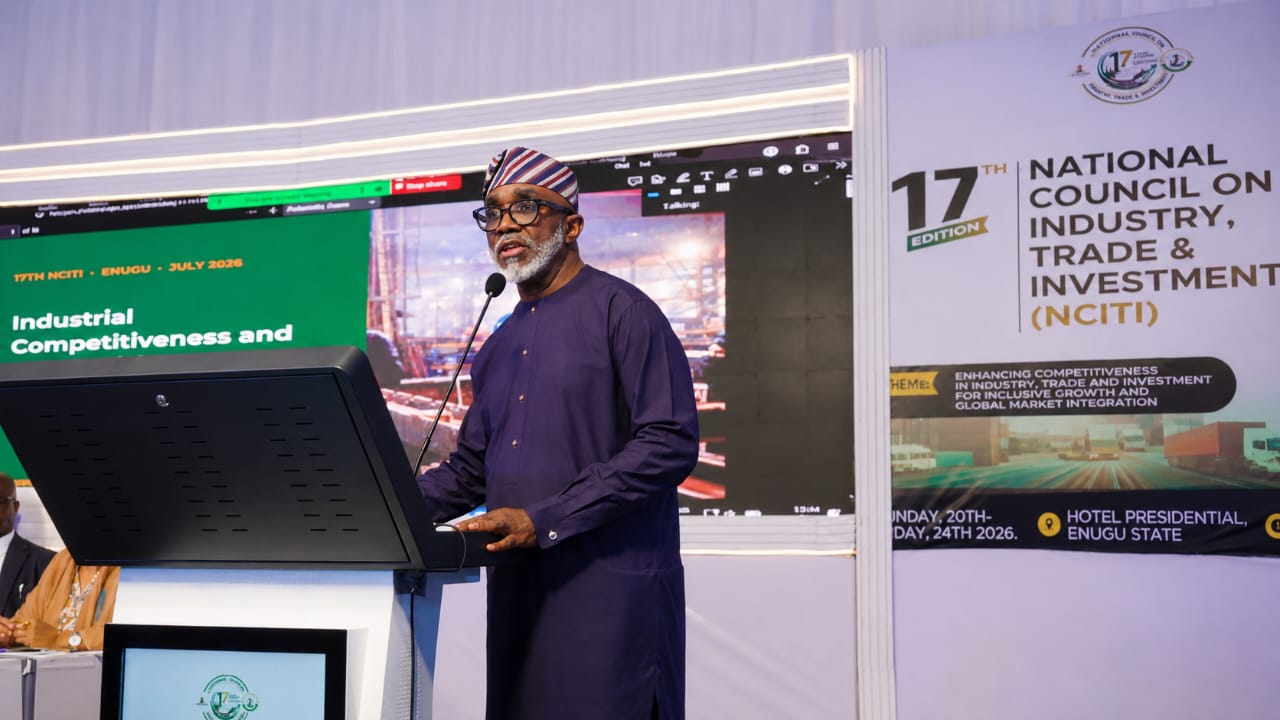
The Executive Secretary of the National Sugar Development Council, NSDC, Mr. Kamar Bakrin, has urged state governments to establish dedicated industrial clusters with reliable power, harmonise taxes and levies, and improve logistics to make Nigerian manufacturers more competitive under the African Continental Free Trade Area, AfCFTA.
Bakrin made the call while presenting a paper on “Industrial Competitiveness and Productivity Enhancement” at the technical session of the 17th National Council on Industry, Trade and Investment, NCITI, in Enugu, warning that unless production costs are drastically reduced, Nigeria risks losing its domestic and continental markets to more competitive economies.
According to a statement issued by NSDC, Bakrin proposed four key resolutions for adoption by the Council, including the designation of at least one dedicated industrial cluster with stable power in every state within the next 12 months, harmonisation of levies through a federal-state compact, the introduction of an annual State Industrial Competitiveness Index, and strict enforcement of the Nigeria First procurement policy across all levels of government.
He stressed that Nigeria’s manufacturers currently face significantly higher production costs than their counterparts in countries such as Vietnam and China, particularly in electricity, access to finance and logistics.
Bakrin noted that while industrial electricity costs about eight cents per kilowatt-hour in Vietnam and around 10 cents in China, Nigerian manufacturers pay about 15 cents on the national grid, with costs rising to nearly 30 cents when diesel-powered generators are used.
He added that local manufacturers also contend with lending rates of between 27 and 35 per cent, compared to about nine per cent in Vietnam and three per cent in China, while logistics bottlenecks continue to erode competitiveness.
According to him, these high operating costs have limited manufacturing’s contribution to Nigeria’s Gross Domestic Product (GDP) to about eight per cent, with factory capacity utilisation falling to 57.7 per cent despite the country’s large consumer market and duty-free access to over 1.4 billion Africans under AfCFTA.
“This is not a demand problem. It is a cost-of-production problem, and costs are within our power to fix,” Bakrin said.
He argued that recent macroeconomic reforms by the Federal Government have restored stability, creating a favourable environment for industrial expansion, citing improved foreign reserves and easing inflation as signs that manufacturers can now plan for long-term investments.
Drawing lessons from Nigeria’s fertiliser industry, Bakrin said the country’s urea production expanded from about 500,000 tonnes in 2005 to 6.5 million tonnes, making Nigeria one of the world’s top 10 exporters of nitrogen fertiliser after government deliberately priced natural gas as an industrial input.
“When a country prices inputs as if it wants industry to live, industry lives,” he said, adding that similar policy discipline transformed the manufacturing sectors of Vietnam and Bangladesh.
Bakrin set measurable targets for improving industrial competitiveness, including reducing electricity tariffs for industrial clusters to between eight and 10 cents per kilowatt-hour, lowering industrial lending rates to single digits, reducing port clearance time to less than seven days from the current 18 to 21 days, and doubling workers’ productivity by 2030.
He maintained that government support should remain performance-driven, insisting that tax incentives, subsidised power and procurement patronage must be tied to verifiable production outcomes rather than treated as permanent entitlements.
The NSDC boss also urged state governments to leverage the Electricity Act 2023 to establish competitive power markets, make industrial land readily available for investors, streamline multiple taxes and align technical education with the manpower needs of industries.
He said improving industrial competitiveness would create jobs for the more than four million young Nigerians entering the labour market annually, reduce dependence on imports, strengthen the naira through increased exports and provide sustainable employment opportunities capable of reducing the growing wave of emigration.
Bakrin also called for annual public tracking of key industrial performance indicators, including manufacturing’s contribution to GDP, industrial electricity costs, lending rates, port efficiency and job creation, insisting that sustained implementation of measurable reforms would determine whether Nigeria emerges as a leading manufacturing hub in Africa or loses its competitive advantage.