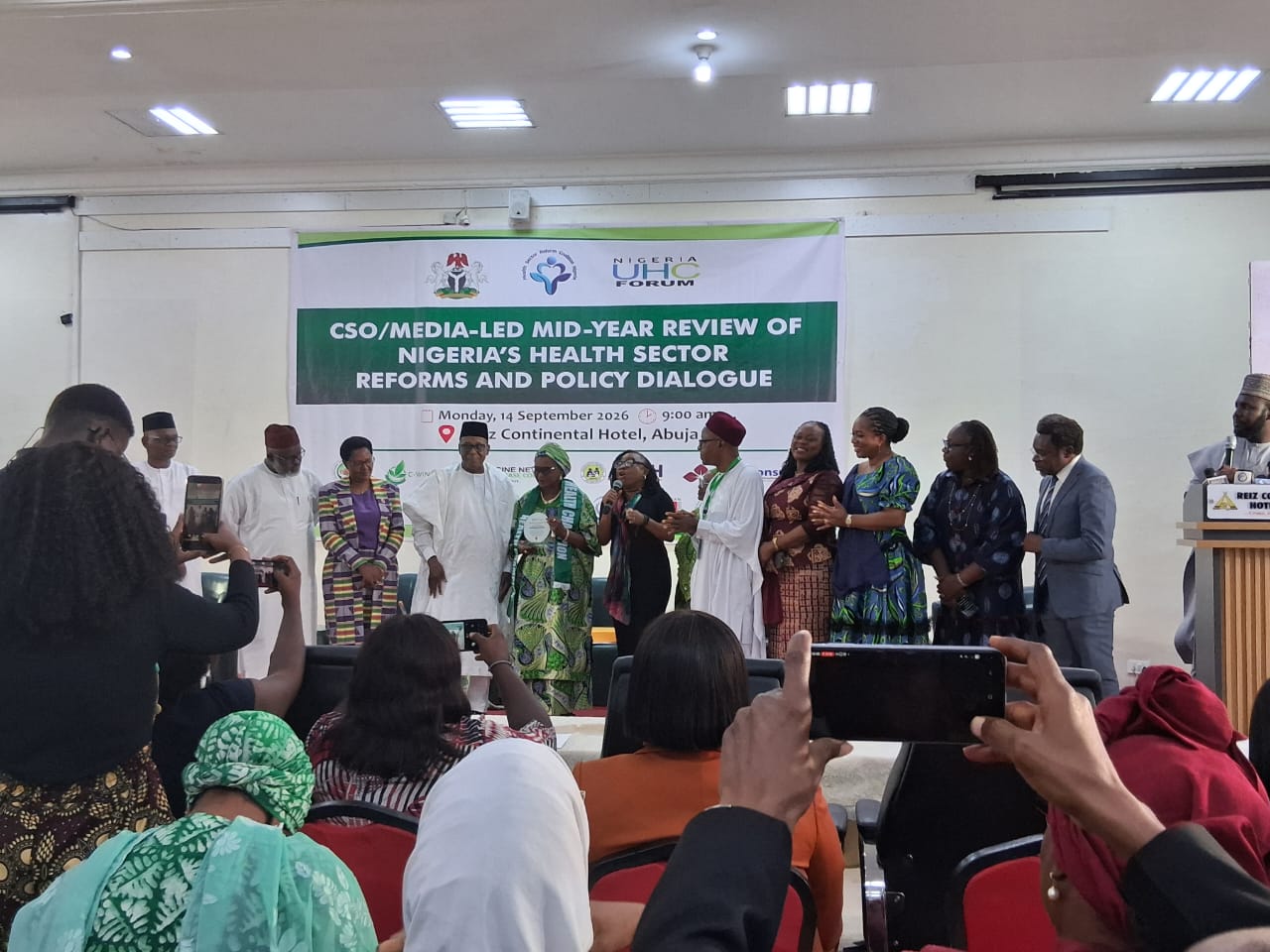
Civil society organisations have urged the Federal Government to measure the success of ongoing health sector reforms by the number of functional primary healthcare facilities rather than the number of facilities renovated.
The position was contained in a communiqué issued at the end of the Civil Society Organisations and Media High-Level Policy Dialogue on the Performance of Ongoing Health Sector Reforms in Nigeria, held in Abuja on Monday.
The communiqué was signed by the Chairperson of the Health Sector Reform Coalition, Dr Muhammed M. Lecky, and the Chair and Co-convener of the Nigeria UHC Forum, Chief (Mrs) Moji Makanjuola, MFR.
 The dialogue, organised by the Health Sector Reform Coalition and the Nigeria UHC Forum in collaboration with the Federal Ministry of Health and Social Welfare, reviewed the Health Sector Renewal Investment Initiative, the Health Sector Renewal Compact signed in December 2023 and the Sector-Wide Approach.
According to the communiqué, although the reforms had recorded progress in coordination and the architecture of health financing, delivery at the point where citizens meet the health system had not kept pace.
The CSOs cited the Nigeria Demographic and Health Survey 2023-24, noting that half of all live births were assisted by a skilled provider, while 39 per cent of children aged 12 to 23 months were fully vaccinated and 40 per cent of children under five were stunted.
The organisations therefore called on the National Primary Health Care Development Agency and State Primary Health Care Boards to publish a baseline of facilities meeting the minimum service package by local government area by June 30, 2027.
They also demanded the full and timely release of appropriated health funds and greater transparency in the disbursement and utilisation of the Basic Health Care Provision Fund.
The communiqué further called for the publication of a National Health Act 2014 Alignment and Implementation Matrix and the institutionalisation of Ward Development Committees, with the BHCPF made a standing item on their agendas.
The organisations also urged state governments to pay health workers monthly without arrears and publish information on rural postings, incentives, supervision coverage and staff deployment by facility.
The CSOs acknowledged government’s reported progress in the revitalisation of close to 4,000 primary healthcare facilities, expansion of medical training and emergency obstetric care.
However, they noted that no figure was provided for the number of facilities meeting the minimum service package.
The communiqué also raised concerns about uneven progress between states, inadequate public information on health financing, workforce deployment, community participation and weaknesses in data quality and use.
It cited an analysis of 862 Ward Development Committee meetings across the 23 local government areas of Kaduna State, which found that only 11.6 per cent discussed the Basic Health Care Provision Fund.
The coalition said it would publish a quarterly reform tracker, conduct independent monitoring of health facilities, publish an annual scorecard on delivery of the Health Sector Renewal Compact and maintain a public register of commitments.
It added that unfulfilled commitments would be escalated to the National Council on Health and the National Assembly committees on health.
The communiqué said the Coordinating Minister of Health and Social Welfare had identified a 25 per cent reduction in maternal mortality by 2027, a 10 per cent reduction in neonatal mortality, increased skilled birth attendance and immunisation coverage, and increased state resourcing of health as measurable outcomes for government to be held accountable for.
The dialogue was attended physically and virtually by 158 participants from 60 organisations drawn from government, civil society, professional associations, development partners, academia, the media and the private sector.