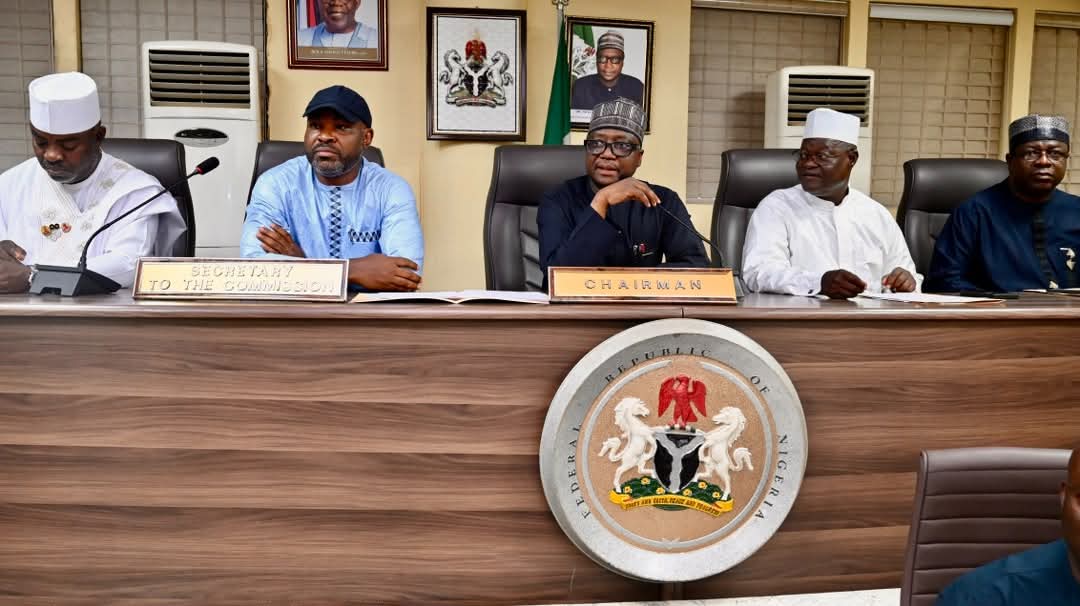
The Revenue Mobilisation Allocation and Fiscal Commission, RMAFC, has reopened the verification of disputed and newly drilled oil and gas wells, following controversies over the accuracy of coordinates and boundaries used in determining beneficiaries of derivation revenue.
The Commission on Wednesday inaugurated a reconstituted Inter-Agency Technical Committee, IATC, to verify oil and gas wells drilled from 2017 to date, with the exercise expected to strengthen fiscal transparency and help resolve disputes among oil and gas-producing states.
The initiative is particularly significant to the distribution of the 13 per cent derivation fund, as accurate identification and location of producing wells are critical to determining the states entitled to derivation revenues.
A statement issued by the Head of Information and Public Relations at RMAFC, Maryam Yusuf, quoted the Commission’s Chairman, Dr Mohammed Bello Shehu, as explaining that the previous draft report on the wells verification exercise had been discarded following claims, counterclaims and complaints by various states.
Shehu, who spoke at the inauguration of the committee in Abuja, said the concerns centred largely on the need to re-verify the coordinates of disputed and newly drilled wells and accurately plot them on approved maps.
He directed the reconstituted committee to take relevant court decisions into account, rely strictly on approved maps and conduct physical verification of affected wells where necessary.
According to him, the committee must ensure that every verified coordinate, map used and boundary assessed accurately reflects the situation on the ground.
The exercise will operate under a two-tier governance structure.
The first tier comprises technical officers and experts from RMAFC, the Office of the Surveyor-General of the Federation, the National Boundary Commission and the Nigerian Upstream Regulatory Commission.
The technical team will undertake field inspections, ground-level verification, technical analysis and preparation of the initial report, while an Executive Committee led by the RMAFC leadership will provide strategic direction, coordinate the participating agencies and oversee final approval of the findings before formal ratification.
RMAFC said it would provide institutional support for the exercise, including liaison with security authorities to facilitate administrative clearances and security coverage for field operations, particularly in complex and coastal environments.
Surveyors-General from affected states and representatives of the Senate Committee on Petroleum Resources, Upstream, will participate as observers, the Commission said, in a move aimed at promoting transparency in the process.
Shehu charged members of the committee to approach the assignment with integrity, objectivity and patriotism, saying its objective was to achieve clarity, fairness and a lasting resolution of disputes over oil and gas wells among beneficiary states.
The Secretary of RMAFC, Comrade Tosin Adeyanju, also urged members to put national interest above other considerations, stressing the need for fairness, diligence and objectivity in the exercise.
He said the committee’s work would attract heightened scrutiny because of lessons from previous verification exercises, expressing confidence that it would produce a credible outcome that would serve the interests of the country and affected states.
The inauguration was attended by the Chairman of the Crude Oil Monitoring Committee and Federal Commissioner representing Kano State, Hon. Adamu Abdu Fanda, other RMAFC commissioners representing Osun, Edo, Yobe, Taraba, Zamfara, Jigawa and Ogun states, as well as representatives of relevant government agencies.