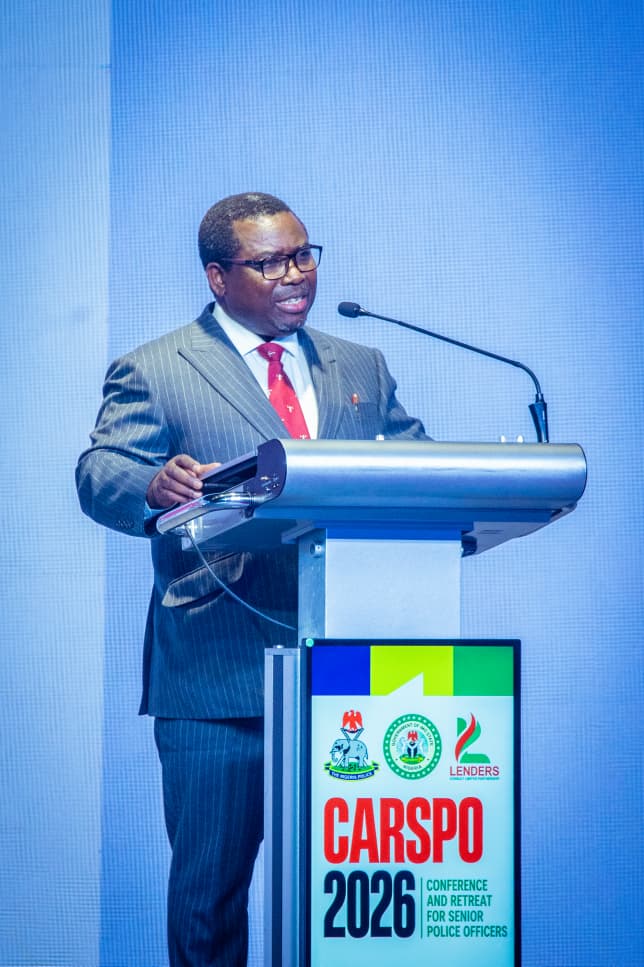
The Independent National Electoral Commission, INEC, has, again, identified insecurity and vote buying as major threats to the conduct of credible elections in 2027, warning that violence in volatile areas could disenfranchise voters.
INEC Chairman, Prof. Joash Amupitan, SAN, disclosed this while speaking with newsmen on the sidelines of the sixth edition of the Conference and Retreat for Senior Police Officers on Wednesday in Owerri, Imo State.
Amupitan, however, noted that the commission would deepen collaboration with security agencies to safeguard the electoral process.
“Our number one concern is the issue of security. Because there are still some states in Nigeria that you have a lot of insecurities around, and it’s a major source of concern for us.
“Because that can be a source of disenfranchisement of Nigerians, and we don’t want any Nigerian to be disenfranchised. So it’s a top priority for INEC, and we are here to liaise and partner with the Nigerian Police, which is the lead agency on election security, so that we can address and strategise towards having election in those volatile areas,” Amupitan said.
He also said the commission was working towards an intelligence-led approach to tackling vote buying, noting that the practice was increasingly taking place outside polling units.
“Most of the issues of vote buying now, you don’t even see them at the polling units. They are done outside of the polling units. So we need to activate intelligence,” he said.
According to Amupitan, INEC was seeking a coordinated response involving the Ministry of Justice, the Attorney-General’s office and other law-enforcement agencies to tackle electoral offences.
“We are also trying to have a form of giant task force, bring in everybody on the same platform… to ensure that we tackle it collectively. Because we don’t have powers to arrest them. We don’t have powers to investigate,” he said.
On pre-election disputes arising from party primaries, the chairman said such matters remained within the jurisdiction of the courts, assuring that INEC would abide by final judicial decisions.
“There are pre-election matters, which is within the province of the courts. If there is a dispute over the primaries, most of them are already in the courts,” he said.
Amupitan said INEC was drawing lessons from recent off-cycle elections to improve logistics, result management and transparency ahead of 2027.
“Every election is a lesson,” he said, adding that the commission had conducted five off-cycle elections without any being declared inconclusive.
He said the commission was determined to deliver a transparent and credible election that would strengthen public confidence in the electoral process.
“What Nigerians are waiting for is just to be sure that the election is transparent. And so as much as possible, we are determined to conduct a free, fair and credible and also inclusive election in 2027,” he said.
The INEC chairman also urged political parties to focus campaigns on issues rather than personalities, saying elections should not be treated as a do-or-die affair.
Amupitan stressed the need for political tolerance and enforcement of provisions of the Electoral Act against offenders.
Earlier, while delivering a goodwill message at the event, Amupitan noted that adequate funding of elections is critical to providing the security and logistics required for successful conduct of the 2027 general elections.
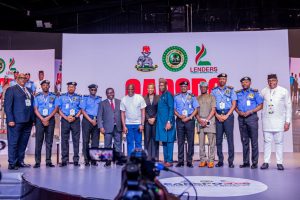
The INEC chairman was accompanied by National Commissioners Dr. Ken Nnamdi Ukeagu and Rear Admiral Jamila Abubakar Malaga, Retd, the Resident Electoral Commissioner for Imo State, Chukwuemeka C. Ibeziakor, and the Chief Press Secretary/Media Adviser to the Chairman, Mr. Adedayo Oketola.
Also on the entourage were Mustapha Muhammad Dogondaji, Personal Assistant; Ahmad Yusuf, Executive Assistant, Finance; and Barr. Ezeh N. Emmanuel, Head of Legal, INEC Imo State.
Amupitan said although the commission’s funding was constitutionally provided as a first-line charge on the Consolidated Revenue Fund, the scale of its responsibilities required sustained financial support to enable it to conduct elections effectively.
He explained that INEC was responsible not only for presidential and National Assembly elections, but also for governorship and state House of Assembly elections, voter registration and the registration of political parties.
According to him, the commission also has statutory powers to request the deployment of security agencies for elections and voter registration, making security an integral part of the electoral process.
“Sometimes, it is not what you would like to do that you are able to do because of financial constraints. The system does make allocations of what is available and what is affordable at a particular time for the expenses and appropriation of the agencies, including the police and also including INEC.”
Amupitan stressed that voter registration remained the foundation of credible elections, saying an inaccurate or outdated voters’ register could undermine the inclusiveness of the electoral process.
He argued that because INEC conducts elections affecting the three tiers of government, election expenditure, including security-related costs, should be approached as a collective national responsibility.
The chairman said adequate funding was particularly important for the deployment of personnel and electoral materials to local government areas, wards, registration areas and polling units.
According to him, even where security agencies succeed in maintaining peace, inadequate logistics could still undermine the conduct of an election.
Amupitan said INEC had made both security and logistics priorities under his leadership, adding that the commission was working with government and security agencies to ensure that operational challenges did not undermine the 2027 polls.
He also highlighted the role of the Inter-Agency Consultative Committee on Election Security (ICCES), describing it as a platform that brings INEC and relevant security and government agencies together to coordinate election security.
He said the committee, which began as a coordinating arrangement after the 2011 general elections following concerns over post-election violence, had evolved into a structured mechanism for election security coordination.
According to him, ICCES now operates at federal, state and local government levels, with the Inspector-General of Police participating at the national level, commissioners of police at the state level and divisional police leadership represented at the local level.
The INEC chairman said stronger coordination among the agencies would be necessary ahead of 2027, noting that the police remained the lead agency when it came to election security.
He also cited recent off-cycle elections as evidence of the importance of adequate security and coordination, recalling that security agencies had helped to resolve incidents that could otherwise have disrupted the electoral process.
Amupitan said the experience of recent elections should be used to strengthen preparations for the 2027 general elections, particularly in intelligence gathering, logistics and inter-agency coordination.
He added that Nigerians expected a highly effective electoral system but must also recognise that achieving such standards required adequate resources.
“In Nigeria, we want the best. We want our electoral system to be 100 per cent. But sometimes we don’t ask ourselves the question: if we want the nation to be perfect, there must be a cost for it,” he said.
He urged the relevant authorities to provide the resources required by security agencies and INEC to perform their respective responsibilities effectively.
Reaffirming the Commission’s commitment to deepening operational synergy through ICCES, the Chairman expressed optimism that the Owerri retreat would produce an actionable, forward-looking roadmap ahead of the 2027 General Elections.
He charged senior police managers to sustain absolute professional neutrality, proactive intelligence gathering, and seamless inter-agency coordination to continuously protect the integrity of the ballot.
Also speaking, President of the Nigerian Bar Association, NBA, Oyinkansola Badejo-Okusanya, charged the leadership and operational personnel of the Nigeria Police Force to extend their unalloyed support and synergy to the INEC Chairman in fulfilling his mandate.
Badejo-Okusanya emphasised that robust policing support remains vital to safeguarding the electoral process and guaranteeing the delivery of free, fair, credible, and transparent elections across the nation.