By Ipole AMAJAMA
The Third Russia-Africa Summit in Moscow was presented as a celebration of cooperation, sovereignty, and mutual respect. Bringing together representatives from almost 50 African countries and more than 20 heads of state, the summit projected an image of a continent seeking new partnerships in an increasingly multipolar world. Yet beneath the rhetoric of solidarity and anti-colonialism lies a fundamental question African leaders must confront: is Russia offering a genuine partnership, or is it simply seeking to replace old spheres of influence with new ones?
African leaders arrived in Moscow with a clear message. They no longer want relationships based on the extraction of raw materials and dependency. African Union Chairperson Évariste Ndayishimiye emphasized that Africa seeks partners capable of helping the continent develop industries, transfer technology, create jobs, build infrastructure, and generate wealth locally instead of exporting raw materials and importing finished products at a premium. He argued that international summits should no longer be platforms for grand declarations but spaces for concrete agreements that improve the lives of African citizens.
This demand reflects a growing maturity in African diplomacy. Across the continent, there is increasing recognition that political slogans alone cannot transform economies. Whether the partner is China, Europe, the United States, the Gulf states, or Russia, African governments are demanding measurable benefits. The challenge for Moscow is that its narrative of friendship and anti-colonial solidarity must withstand scrutiny against its actions.
Russia’s pitch to Africa is attractive on the surface. President Vladimir Putin portrayed Russia as a historic ally of African liberation movements and a defender of sovereign equality. Moscow supports African calls for greater representation in global institutions, including permanent seats on the United Nations Security Council. Russia has also emphasized cooperation in education, energy, agriculture, transport, healthcare, and digital technology. The summit produced around 150 agreements and cooperation frameworks covering multiple sectors.
However, history teaches Africa that rhetoric and reality are often very different things.
One of the most concerning examples of Russia’s contradictory approach can be found in the Alliance of Sahel States (AES), comprising Mali, Burkina Faso, and Niger. Russia has successfully positioned itself as an alternative to France, exploiting widespread anger over decades of French influence and perceived neo-colonialism. In these countries, Russian officials and media narratives have presented Moscow as a liberator that respects African sovereignty.
Yet replacing one external dependency with another is not liberation.
The language of anti-colonialism should not exempt Russia from the same scrutiny applied to Western powers. African sovereignty means the ability to make independent decisions, diversify partnerships, and build domestic capacity. It does not mean becoming politically, militarily, or economically dependent on a new external power simply because that power opposes the West.
The summit itself revealed that African leaders understand this distinction better than many outside observers. Ndayishimiye emphasized that cooperation with Russia should not be viewed as an alternative to relations with Western countries or China. Instead, Africa’s strategy is diversification. The continent seeks multiple partnerships that strengthen African institutions rather than creating new zones of influence. He stressed that any external partnership must reinforce the African Union and regional economic communities rather than undermine them.
That statement is perhaps the most important lesson from the summit.
Russia often portrays itself as a champion of sovereignty, yet its approach sometimes appears driven as much by geopolitical competition as by African development. Moscow is eager to expand its influence across Africa at a time when it faces diplomatic isolation from many Western governments. While there is nothing inherently wrong with pursuing national interests, African leaders must recognize that Russia’s interests and Africa’s interests are not always identical.
The Democratic Republic of Congo provides a timely example of why caution is necessary. Reports indicate that President Félix Tshisekedi has sought Russian support in addressing security challenges linked to Rwanda-backed rebel groups in eastern Congo. While any nation facing security threats naturally seeks partners willing to assist, security cooperation must not become a gateway to long-term dependency. African states have repeatedly experienced how military assistance from foreign powers often arrives with strategic strings attached. Sustainable security ultimately requires strong national institutions and African-led solutions, not permanent reliance on external actors.
Moreover, questions remain about Russia’s broader conduct in Africa. Concerns have been raised by Amnesty International regarding allegations that foreign nationals, including Africans, were recruited into Russia’s war effort in Ukraine after being promised civilian opportunities. Whether these allegations are ultimately proven or not, they illustrate why African leaders should not automatically accept claims of partnership at face value. Genuine friends do not exploit vulnerable citizens. Genuine partners respect the rights and dignity of the people they engage.
The danger facing Africa today is not traditional colonialism in its 19th century form. The modern threat is subtler. It comes wrapped in the language of friendship, solidarity, strategic partnership, and shared struggle. It can emerge from any global power, regardless of whether it is Eastern or Western.
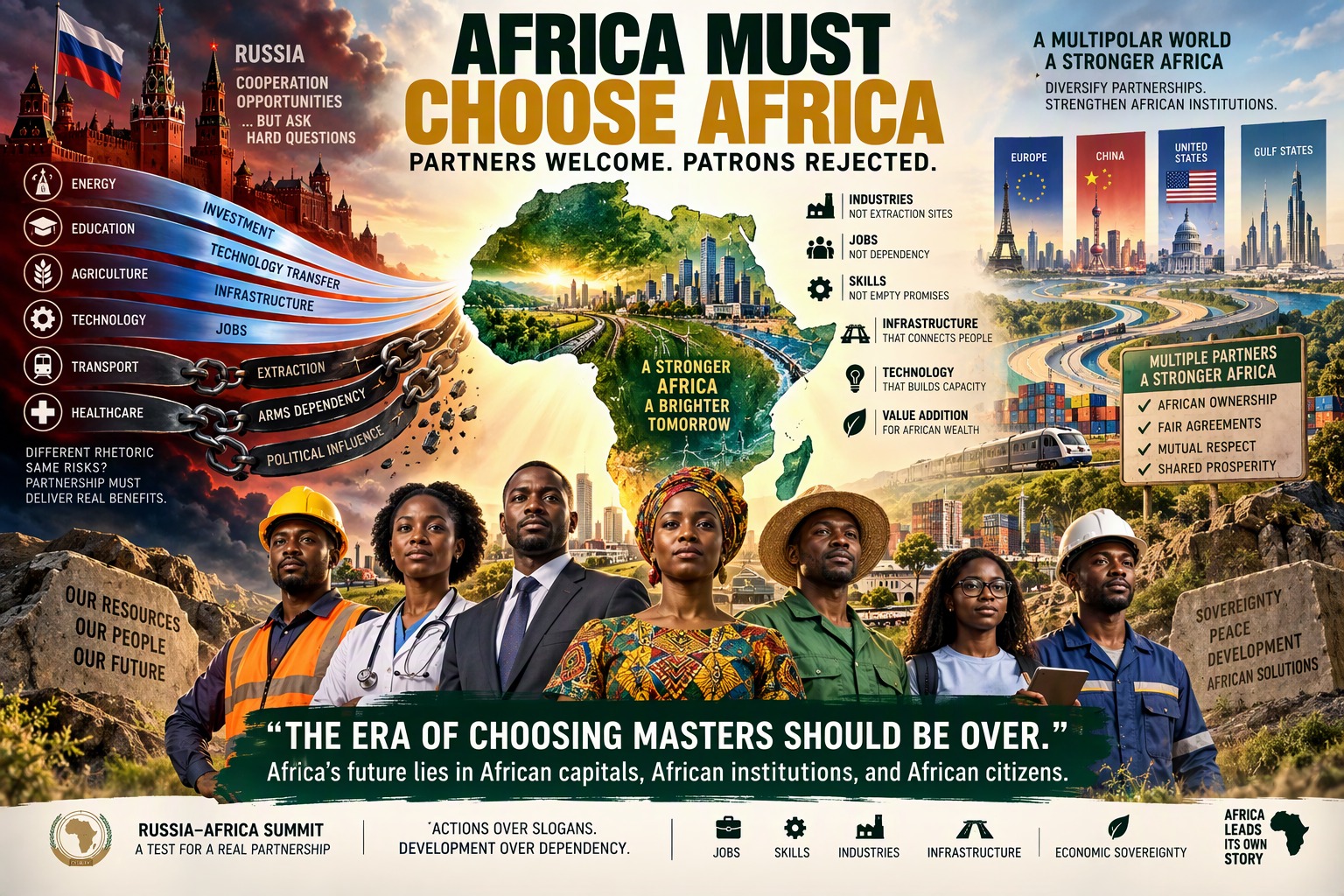
Africa’s challenge, therefore, is not choosing between Russia and the West. It is choosing Africa.
The summit repeatedly demonstrated that African leaders are increasingly aware of this reality. Calls for technology transfer, local manufacturing, value addition, educational exchanges, industrial development, and infrastructure investment reflect a continent determined to move beyond dependency. African governments are seeking partnerships that create factories rather than extraction sites, research centers rather than military outposts, and jobs rather than dependency.
Russia can play a constructive role in that future. Its expertise in energy, science, education, and technology can contribute to African development. However, Moscow should be judged not by its anti-Western rhetoric but by its willingness to enable African self-reliance. If Russian engagement merely expands commodity extraction, arms sales, and political influence while leaving African economies structurally dependent, then it will differ little from the models it claims to oppose.
The central message emerging from Moscow is therefore not that Africa should embrace Russia uncritically. Rather, it is that Africa should engage Russia confidently, pragmatically, and cautiously. African leaders must ask hard questions about every agreement signed, every investment announced, and every military partnership proposed. They must measure success not by diplomatic symbolism but by whether ordinary Africans gain jobs, skills, industries, infrastructure, and greater economic sovereignty.
The era of choosing masters should be over. Africa’s future lies neither in Moscow, Paris, Washington, nor Beijing. It lies in African capitals, African institutions, and African citizens. The continent must welcome partners, but reject patrons. Russia, like every external power, should earn its place through actions, not slogans.
Amajama, a social and policy analyst, writes from Abuja and can be reached via amajamaip@gmail.com