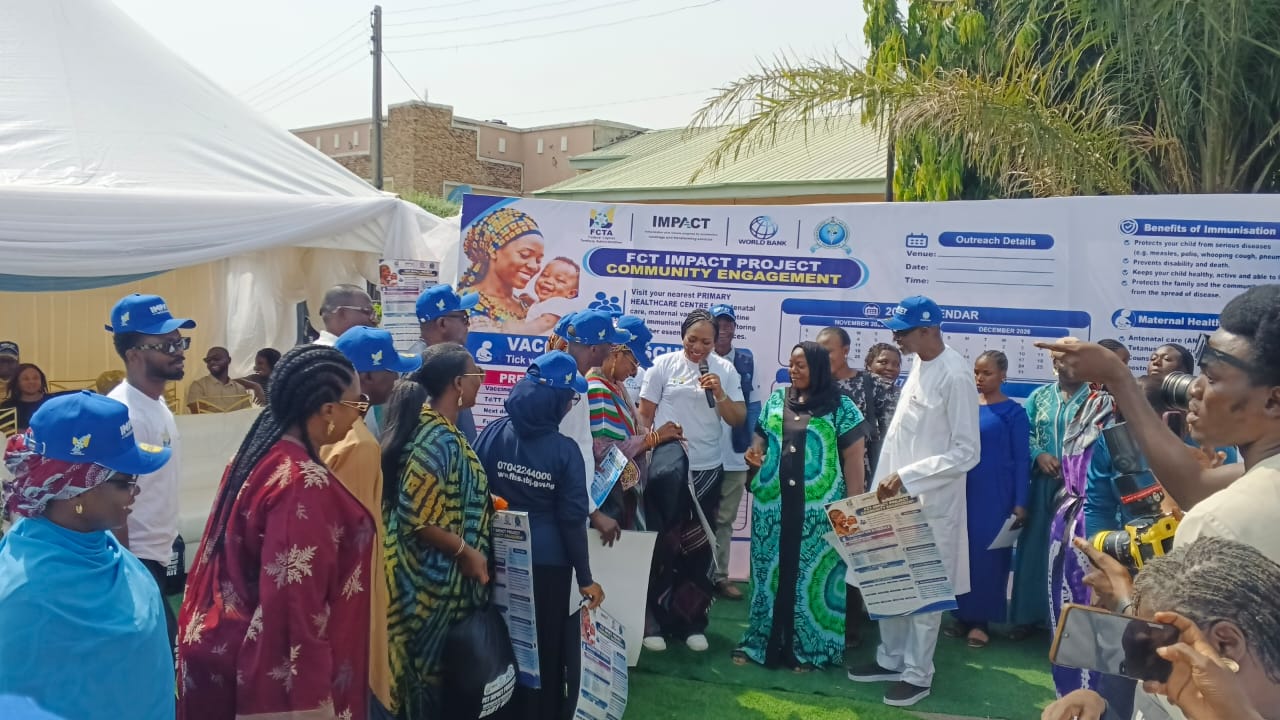
The Federal Capital Territory Administration says it has upgraded and equipped 20 Primary Health Centres, PHCs, across the six area councils of the territory, as part of efforts at providing 24-hour healthcare delivery and curbing maternal and child mortality.
This is coming as the administration enrolled at least 1,000 vulnerable residents free of charge on the spot into the FCT Health Insurance Scheme, granting pregnant women one-year free medical care and free caesarean sections, as well as 12 months of free healthcare for their newborns.
Mandate Secretary, FCT Health Services and Environment Secretariat, Dr Adedolapo Fasawe, who disclosed this during a community engagement and inauguration of the renovated Model PHC at Owner-Occupier Kubwa, on Monday, said the intervention was executed under the World Bank-supported Immunisation Plus and Malaria Progress by Accelerating Coverage and Transforming Services, IMPACT, project.
Dr Fasawe, who noted that the administration was directly tackling the three major drivers of maternal deaths, including delays in seeking care, lack of access to facilities and inability to afford treatment, said the upgraded facilities were fitted with staff quarters, modern hospital equipment and solar-powered electricity systems to ensure round-the-clock operations.
“The PHC is usually the first port of call for most residents. This is fundamental to improving health outcomes, reducing preventable deaths, and achieving universal health coverage.
“This is just one of 20 primary healthcare centres across different communities in the FCT that were upgraded under the IMPACT project,” Fasawe said.
The Mandate Secretary, who also commended the FCY Minister, Nyesom Wike, for massive road construction and rehabilitation across satellite towns and rural communities, said the improved road networks has slashed ambulance travel time from the city centre to Kubwa General Hospital from one hour to 20 minutes.
She further disclosed that the administration had unveiled a community emergency transport scheme in collaboration with the National Union of Road Transport Workers, NURTW, and commercial operators, where registered drivers earn N10,000 per drop for conveying women in labour to health facilities alongside a toll-free 112 emergency ambulance line.
On affordability, she explained that the free insurance coverage under the Basic Healthcare Provision Fund grants beneficiaries access to accredited public and private hospitals, including Nizamiye and Saad hospitals, noting that immunisation coverage across the territory had also risen from 41 to 46 percent.
Warning community leaders and residents against any form of extortion at the renovated facilities, Dr Fasawe said, “Healthcare should not be a luxury reserved for a few. Quality healthcare is your fundamental human right.”
Speaking earlier, Executive Secretary of the FCT Primary Health Care Board, Dr Dan Gadzama, revealed that although the FCT was initially excluded from the immunisation track of the IMPACT project when it commenced in 2021, Dr Fasawe’s persistent advocacy led to the signing of a Subsidiary Loan Agreement with the World Bank in February 2025, initial disbursements in September 2025, and a one-year extension of the project closure date to December 2026.
He said, “That trajectory shifted, however, due to Fasawe’s intervention, who pushed aggressively for the FCT’s inclusion despite initial scepticism that it was too late. She followed up and engaged with the World Bank, and in February 2025, the FCT signed its Subsidiary Loan Agreement, SLA, with the bank.
“Following subsequent disbursements in September and intense advocacy highlighting the capital’s unique status, the project timeline was extended by one year, setting the new closure date for December 2026.
“We also procured and distributed ‘Mama Kits’—essential delivery commodities provided to eliminate financial barriers that typically deter pregnant women from visiting hospitals.
“In addition, we established active collaboration with community leaders, primary healthcare principals, and security agencies to ensure uninterrupted service delivery in security-challenged areas.”
According to him, the 20 facilities were selected through data-driven gap analysis, backed by the procurement of over 70 laptops and tablets to streamline digital health reporting and the specialised training of more than 250 healthcare workers.
Also speaking, Senior Health Specialist and Task Team Leader for the World Bank IMPACT project, Dr Onoriode Ezire, commended the FCT Administration for outperforming states that joined the programme two years earlier in both speed and quality of execution, adding that; “Some states that started this two years ago have not completed their PHCs, and they are not even up to your standard. It shows the type of leadership we have here, the commitment, and the work being done.
“The whole essence of this is not just for photographs, but for the health of our people. Please use these facilities scattered across the territory because your health matters to us.”
On her part, Senior Special Assistant to the President on Community Engagement (North-Central), Dr Abiodun Essiet, commended the FCTA for translating federal health policies into tangible benefits, noting that since 2023, the Federal Government had expanded health insurance coverage to over 16 million Nigerians and invested over N235 billion in upgrading primary healthcare centres nationwide.
In his remarks, the Village Head of Usuma Ward, Kubwa, Chief Beje Tazodayi, lauded the FCTA for transforming the previously dilapidated clinic into a standard medical facility, while appealing for the absorption of volunteer health workers into the formal system.