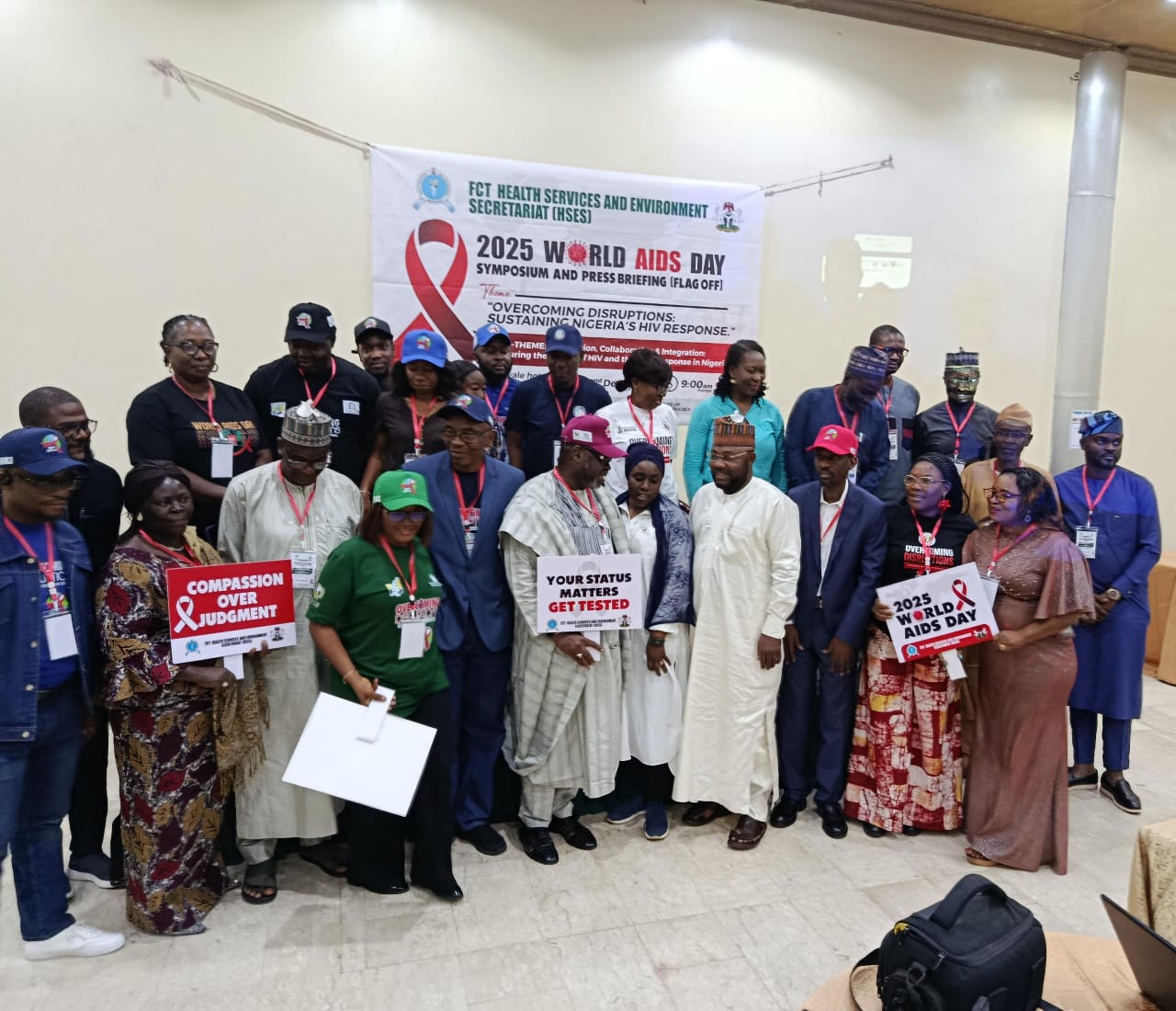
The Federal Capital Territory Administration has renewed its drive for a community-owned HIV response, shifting emphasis from donor dependence to home-grown solutions.
This position was made last week when stakeholders gathered for the 2025 World AIDS Day Symposium in Abuja.
The meeting, focused on building long-term resilience in the FCT’s HIV programming through stronger community structures, domestic financing, and deeper grassroots participation.
Mandate Secretary of the FCT Health Services and Environment Secretariat, Dr. Adedolapo Fasawe, said the future of Nigeria’s HIV response must be owned locally.
Fasawe who was represented by the Permanent Secretary, Dr. Baba-Gana Adam, noted that Nigeria has made gains in viral suppression and treatment access but warned that the era of relying solely on foreign support is gone.
According to the Mandate Secretary, “There is improved case-finding, stronger linkages to treatment, rising viral suppression and deeper integration of HIV services with tuberculosis, malaria, maternal health and primary-care programmes, and the symposium provides a vital moment for honest dialogue and renewed unity of purpose.”
She therefore stressed the need for innovative domestic funding models and broad-based community involvement to sustain progress.
Fasawe added that the FCTA remains committed to ensuring no resident is left behind, pledging wider engagement with community networks, civil society, health facilities, and development partners to consolidate gains toward ending AIDS as a public-health threat.
Meanwhile, the Acting Director of the FCT Public Health Department, Dr. Dan Gadzama, said this year’s theme, “Overcoming disruption, transforming the AIDS response,” underscores both progress and persistent threats, including shrinking donor support, competing health priorities, and new disease outbreaks.
He said the symposium aims to reinforce a territory-wide, community-driven approach integrating HIV services with TB, malaria, STIs, hepatitis, and primary health care.
He urged participants to confront longstanding gaps, ensure treatment access, fight stigma, expand prevention, and “leave no one behind,” expressing confidence that discussions will strengthen a community-led, country-owned HIV response.
In his address, the Keynote Speaker and Chairman of HIV Testing Services, Dr. Ali Onoja, honoured frontline workers and people living with HIV.
Reflecting on his 37-year experience in HIV care, from the era when test results took weeks to today’s 30-minute self-test kits, he warned that progress could stall without strong community leadership.
Regional Manager of the Institute of Human Virology Nigeria, Dr. Tangkat Hosle, also commended the FCTA for sustaining momentum in the HIV response.
Our correspondent reports that as part of ongoing World AIDS Day activities, the Public Health Department’s HIV/AIDS unit will continue community flag-offs, screening, and testing across Lugbe in AMAC and other area councils of the FCT.