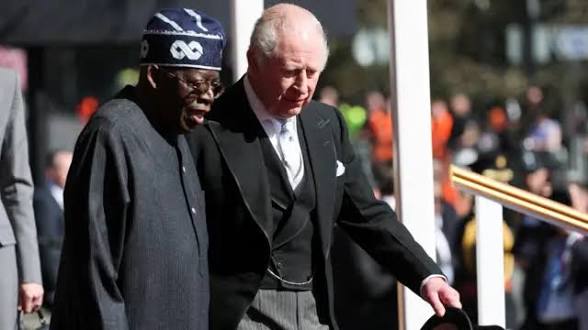
On March 17, 2026, President Bola Tinubu began a historic state visit to the United Kingdom, marked by all the grandeur of British ceremony and hospitality.
From his arrival at London Stansted Airport to the warm reception at Windsor Castle, it was a visit rich in significance, history and diplomacy.
Accompanied by First Lady Oluremi Tinubu, and top government officials, the President was hosted by King Charles III and Queen Camilla, a move that empahsised the importance of the visit.
According to the Presidential Spokesperson, Bayo Onanuga, the goal of the visit was to strengthen bilateral ties and unlock fresh investment opportunities between both nations.
But, as the president engaged global partners abroad, deadly attacks in Maiduguri left many Nigerians grieving, anxious and questioning his priorities.
Tough questions were raised; not necessarily about the value of the trip, but about his response to the unfolding tragedy back home.
Globally, in moments of national tragedy, leaders stay close to their people, because victims of disasters want more than assurances, but to feel the closeness and attentiveness of their leaders, and ensure they are fully in command of the situation.
For such people, decisions made behind the scenes in times crisis do not soothe the pain as physical presence, empathy, and connecting with them do.
While it is true that governance can be conducted remotely, perception about the priorities of a leader matters, as being physically present can send a powerful message that the pain of citizens is seen, shared, and taken seriously.
That being said, it would be unfair to judge the visit only through the lens of domestic tragedy as there is another side to the visit that speaks to Nigeria’s long-term interests.
Beyond diplomatic gains, the visit delivered tangible economic prospects with a £746 million port rehabilitation deal as a major step toward fixing some of Nigeria’s most critical trade infrastructure.
Anyone familiar with the bottlenecks at Apapa and Tin Can Island knows how urgently this intervention is needed. If implemented well, it could ease congestion, cut costs, and boost Nigeria’s competitiveness.
More broadly, the visit reinforced Nigeria’s growing economic relationship with the UK, with increased trade flows, stronger business ties, and deeper collaboration in sectors like technology, education, and finance.
Security was also high on the agenda as talks with the British Prime Minister, Keir Starmer, were expected to strengthen cooperation in intelligence sharing and counterterrorism efforts.
Given Nigeria’s ongoing battle with insurgency, especially in the North-East, such partnerships are not just useful, they are necessary.
Diplomatically, the visit signals a shift in tone as Nigeria is no longer engaging the UK from a position defined by history alone, but as a partner with influence, capacity, and global relevance.
The role of the Nigerian diaspora, thriving across healthcare, finance, technology, and the creative industries, adds another powerful layer to this relationship.
However, the real measure of success will not be the speeches or the ceremonies, but what comes next, which is ensuring that these agreements translate into better infrastructure, improved security, and real opportunities for Nigerians.
While Tinubu’s UK visit opens a door filled with promises in trade, diplomacy, and security, Nigerian leaders must realize that engaging the world must not be at the expense of prompt personal response to national emergencies.