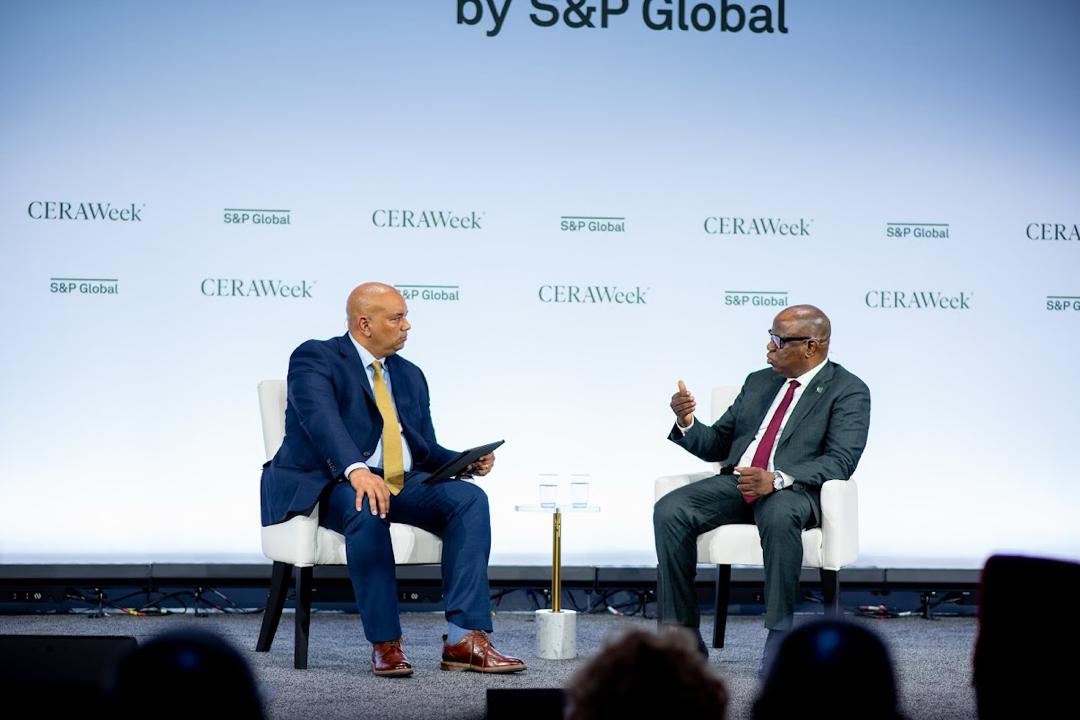
The Group Chief Executive Officer of the Nigerian National Petroleum Company Limited, NNPC Ltd, Engr Bashir Bayo Ojulari, has described Nigeria as a global destination for oil and gas investment, citing improved policy stability, stronger security, and a renewed focus on execution.
Ojulari who spoke at CERAWeek 2026 in Houston, Texas, told a global audience of energy leaders that Nigeria’s fundamentals remain strong and its value proposition increasingly compelling.
“Capital goes where value is clear, and Nigeria has that value,” he said, setting the tone for discussions on Africa’s energy future at the conference with the theme “Convergence and Competition: Energy, Technology and Geopolitics.”
Ojulari emphasised that Nigeria is positioning itself as a dependable energy supplier through deliberate reforms and strategic alignment by government.
“Nigeria is the reliable destination for energy investment the world needs. The country has positioned itself as a dependable supplier, riding on the established legacies of stable policies, improved energy infrastructure security, partnerships, and, lastly, the orientation of the government,” he said.
He added that recent policy direction has strengthened the national oil company’s operational independence.
“The President has given NNPC the autonomy to act on its behalf and consolidate commercial solutions that are long-lasting,” Ojulari noted.
At a fireside chat moderated by Dan Pratt of S&P Global, the NNPC boss outlined a pragmatic strategy that balances current hydrocarbon dependence with long-term energy transition goals.
“We are not choosing between today and tomorrow; we are funding the future with the present,” he said.
According to him, Africa’s reliance on hydrocarbons for revenue and foreign exchange makes sustained upstream investment unavoidable, while gas remains central to industrialisation and energy security.
With over 600 trillion cubic feet of proven gas reserves, Ojulari described natural gas as “not merely a transition fuel but a strategic economic lever.”
He further explained the company’s portfolio approach: “Balance is not about equal allocation; it is about optimal sequencing,” noting that oil will continue to generate value in the short term, while gas drives industrial growth and transition investments are pursued with discipline.
Ojulari also emphasised the importance of partnerships in unlocking Nigeria’s deepwater potential, highlighting the role of international oil companies such as Shell and Eni in providing capital, technology, and execution capacity.
“When the fundamentals are right, partnerships scale naturally,” he said, pointing to reforms under the Petroleum Industry Act, PIA, improved security architecture, and targeted infrastructure investments as key enablers.
On gas development, Ojulari said the focus has shifted from ambition to disciplined execution, anchored on three priorities—commercial pricing, critical infrastructure such as the AKK pipeline, and bankable contracts to assure investors.
He added that Nigeria is adopting a flexible approach to balancing domestic gas utilisation with liquefied natural gas exports, ensuring optimal national and commercial value.
The NNPC chief stressed a broader strategic pivot from resource ownership to resource monetisation, noting that unlocking Nigeria’s vast undeveloped reserves would depend on competitive fiscal frameworks and strong partnerships.
Deepwater assets, he said, remain a priority due to their scale, relative insulation from onshore challenges, and attractiveness to global investors.
Chief Corporate Communications Officer of NNPC Limited, Andy Odeh, said in a statement, that Ojulari’s intervention at the conference reflected a “clear, pragmatic and investor-focused vision” for Nigeria’s energy future.
CERAWeek, hosted by S&P Global, is one of the world’s largest energy gatherings, bringing together over 10,000 industry leaders, executives, and policymakers to examine the evolving intersections of energy, technology, and geopolitics.