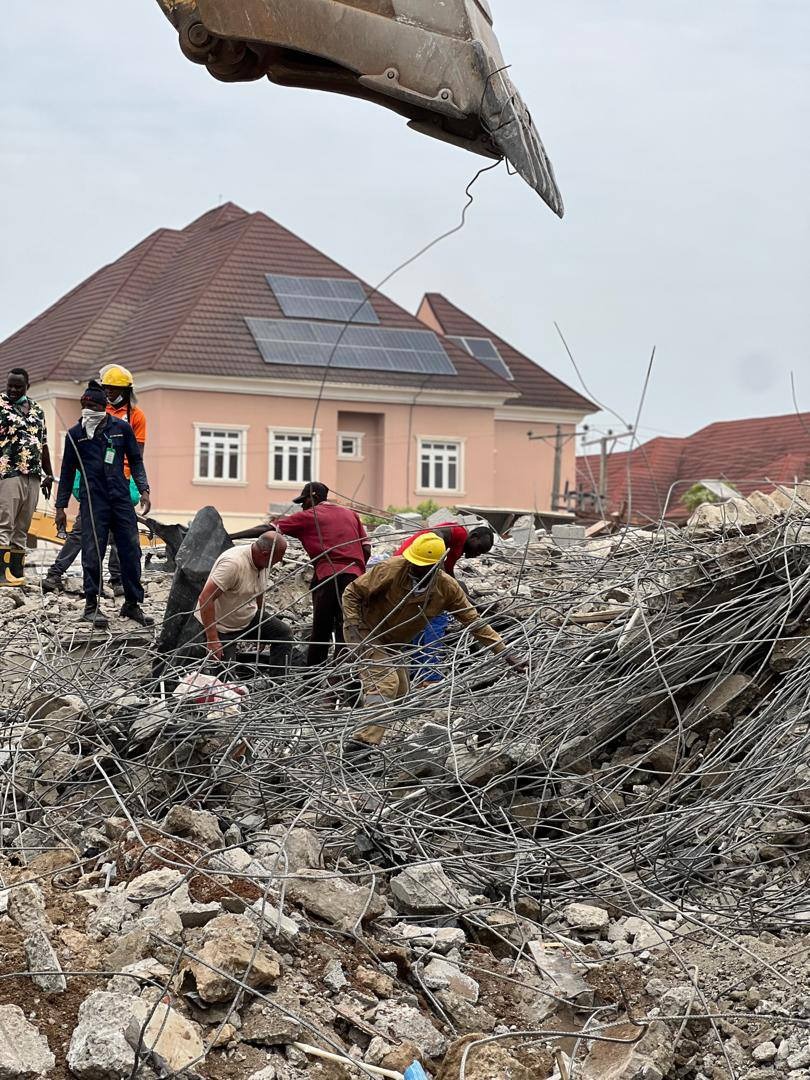
The Federal Capital Territory Administration has commenced investigations into Saturday’s building collapse in the Gudu area of Abuja, that claimed five lives and left several others injured.
FCT Minister, Nyesom Wike, who visited the site on Monday, said already, the Administration has sealed off the premises and ordered the arrest of one of the site engineers, with the developer also set to be picked up as investigations progress.
Wike, while mourning the lives lost in the unfortunate incident, described the incident as avoidable and deeply concerning.
He said, “From the report I got, we lost four persons and some lives were saved. It’s very pathetic, very pathetic. Nobody is happy when you lose somebody.”
He added that the Administration would set up a panel to ascertain the cause of the collapse, adding that he would not make further comments until the report of the investigation was ready.
“The Department of Development Control has sealed off the premises. We are going to set up a panel to really look at what happened. And one of the engineers has been arrested. From there, we’ll get to the developer, and the developer will also be arrested. So the government is taking over here,” he said.
The Minister also reiterated that building regulations must be strictly observed by developers, warning that attempts to bypass supervision compromise public safety.
“Developers should allow the government to thoroughly supervise whatever construction is going on. Nobody will want to make a policy that will hinder development. But again, we know that when you are constructing buildings of this nature, the lives of the people are very, very important. Very, very important,” he said.
He criticised what he described as persistent blackmail against regulatory officials, noting that enforcement actions are often mischaracterised as harassment.
“Sometimes when we come up to a site like this, the press has not been kind to us. Instead of them to really find out why government is taking that decision, some of these people will go to blackmail. They are blackmailing government officials. They are looking for money. They are harassing people.
“But look at these lives. How can you buy back these lives? They are gone. They are gone. That is the responsibility of government: to protect life and property.”
Giving a brief on preliminary findings, the Director of the Department of Development Control, Bashir Sanusi, said a concealed underground well likely triggered the structural failure.
He noted that a consultant commissioned to carry out an integrity test had uncovered significant subsurface weaknesses.
“We issued a consultant to carry out an integrity test on the structure. It’s called Messers Emeko. And the results indicated that this soil is made up from dredged waterways over the years. And there is a local well that is here filled up with debris and clay, which was not visible to the developer. And it was not even known to the developer.”
Sanusi explained that two columns were placed directly on the concealed pit, compromising the stability of the structure.
“Column C and D were placed on the pit and the length of the column was 1.5, the depth of the well was two meters, so that shortage created the collapse,” he said.
He added that earlier soil tests and approvals had shown no indication of danger, noting that the nature of the underground defect made it undetectable through routine checks.
“Before approval too there must be soil test. This whole test did not give us any variation and they don’t give us any negative tendencies, so my guys were here and supervising up to this level. If we say the cause is as a result of a local well that was backfilled with debris and clay, the volume control will not know that.”
Further investigation is expected to review the structural designs, soil test documents and supervision records to determine full responsibility for the collapse.