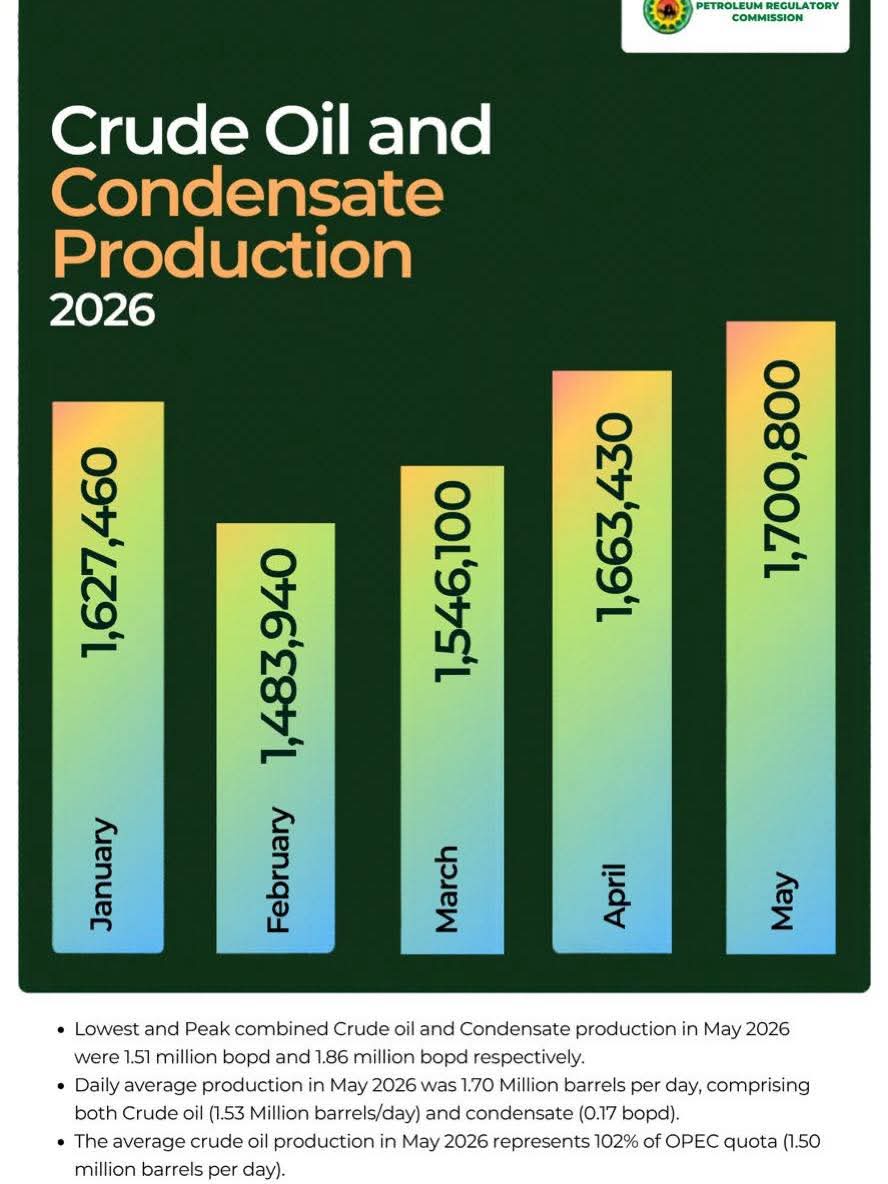
Nigeria’s crude oil production rose above its Organisation of the Petroleum Exporting Countries, OPEC, quota in May 2026, reaching its highest level in 15 months and reinforcing the country’s status as Africa’s leading oil producer.
The latest production data showed that Nigeria produced an average of 1,530,354 barrels of crude oil per day during the month, alongside 170,446 barrels of condensates daily, bringing total hydrocarbon output to 1.7 million barrels per day.
According to a statement by the Head of Media and Corporate Communications at the Nigerian Upstream Petroleum Regulatory Commission, NUPRC, Eniola Akinkuotu, the crude oil output achieved in May represented 102 per cent of Nigeria’s OPEC production allocation of 1.5 million barrels per day.
The figures also marked the highest combined crude oil and condensate production recorded since July 2025, when output stood at 1.71 million barrels per day. In crude oil terms alone, the 1.53 million barrels produced in May was the highest since January 2025, making it a 15-month production peak.
The report further indicated that production levels remained strong throughout the month, fluctuating between a low of 1.51 million barrels per day and a high of 1.86 million barrels per day.
Compared with April 2026, when crude oil production averaged 1.48 million barrels per day, the May figures reflected a 2.77 per cent month-on-month increase.
The upward trajectory has been sustained over the past several months. Total crude oil and condensate production increased from 1.48 million barrels per day in February to 1.54 million barrels in March, rose further to 1.66 million barrels in April and reached 1.7 million barrels in May.
Among Nigeria’s major crude oil streams, Bonny Terminal recorded the highest output at 293,870 barrels per day, followed closely by Forcados Terminal with 289,900 barrels per day. Qua Iboe contributed 173,360 barrels per day, while Escravos Oil Terminal accounted for 135,470 barrels per day.
Odudu, Amenam Blend, rounded out the top five producing streams, delivering 63,250 barrels per day during the reporting period.
The Nigerian Upstream Petroleum Regulatory Commission, NUPRC, attributed the improved production performance to stable operations across the industry, noting that no major pipeline disruptions or facility shutdowns were recorded during the month.
The commission also cited the successful completion of previously scheduled turnaround maintenance programmes as a key factor behind the enhanced operational efficiency and increased production levels.
The latest output figures are expected to boost government revenues and strengthen confidence in ongoing efforts to grow Nigeria’s oil production capacity while maintaining operational stability across the upstream sector.