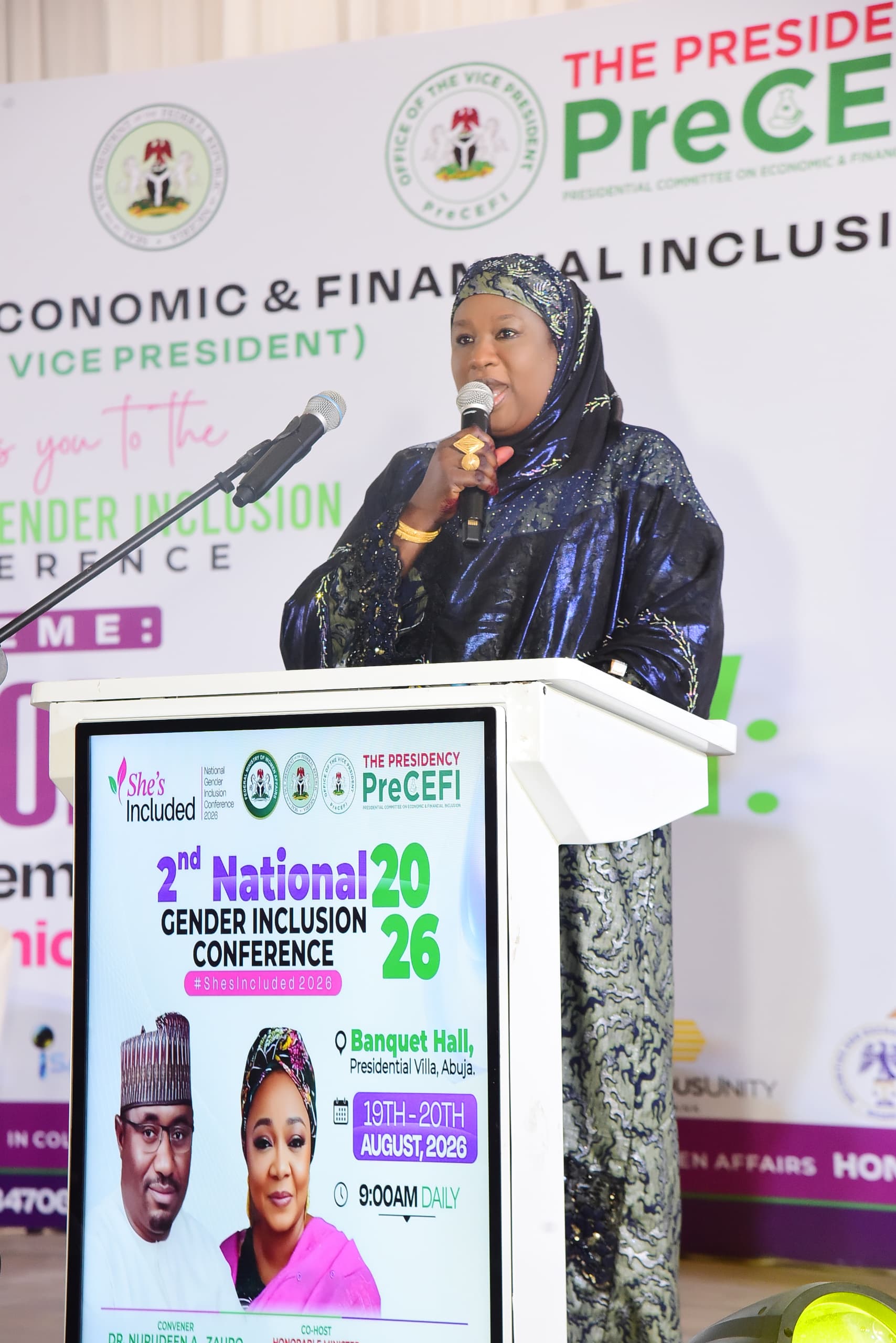
Women’s economic empowerment should be treated as a strategy for Nigeria’s economic transformation rather than charity, Minister of State for the Federal Capital Territory, Mariya Mahmoud, has said.
Mahmoud made the call on Wednesday while delivering a goodwill message at the Second National Gender Inclusion Conference held at the Banquet Hall of the Presidential Villa, Abuja.
She said women remained critical contributors to national development as entrepreneurs, farmers, professionals, innovators, employers and community leaders, despite continuing barriers to finance, markets, land, technology, skills and decision-making.
According to her, meaningful economic empowerment requires sustained access to affordable finance, digital financial services, business development support, insurance and markets, rather than being treated merely as a social intervention.
Mahmoud also called for stronger institutions, gender-responsive budgeting, reliable data and effective monitoring and evaluation in efforts to improve women’s participation in the economy.
She stressed the need for women to be involved in decisions affecting them, saying, “nothing about women should be designed without women.”
The minister said infrastructure and public services also had a direct impact on women’s economic opportunities, citing roads, transportation, markets, water, healthcare, electricity and safe public spaces as areas requiring sustained investment.
She highlighted the FCT Administration’s commitment to inclusive development through skills acquisition, entrepreneurship, social investment, community development and infrastructure.
Mahmoud urged the private sector, financial institutions, development partners, civil society organisations and community leaders to play stronger roles in removing barriers to women’s participation in the economy.
She also challenged stakeholders to move beyond policy resolutions and assess the impact of gender inclusion programmes by the amount of financing reaching women, the efficiency of institutions, the reach of programmes in underserved communities and the actual economic outcomes achieved.
The minister commended the Office of the Technical Adviser to the President on Economic and Financial Inclusion and the Federal Ministry of Women Affairs for bringing stakeholders together to develop practical solutions for translating gender inclusion policies into measurable economic outcomes for Nigerian women.
She expressed confidence that sustained collaboration and deliberate investment in women would strengthen families, communities and the Nigerian economy.