The Federal Government is planning a major overhaul of Nigeria’s tertiary education system, targeting 80 per cent practical training and 20 per cent theoretical instruction.
The move is aimed at tackling graduate unemployment and closing the skills gap between universities and industry.
Minister of Education, Dr Tunji Alausa, said under the proposed model, tertiary institutions are expected to place greater emphasis on hands-on training and job-ready competencies.
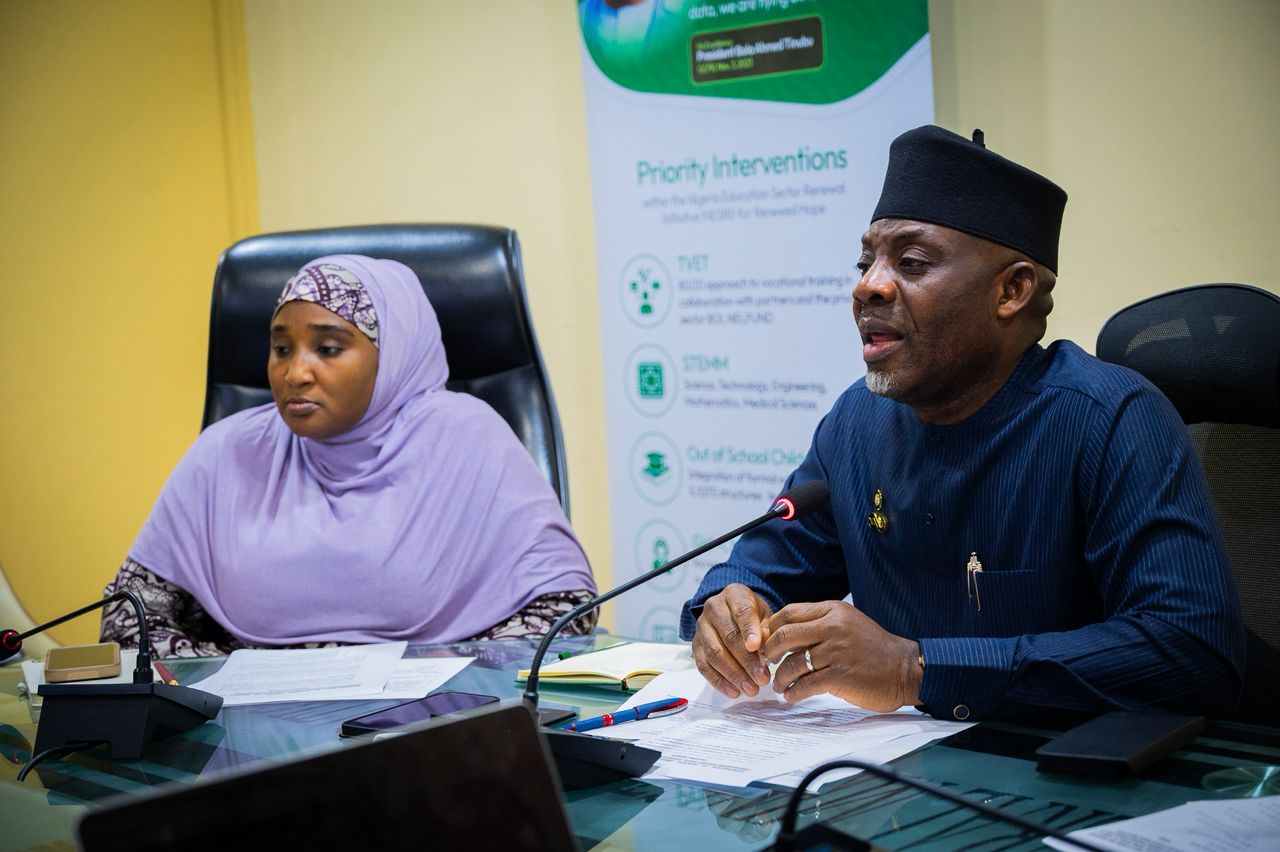
Alausa disclosed this at the 2nd Town Hall Meeting of the Board of Trustees of the Tertiary Education Trust Fund, TETFund, in Abuja on Thursday.
Represented by the Minister of State for Education, Prof. Suwaiba Said Ahmed, the minister said the new policy moves away from the traditional system in which theory accounts for about 70 per cent of learning and practical work 30 per cent.
According to him, the reform was designed to equip students with the practical skills required by employers and prepare graduates to contribute more effectively to industrial development and economic growth.
He said the initiative formed part of the Federal Government’s human capital development agenda under the Renewed Hope Agenda, with education, technology, health and social inclusion identified as key priorities.
He said the ongoing curriculum review has produced new and revised curricula, alongside national occupational standards, to make education and training more responsive to labour market demands.
He called for stronger collaboration between tertiary institutions and industry, improved research capacity, sustainable education financing and greater private-sector investment in innovation.
Also speaking, the Chairman of TETFund’s Board of Trustees, Aminu Bello Masari, challenged beneficiary institutions to justify the Federal Government’s N1.6 trillion investment in tertiary education through measurable improvements in teaching, research, skills acquisition and graduate employability.
Masari said the substantial increase in funding placed a greater responsibility on the Fund and beneficiary institutions to deliver results that would translate into national development.
He said TETFund’s budget increased from N320.3 billion in 2023 to N683.4 billion in 2024 before reaching N1.6 trillion in 2025, representing approximately five times the 2023 allocation.
“The substantial increase in TETFund funding under President Bola Ahmed Tinubu is a clear expression of the administration’s commitment. It places an equally substantial responsibility on the Fund and beneficiary institutions to deliver measurable improvements,” Masari said.
According to him, the resources are supporting infrastructure development, academic programmes, research capacity and improvements in the learning environment, but their ultimate value must be reflected in the quality of graduates and their contributions to society.
He stressed that increased funding alone could not resolve every challenge facing tertiary education, noting that institutional leadership, prudent management, transparency and proper maintenance of facilities were equally essential.
“We must account for these investments through quality projects, effective teaching, useful research and graduates equipped for productive lives,” he said.
On research, Masari said approximately N6.09 billion had been approved in 2026 for 174 successful proposals under the National Research Fund’s 2025 grant cycle.
On his part, the Executive Secretary of TETFund, Arc Sonny Echono, said the Fund was making significant progress in infrastructure development and the provision of digital learning resources.
Echono also highlighted the provision of electric buses to tertiary institutions, disclosing that 88 institutions had benefited from the special transportation initiative, with plans to extend the programme to more schools.
He said the Fund was also working to align skills development with national manpower requirements by collaborating with relevant government agencies to identify priority areas of need.
The TETFund boss expressed the fund’s commitment towards ensuring that its interventions continued to improve the quality of education and equip students with the competencies required for employment and economic growth.
In his remarks, Katsina State Governor Dikko Umar Radda commended TETFund for its support for tertiary institutions across the country, particularly the development of educational infrastructure.
Radda commended the Fund’s assistance to institutions in Katsina State and expressed appreciation for the support provided to the state’s newly established university and its teaching hospital.