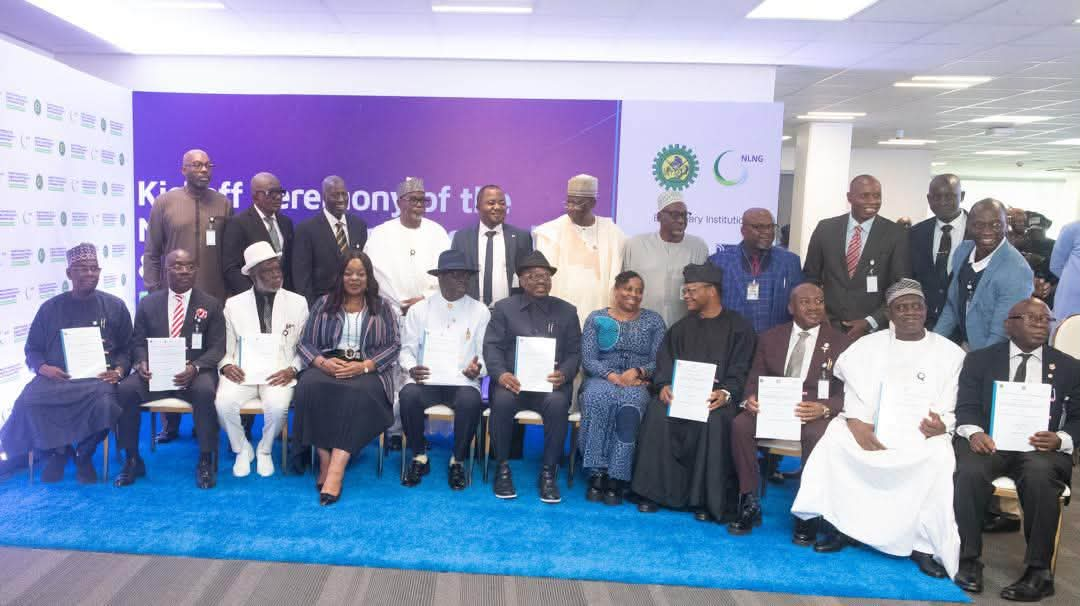
The Nigerian Content Development and Monitoring Board, NCDMB and Nigeria LNG Limited, NLNG, have committed US$9 million to establish professorial research chairs in six Nigerian universities, in a move aimed at developing home-grown technological solutions to challenges in the oil and gas industry.
Under the Nigerian Content Research and Development, NC-R&D Professorial Chair Endowment Progra e, each beneficiary university will receive US$1.5 million to establish a specialised research chair focused on specific industry priorities.
The initiative, implemented in partnership with the NCDMB under the supervision of its Planning, Research and Statistics Directorate, is designed to bridge the gap between academic research and industrial application, strengthen local research capacity and promote the commercialisation of indigenous innovations.
The beneficiary institutions are the University of Ibadan, Rivers State University, Modibbo Adama University, Aliko Dangote University of Science and Technology, Kano, University of Nigeria, Nsukka, and Yakubu Gowon University, formerly the University of Abuja.
Speaking at the programme’s kick-off ceremony, NLNG’s Managing Director and Chief Executive Officer, Adeleye Falade, described the endowment as a strategic investment in Nigeria’s ability to translate academic knowledge into practical solutions.
In his keynote address, titled Reshaping Nigeria’s Future Through Innovation, Research and Capacity Development, Falade stressed the need for sustained collaboration among government, industry and academic institutions to address emerging technological challenges.
“In the energy industry, we understand that technology and energy systems are evolving and the requirement for sustained research cannot be overemphasised,” he said.
He explained that the research programme would address critical issues in the energy sector, including operational efficiency, emissions management, safety, infrastructure integrity and the sustainability of industrial processes.
Falade also advocated a “triple helix” model of collaboration involving government, industry and academia, through specialised training programmes, academic exchanges, sabbaticals, practical testing of research findings and joint development of postgraduate curricula.
He disclosed that the NLNG Research and Innovation Centre for Computer and Electrical Engineering .RICCEE, at Rivers State University was envisaged as a coordinating hub for collaboration among the six universities.
According to him, discussions were already underway with the university on implementation arrangements, while he commended its Vice-Chancellor, Professor Isaac Zeb-Obipi, for supporting the proposed partnership.
Falade further revealed that prospective partners, including Google, Cisco and MTN, had indicated interest in supporting the initiative.
He urged the beneficiary universities to leverage the endowment to attract additional research funding, strengthen institutional partnerships and create pathways for commercialising intellectual property.
“Expand the scope, reach for more grants and funding which can push the frontiers of knowledge and commercialisation of intellectual property,” he said.
The NLNG chief executive emphasised that the ultimate success of the programme would be measured not merely by academic publications but by research outcomes deployed in industry, stronger institutions and the development of a new generation of Nigerian researchers and professionals.
In his remarks, the Executive Secretary of NCDMB, Engr. Felix Omatsola Ogbe, described the US$9 million endowment as a strategic investment in the country’s research and innovation ecosystem.
Represented by his Senior Technical Adviser, Engr. Austin Uzoka, Ogbe said the initiative complemented the Board’s existing investments in research infrastructure, including the establishment of specialised Research and Development Centres of Excellence in six universities.
He said the interventions demonstrated the oil and gas industry’s commitment to building an integrated research ecosystem connecting academic expertise, modern infrastructure, industry requirements and commercialisation opportunities.
Ogbe urged the universities to move beyond research driven primarily by academic publications to research capable of addressing practical industrial challenges and accelerating technological transformation.
He said the beneficiary institutions would be expected to deliver clearly defined research objectives, measurable outcomes, prudent resource utilisation, effective stakeholder engagement and sustained collaboration with industry partners.
“These professorial chairs will generate commercially viable solutions, strengthen local technological capabilities, support industrial competitiveness, and contribute meaningfully to the long-term sustainability of Nigeria’s oil and gas industry,” he said.
Under the programme, the University of Ibadan will focus on natural gas processing, pollution control and environmental management, while Rivers State University will concentrate on digital engineering, intelligent energy systems, automation and asset integrity.
Modibbo Adama University will undertake research in energy transition and the environment, while Aliko Dangote University of Science and Technology will focus on sustainable energy innovation and climate-resilient food systems.
The University of Nigeria, Nsukka, will specialise in green energy production and geoenvironmental engineering, while Yakubu Gowon University will conduct research in geoscience and satellite intelligence for resilient gas infrastructure.
Each institution will operate within agreed research targets and commercialisation pathways, with a joint information management hub established to facilitate knowledge sharing and academic exchanges.
The funding also provides for minor civil works and infrastructure upgrades to convert designated university spaces into functional research centres.
The programme will further create opportunities for industry professionals to contribute practical expertise while pursuing postgraduate qualifications, including master’s and doctoral degrees, thereby strengthening the relationship between academic training and industrial problem-solving.
NLNG said the initiative aligned with its recently approved NextGen Nigerian Content Strategy, which seeks to sustain previous achievements, deepen the integration of Nigerian Content Development into its business operations and accelerate the growth of local capacity.
The company reaffirmed its commitment to supporting indigenous expertise and developing sustainable solutions that can strengthen Nigeria’s industrial competitiveness.
The initiative is anchored on the principle: “Start Local, Go Global, Think Nigerian Content.”