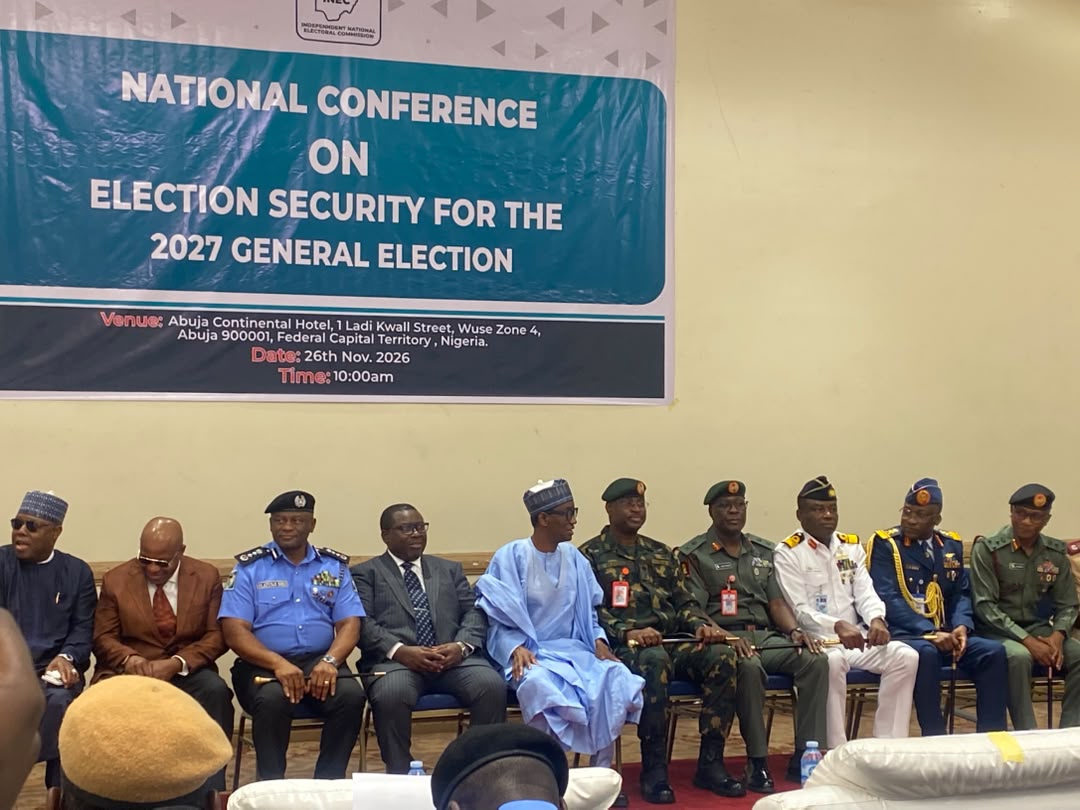
Ahead of 2027 general elections, the Independent National Electoral Commission, INEC, and the Office of the National Security Adviser, ONSA, have vowed to strengthen the fight against electoral violence, warning political parties and their sponsors that attacks on electoral officials and political opponents will attract severe consequences.
INEC Chairman, Prof. Joash Amupitan, SAN, and the National Security Adviser, Mallam Nuhu Ribadu, made the commitment on Thursday in Abuja at the Strategic Election Security Conference jointly organised by INEC and ONSA to strengthen security coordination and address emerging threats ahead of the elections.
Amupitan warned that the commission would no longer tolerate political thuggery, intimidation and attacks on its personnel, stressing that political leaders would be held accountable for the conduct of their supporters and campaign organisations.
He expressed concern over increasing incidents of political intolerance and attacks on campaign convoys, party offices, supporters and town hall gatherings across several states, including Lagos, Edo, Ekiti, Enugu, Ebonyi, Delta, Cross River, Oyo and Benue.
The INEC chairman also condemned reported harassment and physical attacks against the commission’s leadership, staff and ad hoc personnel by supporters and agents of political parties.
“INEC officials are non-partisan public servants discharging a sacred constitutional mandate. When party supporters attack our personnel or seek to intimidate our leadership, they are not merely assaulting individuals—they are attempting to coerce an independent constitutional referee and subvert the democratic order,” he said.
He cautioned political parties against signing peace agreements at the national level while tolerating or financing violence at the grassroots.
“Signing peace accords in Abuja while tolerating or financing thuggery in the states is a contradiction our democracy can no longer afford,” he said.
Amupitan said the Electoral Act 2026 had strengthened the legal framework for dealing with electoral offences, particularly campaign violence, intimidation and the deployment of thugs at political rallies.
He cited Sections 96 and 97 of the Act, which prohibit inflammatory language capable of inciting violence, the deployment of thugs and the use of force to intimidate voters or political opponents.
According to him, the legislation provides for fines of up to N5 million or 12 months’ imprisonment for individuals found guilty of initial breaches, while political parties could face fines of up to N10 million.
He further disclosed that Section 148 empowers INEC’s legal officers and appointed counsel to prosecute electoral offenders, adding that the commission was prepared to pursue cases arising from recent violent incidents across the country.
The INEC Chairman urged the police and other investigative agencies to ensure that arrests were supported by credible evidence, forensic exhibits, video recordings and witness statements to facilitate successful prosecution.
On preparations for the 2027 elections, Amupitan disclosed that Nigeria had 177,299 polling units and more than 100 million verified registered voters, with over 1.41 million ad hoc personnel expected to be deployed.
He said the presidential and National Assembly elections would hold on January 16, 2027, while governorship and State Houses of Assembly elections were scheduled for February 6.
Amupitan also identified insurgency, banditry, kidnapping, separatist agitation, cultism and the growing use of artificial intelligence to spread misinformation as threats requiring urgent attention.
He warned that deepfake videos, voice cloning and fabricated election announcements could trigger panic, communal tension and violence if not promptly addressed.
To strengthen security coordination, he announced plans to decentralise the Inter-Agency Consultative Committee on Election Security, ICCES, through its ICCES Tentacles framework, extending operational coordination from the national level to states, local government areas and wards.
Under the arrangement, Resident Electoral Commissioners and Commissioners of Police are expected to work closely on threat assessments, security deployment and rapid-response mechanisms.
Amupitan stressed that the success of the 2027 elections would depend on effective collaboration between INEC and security agencies, adding that protecting voters, electoral personnel and sensitive materials was essential to safeguarding the credibility of the democratic process.
“INEC manages the ballot; security agencies secure the environment that makes the ballot possible,” he said.
He warned that failure to contain electoral violence could suppress voter turnout, discourage the deployment of electoral personnel and undermine public confidence in election outcomes, with consequences extending beyond Nigeria to the wider West African sub-region.
Also speaking, the National Security Adviser, Nuhu Ribadu, said social media and artificial intelligence-driven misinformation as a growing threat to Nigeria’s elections, pledging that security agencies will protect all voters impartially.
Ribadu said recent incidents of election-related violence underscored the need for early preparation.
“Social media is a big problem. It creates false narratives and misinformation, causing problems among people. One individual, sitting somewhere in a village, could say something that triggers trouble,” he said.
He called for a rethink of early-warning mechanisms, adding: “Our approach must be proactive.”
Ribadu said President Bola Tinubu’s administration was committed to providing the security needed for peaceful, transparent and credible elections.
Security agencies, he said, would act impartially and within the law, and “constitutional independence must be protected and respected,” especially with a professor of law heading INEC.
“We protect the voters. We protect politicians. And even after the election, we make sure there is no violence,” he said, adding that “we are beginning to mature” in conducting elections.
He cited a rise in registered voters as a sign of growing public confidence.
He urged political actors to reject violence, warning: “They are fighting for power. Sometimes they become desperate.”
Turning to the media and civil society, he called for fairness. “Do not take sides. Look at things critically and make your decisions,” he said.
Ribadu said security agencies would assess the situation daily. “Our duty is to protect all Nigerians and their democratic interests,” he said.