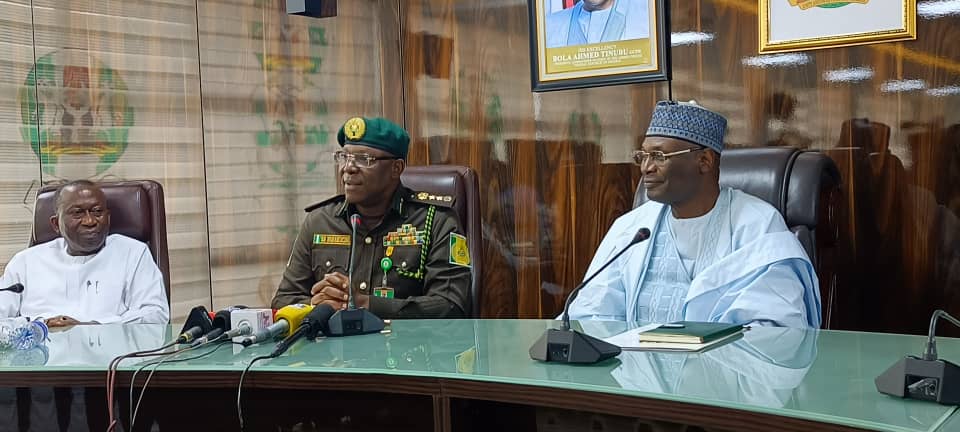
The Independent National Electoral Commission, INEC, has reaffirmed its commitment to extend voting rights to eligible inmates in Nigeria’s correctional facilities, calling for a clear legal framework to guide the process.
INEC Chairman, Prof. Mahmood Yakubu, stated this on Friday, during a courtesy visit by the Controller General of the Nigerian Correctional Service, NCoS, Sylvester Ndidi Nwakuche, in Abuja.
Yakubu acknowledged the Nigerian Correctional Service as a key member of the Inter-Agency Consultative Committee on Election Security, ICCES, noting its active collaboration with INEC and other security agencies during elections.
Speaking on the primary purpose of the visit, voting rights for inmates, the INEC boss described the right to vote as a fundamental human right, not to be denied on the basis of incarceration.
“We are aware that the right to vote is a human right which cannot be taken away from a citizen on account of time being served in a correctional facility. In many parts of the world, including Ghana, Kenya, and South Africa where our officials have observed elections, inmates exercised their right to vote,” he said.
While referencing legal precedents, Yakubu cited the judgments of the Federal High Court and the Court of Appeal in Benin City, which affirmed the right of inmates awaiting trial to vote.
According to him, the rulings held that the right to vote is voluntary and must be asserted by the individual.
The INEC Chairman recalled previous engagements with the Correctional Service to explore the logistics and legality of allowing inmates to participate in elections.
He noted that these efforts included the establishment of a joint technical committee and the provision of facility data and inmate statistics by NCoS.
“Most of the inmates are on remand or awaiting trial and may actually be registered voters,” he noted.
Yakubu, however, identified several challenges that need to be addressed before inmate voting can be actualized, which include access for INEC officials, political parties, election observers, and the media to correctional facilities for voter registration, campaigns, and election monitoring.
“These are legitimate concerns that must be handled transparently. Political parties, for instance, would want to know whether they can campaign within the facilities or appoint polling agents,” he said.
On the legal front, Yakubu called for collaboration with the National Assembly to clarify ambiguous provisions in the current law. He specifically pointed to Section 12(1)(e) of the Electoral Act 2022, which restricts registration to a citizen who “is not subject to any legal incapacity to vote.”
He noted that the provision needs clearer interpretation to address whether it covers inmates on death row, those serving life sentences, or those convicted for treason.
“Our immediate task is to engage with the National Assembly for a clear legal provision on inmate voting,” Yakubu said. “Thereafter, we can address the specific issues that may arise in the course of implementation.”
Yakubu also commended civil society organizations like the Carmelite Prisoners’ Interest Organization, CAPIO, for their persistent advocacy for the inclusion of inmates in Nigeria’s electoral process, and acknowledged the supportive stance of the National Assembly committees on electoral matters.
Earlier, the Controller General of the NCoS, Sylvester Nwakuche, had stressed the importance of restoring inmates’ democratic rights, particularly those awaiting trial.
Nwakuche lamented the inability of inmates to vote, worsening their plight as one of the most overlooked segments of Nigeria’s democratic space.
According to him, out of over 81,000 inmates currently in correctional facilities, more than 66 per cent are awaiting trial, and under Nigerian law, they are presumed innocent until proven guilty.
“Even for those convicted, some fundamental rights remain intact, including the right to vote,” he said.