By Sunny Anderson Osiebe
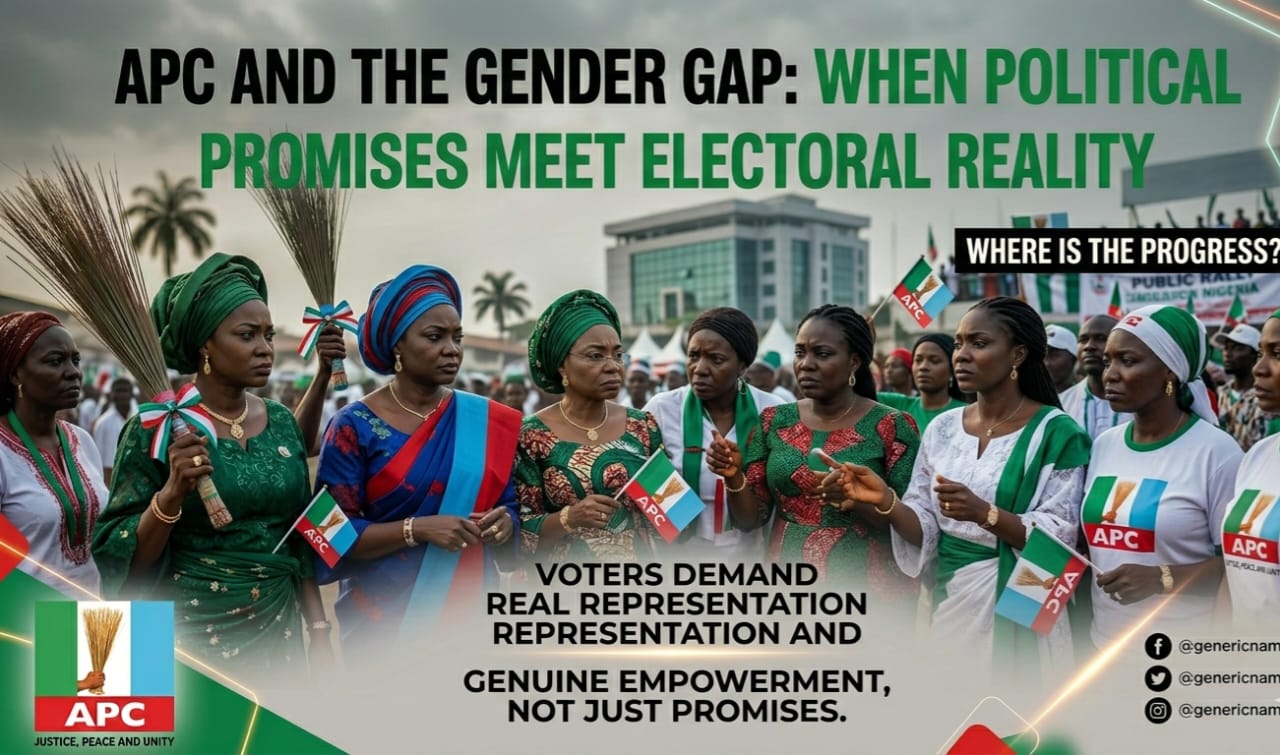
The ruling party in Nigeria, the All Progressives Congress (APC), has consistently projected itself as a champion of women inclusion in politics. Through public statements, policy documents, discounted nomination forms, and repeated references to the 35 percent affirmative action principle, the party has sought to portray itself as gender-sensitive and committed to increasing female participation in politics and governance.
However, the outcome of the party’s primaries paints a completely different picture.
The true test of any political party’s commitment to inclusion is not found in speeches, press releases, or political propaganda. It is found in the number of women who eventually emerge as candidates after the internal contest for power has been concluded.
Sadly, the APC has once again demonstrated that its commitment to women’s inclusion remains largely rhetorical rather than practical.
Recent reports show that despite the party’s repeated emphasis on affirmative action, women continue to be grossly underrepresented in the APC’s candidate selection process.
In the senatorial primaries conducted across most of the country, only a handful of women secured tickets. Out of about 99 senatorial districts where candidates have emerged so far, only a few female candidates were successful, representing a negligible percentage of the total number of tickets available.
The situation is not significantly different in the House of Representatives primaries. In Lagos State, for example, women constituted only 15.4 percent of aspirants contesting for House of Representatives tickets, already falling far below the party’s proclaimed 35 percent affirmative action target.
More disturbing was the fact that only one female aspirant emerged victorious, and even that victory became subject to controversy.
At the State House of Assembly level, the story remains largely the same. While APC officials celebrated the emergence of five female candidates out of 26 Assembly seats in Ondo State as a historic achievement, the reality is that even this represents just about 20 percent female representation, still significantly below the party’s advertised inclusion benchmark.
This raises a fundamental question: if a political party genuinely believes in women inclusion, why are women consistently excluded whenever tickets are being allocated?
The answer lies in the structural realities of Nigerian politics. Political parties often use women as mobilizers during campaigns and conventions but rarely position them at the center of power. Key decision-making structures remain overwhelmingly male-dominated, while female politicians are frequently confined to ceremonial roles and women affairs departments.
The APC’s experience during the current primaries has once again exposed the contradiction between policy and practice. While the party publicly advertises inclusion, the actual distribution of tickets tells a story of exclusion. The numbers simply do not support the narrative.
Women constitute nearly half of Nigeria’s population. They vote, campaign, organize rallies, fundraise, and mobilize support for political parties. Yet when it comes to nominations for the Senate, House of Representatives, and State Houses of Assembly, they remain significantly marginalized.
The reality is that women’s political participation in Nigeria cannot be advanced through slogans alone. It requires deliberate action, enforceable quotas, transparent nomination processes, reduced financial barriers, and genuine commitment from party leaders. Without these measures, affirmative action becomes nothing more than a political catchphrase designed for public relations.
The APC must, therefore, answer difficult questions. How can a party that repeatedly promotes women inclusion produce only a tiny fraction of female candidates? How can a party that speaks about affirmative action fail to meet its own targets? And how can women continue to trust promises of inclusion when the outcomes consistently reflect exclusion?
Until these questions are honestly addressed, many Nigerians will continue to view the APC’s women inclusion campaign as political propaganda rather than a sincere commitment to gender equity.
The figures emerging from the primaries have spoken louder than the party’s rhetoric. And they reveal an uncomfortable truth: despite all the promises, women remain largely on the margins of political representation within the APC.
Osiebe, Executive Director, HallowMace Africa, Public Policy Expert, Administrator writes from Abuja.