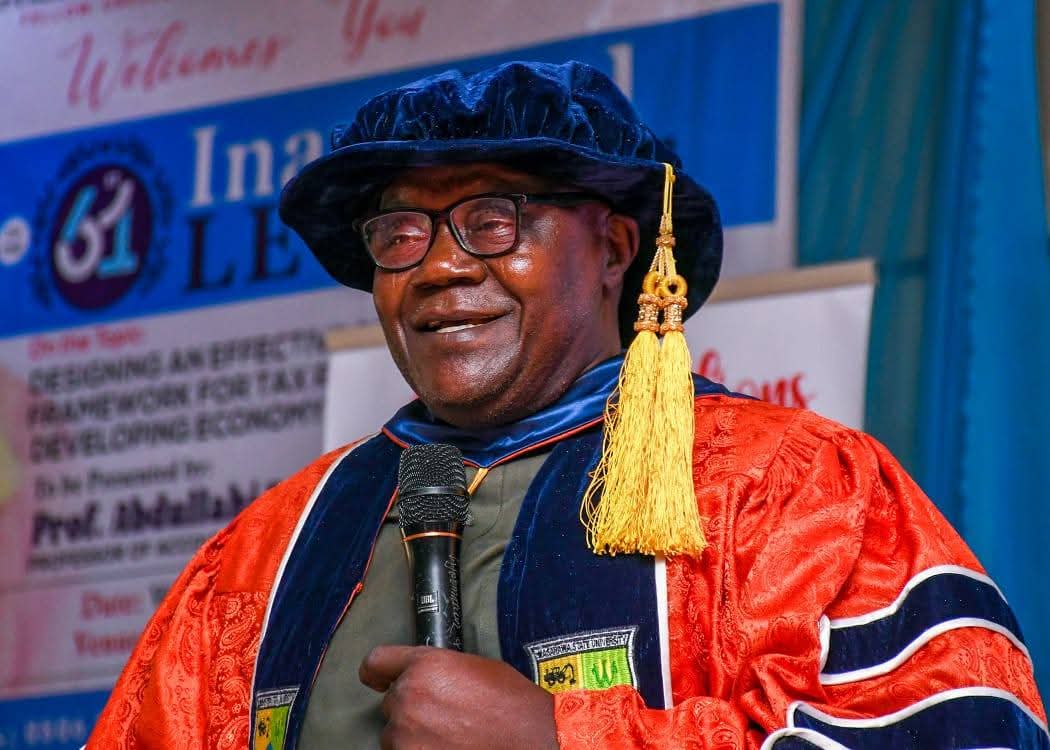
Nasarawa State University has called for the development of a more transparent, inclusive and people-oriented tax system capable of driving sustainable national development in Nigeria.
The call was made on Wednesday during the institution’s 61st Inaugural Lecture delivered by Prof Abdullahi Danjuma Zubairu at the University Assembly Hall in Keffi.
According to the university’s Information and Protocol Unit, the lecture, titled “Designing an Effective Governance Framework for Tax Reform in Nigeria’s Developing Economy,” attracted academics, traditional rulers, public officials and other dignitaries who gathered to examine the challenges and future of Nigeria’s tax administration system.
Representing the Vice-Chancellor, Sa’adatu Hassan Liman, the Deputy Vice-Chancellor, Academics, Prof Maikano Mohammed Ari, welcomed guests and commended the Inaugural Lecture Committee for organizing what he described as a successful intellectual engagement.
Ari noted that taxation goes beyond revenue generation, stressing that it remains a critical instrument for strengthening the relationship between citizens and government.
According to him, taxation serves as a mechanism through which governments and citizens negotiate the social contract sustaining critical sectors such as education, healthcare, infrastructure and national security.
He added that meaningful tax reforms can only succeed where transparency, effective data management and clear communication are given priority.
Delivering the lecture, Prof. Zubairu argued that a strong governance structure is essential for building a fair, efficient and inclusive tax system in Nigeria.
The professor identified several challenges weakening the nation’s tax ecosystem, including low taxpayer confidence arising from perceived lack of transparency, weak policy frameworks, fragmented stakeholder coordination and the difficulty of integrating Nigeria’s large informal sector into the tax system.
He further observed that many existing tax structures fail to consider the psychological and behavioural factors influencing tax compliance among citizens.
“Taxation is not merely a financial obligation; it is a visible, living contract between the state and its citizens,” Zubairu stated.
As part of recommendations for strengthening tax governance, the scholar urged universities to play more active roles in providing data-driven research, policy simulations and professional training for future tax administrators.
He also called on international development partners to support reforms tailored to Nigeria’s socio-economic realities instead of importing foreign models without local adaptation.
The don further advocated stronger collaboration among government institutions, civil society organisations, sub-national actors and the private sector to ensure sustainable tax reforms.
In separate goodwill messages, former Vice-Chancellor, Muhammad Akaro Mainoma, alongside Aliyu Tijani Ahmed and Abdulmumin Zubairu Loko, commended the university management for sustaining academic excellence and praised Prof. Zubairu’s contributions to scholarship and national development.
The event climaxed with the presentation of an Award of Excellence to Prof. Zubairu by the university management in recognition of his contributions to academic advancement and fiscal research.