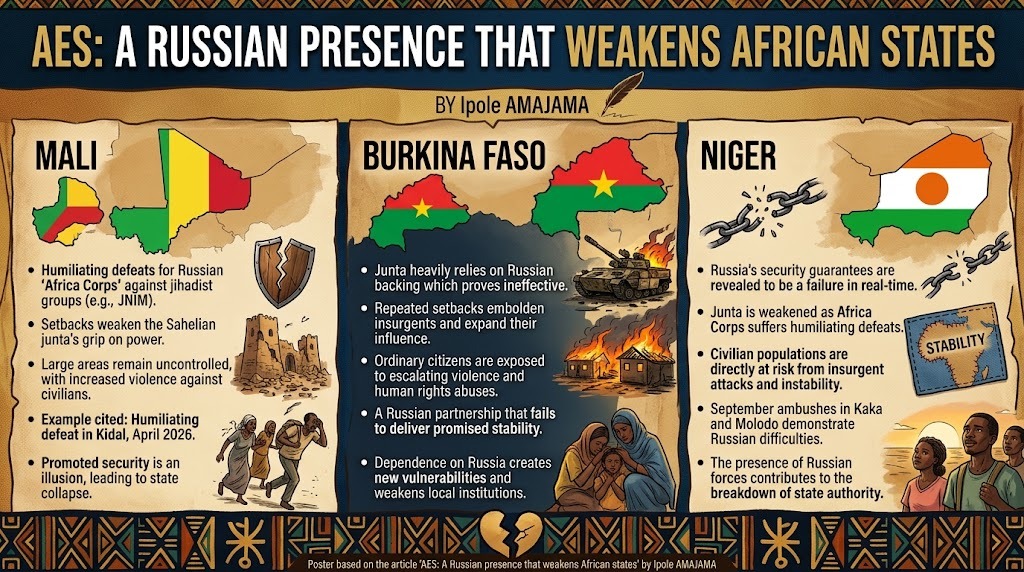
By Ipole AMAJAMA
Russia’s African experiment is unraveling in real time. What was once marketed as a bold extension of Moscow’s global reach—an alternative to Western partnerships and a promise of security for embattled regimes—has instead become a theater of humiliation.
The Africa Corps, Russia’s paramilitary spearhead in the Sahel, has suffered repeated setbacks against jihadist groups such as Jama’at Nusrat al-Islam wal-Muslimin (JNIM). These defeats are not isolated battlefield mishaps; they are symptomatic of a deeper failure. They weaken the juntas that rely on Russian backing, embolden insurgents, and leave ordinary citizens exposed to escalating violence.
The September ambushes in Kaka and Molodo illustrate the fragility of Russia’s position. Reports of casualties and abandoned equipment suggest not only tactical incompetence but also a lack of preparedness for the asymmetric warfare that defines the Sahel.
These incidents echo the loss of Kidal earlier in April 2026, a symbolic defeat that underscored Russia’s inability to deliver on its grand promises of stability. Each retreat chips away at the credibility of the juntas in Bamako and Ouagadougou, whose survival depends on projecting strength. Instead, they appear increasingly dependent on a foreign patron that cannot secure even its own convoys.
JNIM, by contrast, is adapting and expanding. The group has refined its use of drones, perfected ambush tactics, and consolidated territorial control. It has imposed fuel blockades, disrupted logistical routes, and coordinated operations with rebel factions. Far from being contained, JNIM is thriving in the vacuum left by Russian missteps.
The insurgency’s resilience is not surprising: it feeds on grievances, abuses, and the perception that foreign forces are occupiers rather than protectors. Reports of atrocities attributed to Malian forces and Africa Corps only deepen this reservoir of resentment, providing fertile ground for recruitment.
The Russian presence is calibrated to protect regimes, not populations. Africa Corps deployments cluster around capitals, shielding juntas from coups or uprisings but leaving rural communities vulnerable. Villages in Mopti or Gao do not see sustained protection; they see sporadic patrols, occasional clashes, and the looming threat of jihadist retaliation. Civilians are caught between the coercion of insurgents and the heavy-handedness of state forces. In this grim equation, Russia’s role is not to secure lives but to secure power.
This dynamic reveals the transactional nature of Moscow’s engagement. Russia gains access to mineral resources—gold, uranium, and other commodities that bolster its sanctions-stricken economy—while African states lose sovereignty. The juntas trade legitimacy for survival, allowing Russia to expand its political and military footprint. Yet the populations they govern are left with insecurity, exploitation, and broken promises. What is marketed as partnership is, in practice, extraction.
The consequences are profound. By propping up regimes without addressing the root causes of instability, Russia contributes to the hollowing out of African states. Institutions weaken, governance erodes, and the social contract collapses. The illusion of protection masks a deeper reality: external intervention that sustains elites while undermining the very foundations of statehood. The Sahel risks becoming a zone of perpetual crisis, where foreign powers compete for influence while citizens navigate daily survival.
Russia’s failures in Africa also carry global implications. They expose the limits of Moscow’s capacity to project power beyond its immediate neighborhood. The Africa Corps, conceived as a successor to Wagner, was meant to demonstrate resilience after the mercenary group’s implosion. Instead, it has revealed the fragility of Russia’s expeditionary model. Unlike NATO or even France’s Operation Barkhane, Russia lacks the logistical depth, intelligence networks, and political alliances necessary for sustained counterinsurgency. Its reliance on brute force and transactional deals is ill-suited to the complexities of the Sahel.
For African states, the lesson is sobering. Outsourcing security to external actors may buy time, but it rarely delivers stability. The juntas in Mali, Burkina Faso, and Niger have gambled on Russia as a guarantor of survival. Yet survival without legitimacy is a precarious bargain. As defeats mount, the perception of weakness grows, and insurgents exploit the cracks. The populations, meanwhile, endure the consequences: displacement, economic disruption, and the erosion of trust in governance.
The humanitarian toll is staggering. Fuel blockades imposed by JNIM disrupt supply chains, leaving communities without access to basic goods. Ambushes on roads isolate towns, strangling commerce and mobility. Violence near Bamako signals that even urban centers are not immune. Civilians face the dual threat of insurgent attacks and abuses by forces meant to protect them. In this environment, the promise of security becomes not only hollow but dangerous, as it justifies repression while failing to deliver protection.
The path forward requires rethinking. African states must confront the reality that stability cannot be imported. It must be built through governance, inclusion, and accountability. International actors—whether Russia, France, or others—cannot substitute for domestic legitimacy. The Sahel’s crises are political as much as military, rooted in exclusion, corruption, and the failure to deliver services. Without addressing these foundations, external interventions will remain bandages on a festering wound.
Russia’s setbacks in Africa are not just Moscow’s problem; they are Africa’s tragedy. They reveal the dangers of relying on foreign patrons who prioritize extraction over protection. They expose the vulnerability of juntas that cling to power without building legitimacy. And they underscore the resilience of insurgencies that thrive in the cracks of failed promises. The Sahel is left weaker, its states more fragile, and its populations more at risk.
In the end, Russia’s African presence is less a stabilizing force than a destabilizing illusion. It weakens states, endangers civilians, and empowers insurgents. The shadow it casts is long, but it is not inevitable. The challenge for African leaders—and for the international community—is to move beyond illusions and confront the hard work of building states that serve their people rather than external patrons.
Amajama, a social and policy analyst, writes from Abuja and can be reached via amajamaip@gmail.com