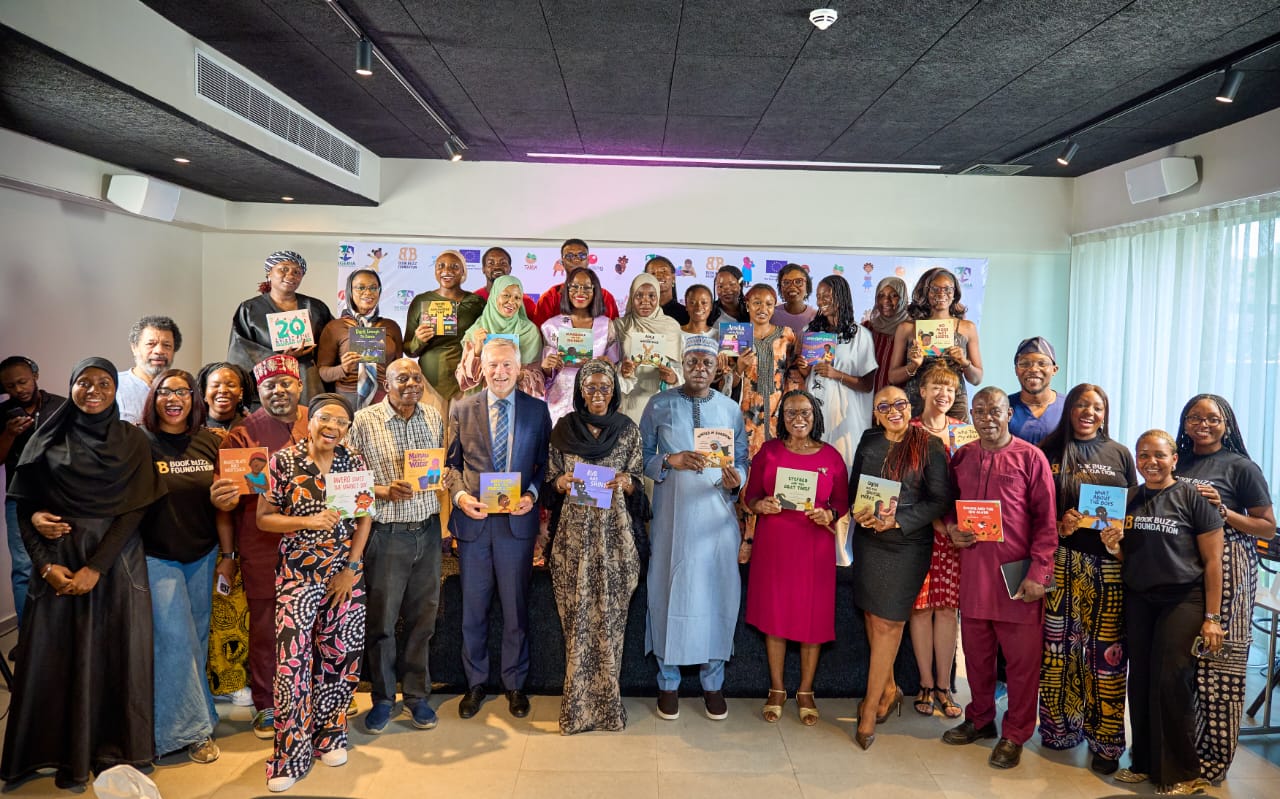
The Book Buzz Foundation and its partners have unveiled 20 Nigerian children’s picture books aimed at promoting reading, strengthening cultural identity and giving Nigerian children access to stories that reflect their communities, experiences and aspirations.
The books were unveiled in Abuja as part of activities around the Abuja Festival of Literature & Ideas, organised by the Book Buzz Foundation, which brings together writers, illustrators, literary practitioners, development partners and other stakeholders in Nigeria’s creative sector.
The festival is supported by the European Union and Sterling Bank, with the Embassies of Sweden, Spain and Italy, the Spanish Agency for International Development Cooperation, AECID, and Spine & Label among its partners.
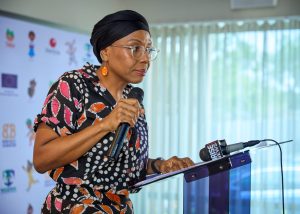
Speaking at the launch, the Founder and Director of the Book Buzz Foundation, Lola Shoneyin, said the project was driven by the need to ensure that Nigerian children could find themselves, their communities and their cultural experiences represented in the books they read.
Shoneyin said the strong Nigerian identity reflected in the collection was one of the most significant aspects of the project, noting that the books featured Nigerian children, names, streets, landscapes and themes.
“I have never seen so many Black faces, so many Nigerian faces in one series of books. Our children, our streets, our names, our landscapes, our themes,” she said.
She explained that the objective was to enable children from different parts of the country to open a book and recognise something familiar about themselves and their environment.
“This is what we want for every child that these books reach. We want the girl in Shogoto, the boy in Karaba, the child in a classroom in Ibadan, to open these books and think, this is me,” Shoneyin said.
According to her, such representation could shape how children see themselves and the world around them, particularly when they encounter characters who reflect their own experiences.
“A child who believes that they are worthy of being on the pages of a beautiful book will grow up seeing the world differently,” she said.
Shoneyin said the Nigerian Picture Book Project was also conceived as part of a broader effort to build a sustainable pipeline for Nigerian children’s literature. She recalled that her interest in children’s books deepened in 2016 after Marine Platforms commissioned mini-libraries for 100 schools in Kaduna State, where Nigerian children responded strongly to books featuring familiar Nigerian characters and environments.
She said the project brought together writers and illustrators from Nigeria’s six geopolitical zones, with four writers and four illustrators selected from each zone. The participants were deliberately paired across regions to encourage them to research and engage with cultures outside their immediate environments.
The founder also said diversity and inclusion were incorporated into the training, including disability representation, to help normalise differences for children from an early age.
“By the time a child grows up, seeing a character called Amina in a wheelchair, she’s no different, she’s enjoying herself, she’s drawing, she’s doing things, showing that she’s capable,” she said.
Shoneyin added, “What they deserve is empathy, support and friendship and trust.”
She stressed that the 20 books should not be regarded as the end of the project but as the beginning of a wider cycle of training writers, illustrators and other professionals, producing books and expanding their distribution to Nigerian children.
“But these 20 books are just the first drop,” she said, adding that the books would also be made available on digital platforms.
Also speaking, the EU Ambassador to Nigeria and ECOWAS, Gautier Mignot, said the European Union was supporting the initiative because of the importance of locally produced creative content and the role of literature in helping children understand themselves, their families and their communities.
Mignot said the objective of the partnership was not to import European products or ideas into Nigeria but to support Nigerian creativity and the development of locally produced books.
“We don’t want to import products, ideas, works from Europe, but we want to support a number of ideas, of books, of products in Nigeria,” he said.
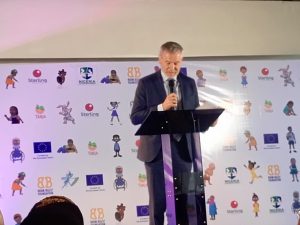
The ambassador said the launch represented more than the publication of books, describing it as a celebration of storytelling and the ability of literature to give children a sense of identity and belonging.
“Today we are celebrating much more than the publication of books. We are celebrating the power of stories to help children see themselves, their families, their communities, and their future reflected on the page,” Mignot said.
He said the European Union was working with Book Buzz Foundation and Sterling Bank on the initiative, while stressing that the project’s success would ultimately be measured by how effectively the books reached children, teachers, families and communities.
“The success of this project will depend not only on the number of books made available, but also on how effectively they are placed in the hands of children, teachers, families, and communities,” he said.
Mignot called for wider private-sector participation to expand access to the books, particularly in rural and hard-to-reach communities, stressing that the fact that the books were launched in Abuja should not mean their reach would be limited to the Federal Capital Territory.
The creative dimension of the project was highlighted by Maša P. Žmitek, Head of the Centre for Illustration, Slovenia, who said the initiative was helping to address gaps in Nigeria’s illustration ecosystem, particularly the limited opportunities for specialised training and professional development.
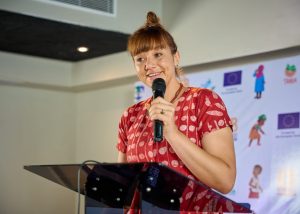
“We have been building the foundations of an illustration ecosystem in Nigeria,” she said.
Žmitek stressed that children’s book illustration was not simply about producing attractive images, but about using visuals to tell stories and build believable worlds for young readers.
“Illustrating a children’s book is not simply about making attractive images. It’s about telling a story and building a world,” she said.
She also noted that details such as architecture, clothing, landscapes, food and everyday objects could give children’s books cultural authenticity while preserving aspects of Nigerian life for future generations.
“Because these details do more than make a story actually believable. They also document,” Žmitek said.
On his part, the –Nigerian Educational Research and Development Council, NERDC, also underscored the educational value of the project, with a representative speaking on behalf of its Executive Secretary, Prof. Salisu Shehu, describing children’s books as important tools for developing imagination, knowledge, values and confidence.
“A children’s book may look small in the hands of a child, but its impact can be enormous. Within those pages are ideas, imagination, values, knowledge, and possibilities,” the representative said.
Shehu said books should not be viewed merely as collections of words and pictures, but as tools through which children could encounter new cultures, ideas and ways of understanding themselves and their environment.
“Books are not simply collections of words and pictures. They are doors. They open children’s minds to new worlds, new cultures, new ideas, and new ways of understanding themselves and the world around them,” the representative said.
NERDC also stressed that children needed books they could identify with, enjoy and learn from, while urging parents, teachers, librarians and caregivers to actively encourage children to read and engage with the stories.
“A book becomes truly valuable when it is opened, read, discussed, and enjoyed,” the representative said.
Representing Sterling Bank, Jacqueline Ekpang said the financial institution was pleased to support the project, linking the importance of illustration to her own experience of seeing how picture books could help children engage with learning.
Ekpang recalled that when her son was about three years old and was struggling to speak, illustrative books helped him become excited about identifying objects and concepts.
“Illustration for me is the foundation of education for every child,” she said.
She said education should go beyond the provision of classrooms to include access to appropriate tools, ideas and opportunities that make learning richer and more relevant to children.
“Education is in the heart of Sterling,” Ekpang said.
She disclosed that more than 30,000 copies had been produced and urged stakeholders to become ambassadors for the books by helping them reach schools, libraries and homes.
The experience of the participants was highlighted by Nana Sule, one of the writers involved in the project, who said the 12-week programme challenged participants to return to the perspective of childhood and rethink how stories were created for young readers.
She said the writers and illustrators came from different parts of Nigeria and brought varied experiences and backgrounds to the programme, creating an opportunity for them to understand the diversity of Nigerian childhood.
“While we do share the experience of having been Nigerian children, there is no single Nigerian child or a Nigerian child story,” Shukudi said.
She said the training exposed participants to issues of representation, imagination, critical thinking and collective well-being, while requiring them to attend classes, complete assignments, conduct research, read recommended materials and participate in review sessions.
Shukudi said the resulting books demonstrated that Nigerian children deserved stories that reflected the richness and diversity of their country.
“We have 20 incredible books,” she said.
She added that children should encounter characters who look like them, carry familiar names or come from cultures different from their own, noting that the project had given her a book that she could share with her own son.
The project’s development process was explained by the Project Coordinator, Tobe Chukwu Chedudu, who said the idea was conceived in 2025 before a 12-week programme was developed in early 2026.
Chedudu said the February 2026 open call attracted 110 illustrators and 135 writers, after which a panel selected 24 writers and 24 illustrators, with four writers and four illustrators drawn from each of Nigeria’s six geopolitical zones.
The training ran from March 3 to May 29 and included weekly assignments and personalised feedback. Writers were trained in language, story structure, inclusion, diversity, culture and setting, while illustrators received training in colour, composition, character development, visual storytelling, observation and other elements of picture-book production.
She said the writers and illustrators were subsequently paired, with art directors providing one-on-one consultations as the stories moved through character development, storyboarding, illustration, colouring and final production.
Chedudu said the project had begun with 48 participants but that some were unable to complete the programme, while those who remained committed ultimately produced the 20 books launched in Abuja.
“We started this journey with 24 writers and 24 illustrators. Some were unable to complete it, but those who stayed gave everything, and the result of their commitment is 20 picture books representing the stories of a new generation of Nigerian creative,” she said.
Chedudu described the completed project as the product of sustained collaboration and commitment.
“From an idea in 2025 to a launch in Abuja today, this is what commitment, creativity, and community looks like,” she said.
She added, “This book belongs to Nigeria, and this is just the beginning.”
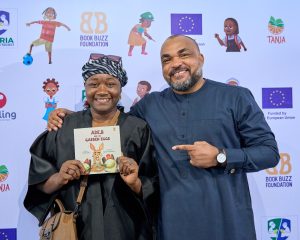
The 20 titles unveiled are Ariyo and the Spelling Tree; Etefolo and the Goat Thief; Talatu and the Desert Sates; Amaka and the Ants; No More Wet Sheets; What About the Boys; Okon Can’t Dance; Bakura’s Big Mistake; Dark Enough to Dance; Who Took My Akara; Oyin and the Special Marks; Adeji and the Garden Eggs; Maimuna Waits for Water; Awero Saves the Market Day; When the Bulldozers Came; Mmesoma and the Big Gully; Wheels of Sunshine; Emike and the Idu Mask; Ewatomi and The Magic Loom; and Rub and Shine.