By Ipole Amajama
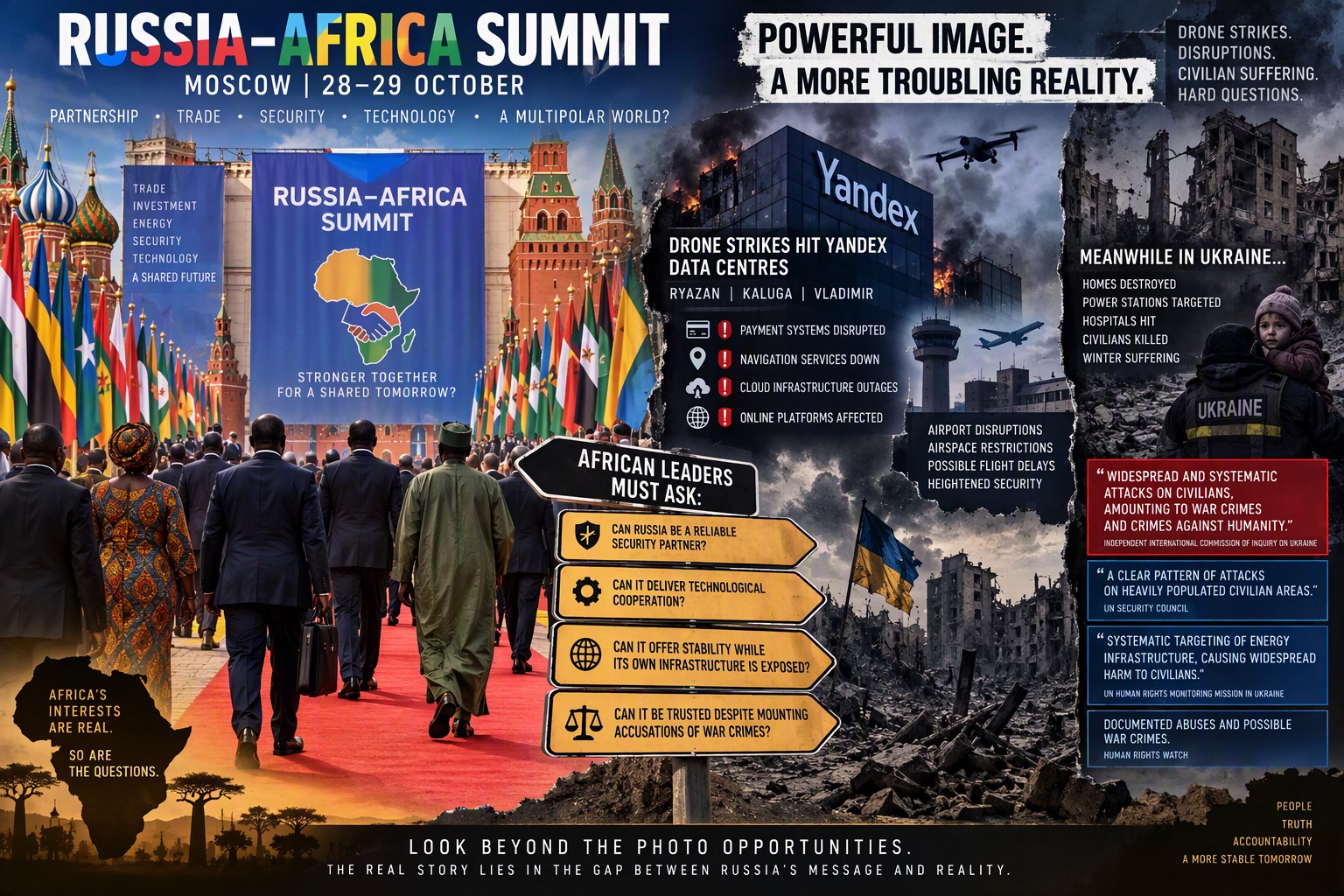
As African leaders and delegates prepare for the Russia-Africa Summit in Moscow on 28-29 October, an uncomfortable question hangs over the gathering: can Russia credibly present itself as a reliable strategic partner when it is increasingly struggling to protect critical infrastructure on its own territory?
The recent drone strikes against three Yandex data centres in Ryazan, Kaluga and Vladimir regions have exposed vulnerabilities at the heart of Russia’s technological ecosystem. Yandex, often described as Russia’s equivalent of Google, powers everything from digital payments and ride-hailing services to cloud computing and artificial intelligence development.
Within days of the attacks, users reported disruptions to payment systems, navigation services, cloud infrastructure and online platforms that millions of Russians depend on daily. Reports indicated that some customers could not access their funds, while businesses relying on Yandex Cloud experienced outages and operational disruptions.
These incidents are more than technical failures. They raise serious questions about Russia’s ability to guarantee security, stability and operational reliability at a time when it is attempting to showcase itself as a major global partner for African states.
The Kremlin wants the Russia-Africa Summit to demonstrate that Moscow remains influential despite years of sanctions, diplomatic isolation and a costly war in Ukraine. Yet the timing could hardly be worse. The attacks on Yandex reveal a country whose strategic infrastructure is increasingly exposed to disruption. Even Russian officials have acknowledged the seriousness of the situation, with authorities reportedly exploring new methods of protecting data centres following what they described as unprecedented attacks.
For African delegations, the issue is not merely theoretical. Large-scale drone attacks have already disrupted airports, transportation systems and security operations in and around Moscow. Analysts note that future attacks could result in flight delays, airspace restrictions, traffic disruptions and heightened security measures during the summit itself.
The symbolism is difficult to ignore. Russia seeks to convince African governments that it can be a dependable security, economic and technological partner. Yet it now faces growing challenges defending key infrastructure hundreds of kilometres from the battlefield.
More importantly, the current insecurity within Russia is inseparable from the war that the Kremlin itself chose to launch. Moscow often portrays itself as a victim of escalating attacks. However, those attacks are occurring against the backdrop of Russia’s sustained campaign against Ukrainian cities and civilian infrastructure. For years, Russian forces have conducted missile and drone strikes against residential areas, power stations, heating networks, water systems, hospitals and transportation infrastructure throughout Ukraine.
International organisations have repeatedly documented the consequences. The United Nations Human Rights Monitoring Mission in Ukraine reported that civilian casualties reached alarming levels throughout 2026, with Russian missile and drone attacks causing extensive civilian harm across multiple regions. In October alone, UN officials described some of the deadliest periods for Ukrainian civilians in years, citing large-scale Russian attacks that killed and injured civilians in cities far from active front lines.
UN officials have also warned of a clear pattern in Russian attacks on urban centres with large civilian populations. Addressing the UN Security Council in July 2026, senior UN officials highlighted repeated Russian missile and drone strikes on Ukrainian cities and noted that such attacks demonstrated a pattern of targeting heavily populated civilian areas.
Particularly troubling are findings regarding attacks on energy infrastructure. UN investigators concluded that Russian forces systematically targeted Ukraine’s energy and heating systems during the winter of 2025-2026, causing widespread electricity shortages, heating disruptions and severe consequences for millions of civilians. According to UN reports, the attacks damaged power generation and transmission facilities, disrupted healthcare and education, and left many civilians facing harsh winter conditions. Investigators stated that these attacks appeared to violate fundamental principles of international humanitarian law.
Even more serious are findings by the Independent International Commission of Inquiry on Ukraine. The commission concluded that Russian forces carried out widespread and systematic drone attacks against civilians in Kherson province, amounting to crimes against humanity and war crimes. Investigators found evidence that civilians, ambulances and civilian infrastructure were intentionally targeted, often with operators able to see their victims in real time through drone cameras.
The commission described attacks that appeared designed not merely to achieve military objectives but to terrorise civilian populations and make areas uninhabitable. It reported recurring strikes on homes, medical facilities and emergency services.
These findings matter because they expose a striking contradiction at the centre of Russia’s diplomatic outreach.
Moscow seeks recognition as a defender of sovereignty and a champion of a multipolar international order. At the same time, it faces mounting accusations from UN bodies and international human rights organisations over conduct in Ukraine that they say involves serious violations of international law. Human Rights Watch has similarly documented alleged war crimes, crimes against humanity and widespread abuses committed during the conflict.
Against this backdrop, the Kremlin’s efforts to present itself as a pillar of stability look increasingly unconvincing. African governments are entitled to ask hard questions. Can Russia offer security partnerships when its own critical infrastructure faces repeated disruption? Can it market technological cooperation when one of its flagship technology companies struggles to keep core services operating after a handful of drone strikes?
Can it claim to be a force for stability while prosecuting a war that UN investigators say has involved repeated attacks on civilians and civilian infrastructure?
None of this means the summit will fail. African countries engage with Russia for a variety of reasons, including trade, security cooperation, energy partnerships and geopolitical diversification. Those interests will continue to shape relations regardless of events on the battlefield.
Yet perception matters in international diplomacy.
The image Russia hopes to project this month is one of confidence, resilience and geopolitical relevance. The reality visible to the world is rather different: drone attacks penetrating deep into Russian territory, critical digital infrastructure knocked offline, emergency measures to restore disrupted services and growing evidence of a war effort that has inflicted enormous suffering on civilians.
The Yandex attacks are therefore significant not simply because servers were damaged or services interrupted. They have become a metaphor for a broader reality. A state that cannot fully protect its own strategic assets is attempting to host a summit designed to showcase its strength. A government accused by international investigators of systematic attacks on civilians is asking foreign partners to trust its leadership.
As African delegations arrive in Moscow, they should look beyond the carefully staged photo opportunities. The real story is not the summit itself. It is the widening gap between the image of power the Kremlin wants to project and the vulnerabilities, contradictions and consequences of war that are becoming increasingly impossible to hide.
Amajama, a social and policy analyst, writes from Abuja and can be reached via amajamaip@gmail.com