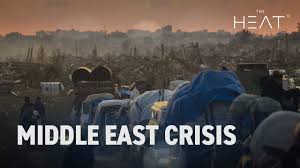
As the war in the Middle East reaches a febrile pitch, Nigerians at home and abroad are caught in a flux with nowhere as it seems to turn to.
Prices of goods and services are soaring as petroleum prices hit over N1, 300 as at last week with the NNPC and Dangote Refinery in a topsy-turvy pricing with marginal increases or pinching off as the case may be.
Nigerians caught abroad have reported poor consular services as they watch citizens of other countries leaving their trapped zones or meeting officials are border crossings to ease their way home.
While it is agreed that the outcomes of the Middle Crisis are not the doing of the Federal Government or any other country except for the United States, Israel and Iran, governments across the world are demonstrating that their citizens come first and are pulling out the stops to assist them mitigate the fallout of the war.
Indeed, prices of fuel hit roof top globally after the barricade at Strait of Hormuz, a vital 30-mile-wide shipping lane between Iran and Oman.
The Strait connects the Persian Gulf to the Gulf of Oman and the open ocean. As a critical global oil chokepoint, roughly 20% of the world’s total liquid petroleum consumption passes through it daily. However, after Israel and the US launched a war on Iran, the Middle East country fought back, blocking vessels from the lane.
For context, nothing best illustrates a country’s commitment to its citizens than the words of Sébastien Beaulieu, Director General of Global Affairs Canada, GAC’s, Emergency Response Centre. “In moments like these, what matters most is being present and responsive to the people who rely on us,” Beaulieu said.
The question at the moment is; Is Nigeria present and responsive to Nigerians who rely on it? If the words of officials are to be taken, then this newspaper can very much doubt.
Take the Minister of Finance, Wale Edun, for instance. According to him, the current prices reflect market realities, so Nigerians should be thankful that the country can refine petroleum products.
He said, “the resilience that the Nigerian economy has is coming largely from the fact that we do have that investment by the private sector, by Alhaji Aliko Dangote, in refining, and we need to support our refiners just as others are supporting them to keep petroleum products flowing.”
It still beggars’ belief that the country has surrendered its energy security entity to one entity and seems immune to the vagaries of such thinking.
Worried by the development, energy expert, Professor Emeritus Wumi Iledare, advised that the government should allow competitive petrol supply instead of import substitution.
According to him, not doing so could manifest through precautionary stockholding, opportunistic pricing, or attempts to secure logistical and supply advantages. And true to his words, Nigerians are feeling the pinch at the pump.
The Ministry of Foreign Affairs and Nigeria in the Diaspora Commission, NIDCOM, have turned to press statement tigers and offering no real time updates on events in the Middle East particularly as they relate to Nigerians.
This is the time for the ministry and the NIDCOM to give value to taxpayers and demonstrate the competence that is sadly lacking.
The last time the ministry provided any information was on March 7 at about 8:28pm providing telephone numbers of embassies in the Middle East and have not updated any information since then. Rather, it has concentrated on inanities, birthday messages for the minister and conference attendances. Ditto for the NIDCOM.
The comments on the various social media handles of the ministry offer the resignation of Nigerians to their fate owing to the “I don’t care” attitude of ministry officials and the gross incompetence that seems to be a hallmark of public administration in the country.
The Abuja Inquirer calls on the federal government to activate an emergency response centre that is fully digitized, manned by tested hands cutting across consular operations, logistics specialists and mission liaisons working side by side—fostering collaboration across departments and time zones.
Nigerians caught in this crisis deserve better and it is now more than ever that the federal government should show that truly Nigerians matter in the long run.