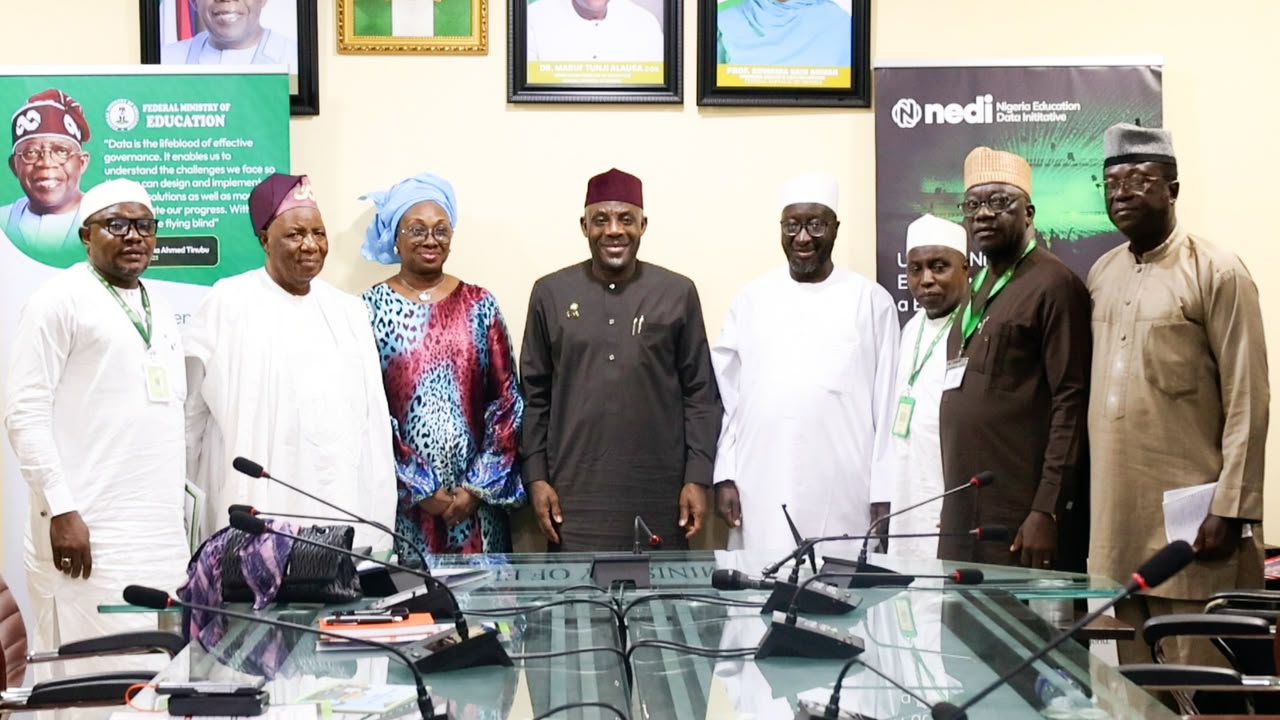
The Minister of Education, Dr. Maruf Tunji Alausa, has directed Vice Chancellors, Rectors and Provosts across the country to immediately dismiss any student found culpable of kidnapping or related criminal activities after due investigation.
Alausa, who declared that Nigeria’s tertiary institutions must never become breeding grounds for criminality, also instructed heads of universities, polytechnics and colleges of education to strengthen internal intelligence systems and deepen collaboration with the Department of State Services, DSS, and other security agencies as part of a nationwide strategy to enhance campus security and protect students.
The Minister spoke during a meeting with the Pro-Chancellor, Governing Council and Management of the Federal University of Lafia in Abuja, where he stressed that institutions must adopt a zero-tolerance approach to criminal activities involving students.
According to the Minister, safeguarding lives and preserving the integrity of higher education institutions remain central to the Federal Government’s education reform agenda.
Special Adviser on Media and Communications to the Minister, Ikharo Attah, said the meeting focused on campus security, infrastructure development, student welfare and the Federal Government’s ongoing higher education reforms.
He noted that the discussions also centred on practical measures to strengthen the Safe Schools Initiative and improve collaboration between tertiary institutions and security agencies nationwide.
While noting that universities, polytechnics and colleges of education across Nigeria remain largely safe, Alausa said recent isolated incidents involving students outside campus underscore the need for stronger intelligence gathering and closer cooperation with security agencies.
“We have a collective responsibility to protect every Nigerian child, from primary school to tertiary education. While our campuses remain safe, we must continue to strengthen intelligence gathering and work closely with our security agencies to ensure that students are protected both within and outside our institutions,” he said.
The Minister disclosed that he recently held an extensive meeting with the Minister of Defence, General Christopher Musa (Rtd.), to develop a coordinated strategy aimed at strengthening the Safe Schools Initiative and enhancing the protection of learners across the country.
He commended President Bola Ahmed Tinubu for providing the political will, strategic leadership and resources required to improve national security while driving far-reaching reforms in the education sector.
According to him, the administration remains committed to ensuring that every Nigerian child has access to quality education in a safe and conducive learning environment.
While reaffirming President Tinubu’s directive that no government institution should negotiate with or pay ransom to kidnappers, Alausa warned that yielding to criminal demands only emboldens criminal elements and weakens the nation’s fight against insecurity.
He consequently directed governing councils and heads of tertiary institutions to establish effective internal intelligence mechanisms, sustain close collaboration with the DSS and other security agencies, and take decisive action against anyone who threatens the safety of students.
“If you tolerate bad behaviour for too long, it becomes a culture. Any student found culpable, after due investigation, of planning or participating in the kidnapping of fellow students has no place in our tertiary institutions.
“Such individuals must be dismissed. Our campuses must never become safe havens for criminal elements. Government has a duty to protect innocent citizens and preserve our institutions as centres of learning and excellence,” the Minister stated.
On infrastructure, Alausa announced that the Federal Government would support security enhancement projects in tertiary institutions through the TETFund 2027 intervention programme, including perimeter fencing and other critical security facilities.
He urged eligible institutions to submit their proposals early for consideration.
The Minister also reaffirmed the Federal Government’s commitment to expanding the Energising Education Programme in partnership with the Federal Ministry of Power, explaining that institutions requiring additional electricity capacity could benefit from expanded solar infrastructure, increased power generation and improved battery storage.
Earlier, the Pro-Chancellor of the Federal University of Lafia, Dr. Mrs. Adebimpe Adebajo, commended the Minister for his sustained support for the institution.
She highlighted key challenges confronting the university, including inadequate hostel accommodation, electricity supply to Campus II and security concerns.
She disclosed that some students were suspected to have been involved in kidnapping activities carried out off-campus, noting that preliminary indications from recent incidents pointed in that direction. She maintained that the university strongly opposes the payment of ransom, warning that such actions only encourage criminality.
The Vice-Chancellor, Prof Mohammed Isa Kida, also commended the Minister for his bold reforms and unwavering commitment to repositioning Nigeria’s education sector.
Professor Kida expressed appreciation for the Federal Government’s continued support for the university and appealed for the extension of the Energising Education Programme to the institution’s second campus. He also requested additional office accommodation and increased staffing to strengthen the university’s teaching, research and administrative capacity.
Responding, Alausa advised the university to submit formal requests under the relevant intervention programmes, assuring the Governing Council and Management that the Ministry would give due consideration to projects that meet the established requirements and align with national priorities.
The Minister reaffirmed that the Federal Government, under the leadership of President Bola Ahmed Tinubu, would continue investing in safer schools, stronger institutions and modern infrastructure to build a globally competitive, innovation-driven and development-focused higher education system.
He assured Nigerians that the Ministry of Education would continue working with security agencies, governing councils and other stakeholders to ensure that campuses remain safe, students are protected and institutions are empowered to deliver quality teaching, impactful research and national development.