Nigeria is targeting annual sugar production of more than two million metric tonnes through a $7.1 billion investment programme aimed at ending dependence on imported sugar, creating 110,000 jobs and saving about $2.1 billion in foreign exchange annually.
The 10-year programme, which is driven by the National Sugar Development Council, NSDC, comprises 13 projects, including three existing backward integration operators and 10 proposed greenfield developments across eight states.
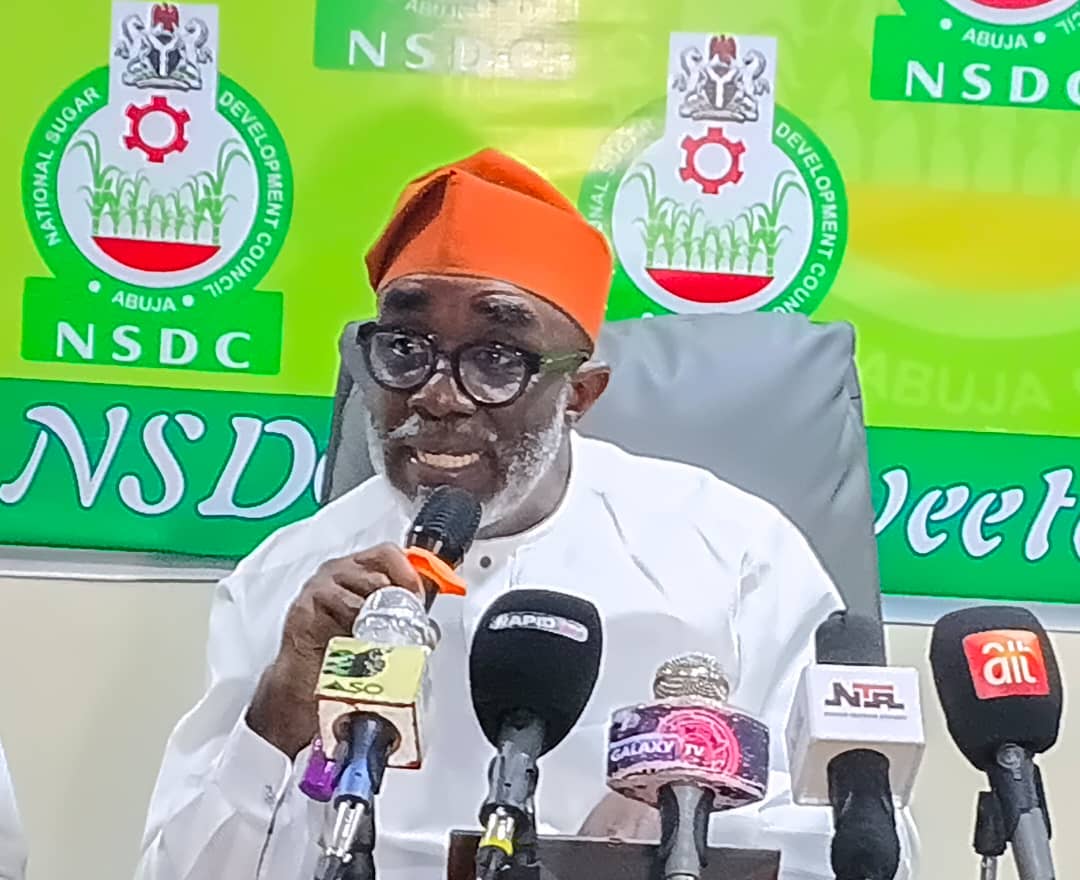
NSDC Executive Secretary, Mr Kamar Bakrin, disclosed this while unveiling the strategy at a news briefing in Abuja on Friday.
Bakrin said the initiative would integrate sugar production with ethanol manufacturing and electricity generation to improve commercial viability and attract investment.
“For as long as most of us can remember, conversations about Nigeria’s sugar industry have been about what is wrong with it. We import almost all the sugar we consume. Plants have been launched and relaunched. Targets have come and gone,” Bakrin said.
He said the council had moved beyond identifying the industry’s challenges to implementing practical solutions to address structural weaknesses that had hindered domestic production.
According to him, Nigeria consumes about 1.8 million metric tonnes of sugar annually, with more than 97 per cent refined from imported raw sugar. The country’s two operating mills produced approximately 27,000 metric tonnes in the last production season.
Bakrin said the strategy prioritised maximising existing mills through outgrower farming, expanding production by established operators and attracting new investors into greenfield projects.
Under the Sugarcane Outgrower Development Programme, the council is targeting 11,000 hectares of farmer-grown sugarcane to produce approximately 880,000 tonnes of cane annually.
About 7,000 hectares have been identified with partners in Kwara, Niger and Adamawa states, while planting is expected to begin on the first 1,320 hectares by 2027.
The council is also facilitating offtake agreements to guarantee markets for farmers’ produce.
The three existing backward integration operators are targeting combined annual production of 1.2 million metric tonnes, supported by plans to cultivate approximately 107,000 hectares and expand factory capacity.
The 10 proposed greenfield projects across Niger, Kwara, Oyo, Kaduna, Jigawa, Bauchi, Nasarawa and Adamawa states are expected to contribute another 835,000 metric tonnes annually at full capacity.
Bakrin disclosed that the council had validated 1.2 million hectares of land suitable for sugar production, against an estimated 250,000 hectares required for national self-sufficiency.
“We have a plan that takes Nigeria from where we are past two million tons across 13 projects,” he said, adding that ethanol and electricity sales would provide additional revenue streams.
On financing, Bakrin said the programme would require approximately $7.1 billion over 10 years, with about $5 billion expected from long-term debt and development finance institutions, while investors would provide the remaining $2.1 billion.
The financing plan includes a $1 billion agreement with Chinese firm Sinomach for engineering, procurement, construction and financing, subject to financial close.
The council has also established a N10 billion Sugar Project Acceleration Fund with the Bank of Industry to support feasibility studies and prepare projects for financing.
To improve productivity, the council has established 222 hectares of seed-cane farms, with another 122 hectares planned.
The farms are expected to supply nearly 19,000 tonnes of certified seed cane for the 2026/2027 planting season.
Meanwhile, the Nigeria Sugar Institute trained 95 professionals in 2026, including 80 certified in basic sugarcane agronomy.
The programme is projected to create 110,000 direct and indirect jobs, support more than one million livelihoods and prevent approximately two million tonnes of greenhouse gas emissions annually.
“This is not a sugar story. It’s a foreign exchange story, it’s a job story, and it’s a rural development story,” Bakrin said.
Speaking during a question-and-answer session, the Head of the Executive Secretary’s Office at the NSDC, Mr Teslim Bello, said several Nigerian and international business groups had expressed interest in investing in the sector.
Some prospective investors have acquired land and commenced feasibility studies, with some projects expected to break ground before the end of the year.
Bello said the strategy would establish integrated bioenergy platforms producing sugar, ethanol and electricity for sale or supply to the national grid.
He added that the investment programme could enable Nigeria to meet its E10 ethanol-blending mandate, adopted in 2007, under which ethanol is expected to account for about 10 per cent of fuel consumed nationally.