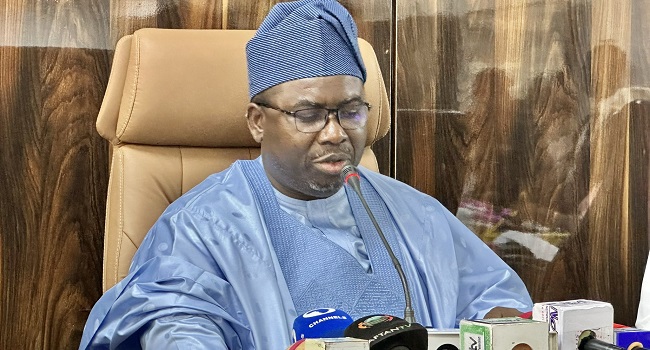
The Independent National Electoral Commission, INEC, has said it is strengthening its capacity to detect and counter digital manipulation, including fabricated announcements, cloned audio recordings and manipulated videos targeting election officials, political candidates and electoral processes.
INEC Chairman, Prof. Joash Amupitan, SAN, warned that artificial intelligence-generated misinformation and deepfake content pose a growing threat to the credibility of the 2027 general elections as it could undermine public confidence and trigger civil unrest.
Amupitan spoke on Monday in Abuja at the opening of the National Summit on Electoral Information Integrity, organised under the European Union Support to Democratic Governance in Nigeria, EU-SDGN III, programme.
With the 2027 general elections approaching, the INEC chairman said electoral threats had shifted beyond physical interference at polling units to increasingly sophisticated digital operations capable of undermining elections even before voting begins.
He warned that the spread of synthetic media, automated disinformation, digital micro-targeting and Foreign Information Manipulation and Interference, FIMI, could erode citizens’ trust in the electoral process.
“Today, elections can be undermined long before the first ballot is cast. The threat is no longer limited to physical interference (such as violent ballot snatching) at the polling unit; it takes shape within digital networks through synthetic media, automated misinformation/
disinformation, deepfake fabrications, digital micro-targeting, and Foreign Information Manipulation and Interference (FIMI),” he said.
According to him, public awareness campaigns alone would no longer be sufficient to protect voters against coordinated and well-funded information manipulation, making institutional collaboration and rapid response mechanisms imperative.
“What Nigeria urgently requires is a trusted, coordinated, and rights-respecting operational ecosystem through which public authorities, security bodies, independent fact-checkers, media networks, and platform operators can collectively anticipate emerging threats, verify evidence, escalate incidents without delay, communicate authoritatively, and institutionalise post-event lessons,” Amupitan said.
He cited the 2023 Slovak parliamentary election, where an AI-generated audio recording allegedly implicating a political party leader in plans to buy votes and manipulate election results went viral two days before voting.
The recording circulated during an electoral blackout period, limiting the opportunity for election authorities, fact-checkers and media organisations to respond before voters went to the polls.
Amupitan said the incident demonstrated the limitations of relying solely on public awareness and post-publication fact-checking to contain sophisticated disinformation campaigns.
He noted that similar tactics could be deployed in Nigeria during critical stages of the 2027 elections, including voter registration, political campaigns, the eve of elections and the announcement of results.
He particularly warned that fabricated audio or video recordings announcing false election results or claiming that polls had been cancelled in strategic constituencies could provoke violence and undermine the credibility of the collation process.
To address the threats, the INEC chairman identified voter education, stronger technological safeguards and real-time misinformation response as key priorities in the commission’s preparations for the elections.
He said INEC was working to equip citizens with the ability to distinguish authentic electoral information from AI-generated fabrications while strengthening its digital infrastructure to withstand foreign and domestic manipulation.
The commission, he added, was also developing mechanisms to identify and debunk viral misinformation within minutes of its emergence and deepen collaboration with social media platforms.
“We already have an MOU with TikTok,” he disclosed, adding that INEC was seeking stronger partnerships with other major platforms, including Facebook, Instagram, WhatsApp, YouTube, Telegram and X.
Amupitan, however, cautioned against allowing efforts to combat electoral disinformation to become instruments for censorship or the suppression of legitimate political expression.
“The legitimate threat of AI manipulation must never become a pretext for state overreach, digital censorship, or the suppression of political dissent,” he said.
He stressed that measures to tackle electoral misinformation must remain transparent, proportionate, respectful of fundamental rights and subject to legal accountability.
“The goal is not to police opinion, regulate political debate, or restrict citizens’ freedom of expression. The sole objective is to protect the authenticity of operational election information so that when a citizen makes a choice at the ballot box, that choice is based on genuine facts rather than engineered deception,” he added.
The INEC chairman called on media organisations, civil society groups, security agencies, technology companies and telecommunications operators to establish coordinated mechanisms for identifying, verifying and responding to digital threats.
He urged journalists to prioritise accuracy over speed, describing the media as the first line of verification in protecting electoral information.
“Speed is important, but accuracy is the currency of democracy,” he said.
He also called for the establishment of clear inter-agency escalation protocols, institutionalised fact-checking desks and practical simulations to test the readiness of stakeholders to respond to AI-driven electoral crises before the 2027 elections.
Amupitan insisted that the summit must produce practical commitments rather than another conference declaration without tangible outcomes.
“The integrity of the ballot in 2027 depends not only on the physical security of the polling unit, but on the authenticity of the information environment in which voters make their decisions,” he said.