By Sarah NEGEDU
In a few days from now, the recently appointed Mandate Secretaries of the Federal Capital Territory Administration would have spent a hundred days in office, following their appointment on 30th November, 2021.
For most residents of the FCT, the appointment of the eight mandate secretaries, alongside 32 other political appointees, was long overdue and a necessary boost for the Secretariats, Departments and Agencies, having been without substantive heads for over two years.
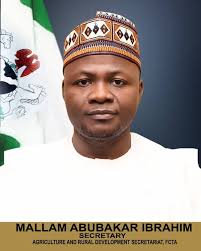
There is therefore no gainsaying that the appointment of Mallam Abubakar Ibrahim as the Mandate Secretary for the Agricultural and Rural Development Secretary, ARDS, has bolstered the effort towards tackling the myriads of issues confronting the Agricultural sector in the FCT, thereby resulting in the outpouring of exciting trends in the sector, just one hundred days into office.
Recall that President Muhammadu Buhari, had in November, 2021, based on the recommendation of the FCT Minister, Malam Muhammad Bello, approved the appointment of Mandate Secretaries to oversee the critical Secretariats of the FCT Administration. And on 30th November, 2021, Bello performed the swearing-in of the newly appointed mandate secretaries and other appointees into their various offices. Then, the minister, who noted that appointees had undergone a very rigorous selection process, added that their antecedents and proven track records were the major considerations that earned them the appointments.
Overtime, the agricultural sector, which hitherto the discovery of oil was the sector mainstay of the economy had been relegated to the background, and consequently brought about swelling numerous challenges such food insecurity, poverty and unemployment amongst others. It is on record that the FCT has one of the fastest growing population in Nigeria and the worry is most of those trooping into the nation’s capital, often than not are more interested in white collar jobs, which are not readily available.
Expectedly to change the trend, following a ministerial directive to hit the ground running, Mallam Ibrahim mandated to oversee agric sector, which plays a significant role in human livelihoods, after receiving official briefs, kicked off with visits to Abattoirs, project sites, and setting up of Committees, thereby making visible and immediate impact within the first 100 days in office.
Clearly, Ibrahim, through reinvigorated strategic sustainable developmental activities at the ARDS demonstrated unwavering resolve towards reversing the seemingly unrelenting sad trend, and put the FCT back on the track of attaining of self-sufficiency in food production. This, is also in line with the focus of the FCT Administration to ensure the economic viability of the Agricultural Sector as a strategy to address the challenges of unemployment and hunger.
Interestingly, the new ARDS Secretary’s strategy of a button-top approach that is by laying a strong foundation at the grassroot level to address issues of revitalising decayed infrastructure and to build the capacities of farmers to ensure that they can see beyond the perceptive of agriculture not just for consumption, but as a business that the help them earn sustainable livelihood. This is so, because when farmers begin to take it as a business that they will be able to make rational decisions that will enhance better business planning, and utilisation of appropriate Agri-practices to enhance production in terms of quality and quantity. Moreso, there is clear desire to strengthen the operations of cooperative groups in the FCT, given the vital role they play in group empowerment, this will help enhance access to micro-credit facilities, inputs as well as other government programmes in the Territory.
Also, within same period, ARDS under the supervision of the FCT Minister of State, Dr. Ramatu Aliyu, through Mallam Ibrahim, ensures that the issue of staff welfare is given priority, by initiating and implementing measures that would improve their working conditions and general welfare. So far, the current leadership has tried to operate a policy that will listen to varying opinion on how to move the Secretariat in realising its mandate, that would ensure that agriculture become a viable sector in the FCT that can generate employment, employer of the growing population of the FCT.
Ibrahim reiterated that his programmes will be tied to the policy thrust of the present administration which is to implement people-oriented programmes.
According to him, ” in furtherance of the directive given to us immediately I assumed duty my first point of call were the abattoirs. I am looking towards a situation where we can have befitting abattoirs, where practices will be in accordance to recommended safety standards, where the environment will be clean devoid of squalor. In line with this, I have held series of meetings with abattoir operators, butchers as well as Area Council Authorities and we have all agreed to work together to address the issue of hygienic practices as well as the use of tyres to process cow meat.”
Also, the secretary took decisive steps such as setting up a committee that will review the current situation and recommend strategies to block leakages and other measures that will attract patronage, thereby enhancing revenue generation to the FCT administration.
Notwithstanding, while projecting the future objectives of the ARDS during a recent media interaction, Malam Ibrahim, reiterated desire to see an agric sector in which the various value chains are vibrant with production and processing activities; as well as a technically driven sector where modern trends are operational and where our farmers will no longer complain of post-harvest loses or even pest infestation. Expressing hope that the reintroduced tractor hiring scheme will bring in revenue for the Secretariat, he anticipated to have a situation where not only government but the private sector is involved in agriculture.
Similarly, it was observed that to boost mechanisation, the ARDS intensified measures to ensure that not only do farmers get access to quality inputs, timely but also that they are affordable. In this line, the Secretariat will be exploring the integration of modern technology in the other aspects of Agricultural practice such as addressing post-harvest loses, organic Agriculture, fisheries and livestock development etc.
Furthermore, the ARDS Secretary revealed the adoption of Training, Infrastructural Collaboration, Mechanisation, Inputs & Empowerment, TICMIE, as a strategy to address the myriads challenges bedeviling the agricultural sector. This, he stressed will enable the secretariat focus on knowledge transfer to our farmers to acquire good agricultural practices, strengthening the synergy with research institutions such as IITA and other reputable individuals to train our farmers as well as Agric. Extension Agents, easing the activities of FCT extension agents to enhance their step-down activities in all the nooks and crannies of the Territory.
Also, part of the expected outcome of the TICMIE initiative, is to ensure that the agric sector is repositioned into a viable sector that will help empower FCT populace.
“The fact is that due to population increase, the facilities are overstretched and can no longer effectively serve their purposes. It is equally significant to ensure that with the position of the FCT, our facilities should be befitting the image of the FCT. In the same vein we have kick started the process of renovating all the dilapidated Agro-service Centre’s and warehoused, just as we are doing with our abattoirs and veterinary clinics.
“It is my belief that with the complimentary support of the private sector as well as other non-governmental organizations and donor agencies, our target of realising food security will be achievable. As we make progress, it is imperative that we improve flow with the latest trends which is technologically driven”, the ARDS boss stressed.