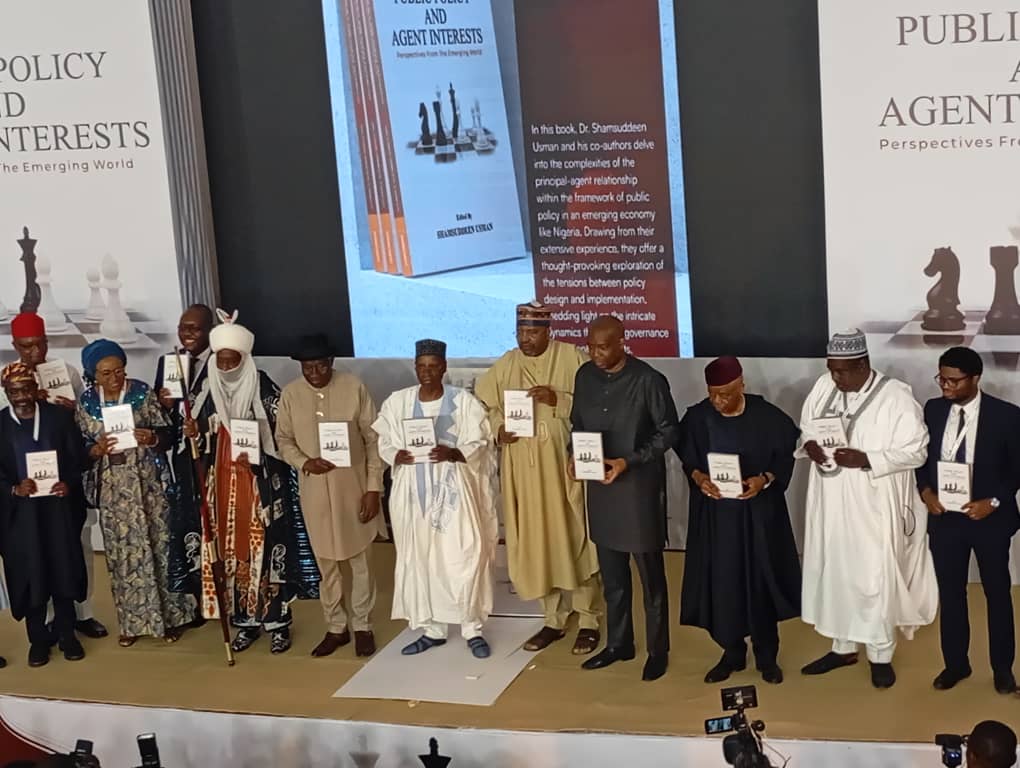
Former President Goodluck Jonathan has again refuted renewed claims by the Emir of Kano, Dr Muhammadu Sanusi II, that $49.8 billion was lost during his administration, saying Nigeria could not have lost such a large amount of money and still pay salaries.
Jonathan spoke in Abuja on Thursday at the public presentation of a book on “Public Policy and Agent Interest: perspectives from the emerging world,” edited by a Former Minister of National Planning, Dr Shamsudeen Usman.
The former president, who wrote the forward of the book, and doubled as chairman of the occasion, disagreed with some sections of the chapter authored by Sanusi, in which he reiterated claims that $49.8 billion was lost.
Sanusi served as the Central Bank of Nigeria, CBN, Governor from 2009 to 2014, and was suspended from office when his allegations could not be proven after thorough investigation.
Putting the record straight, Jonathan said “I don’t agree with some issues that he wrote, especially the one he raised that he was sacked because he blew a whistle that the federal government lost $49.8 billion. It’s not quite correct.
“He was not sacked but suspended because the financial reporting council queried the expenditure of CBN; it’s the Financial Reporting council that has the authority to audit the CBN, not the Auditor General of the Federation.”
He explained that that year, Nigeria’s budget was $31.6 billion, adding that to lose $50 billion and and still pay salaries, without feeling anything was not possible for an economy like this.
The former president urged researchers who will read the book to further research on the subject and see for themselves.
“Moreso, when our revered royal father came up with the figures, first $49.8 billion, later $20 billion and later $12 billion . So I don’t know the correct one,” he said.
Jonathan further noted that when the allegations were brought up, his administration immediately that commissioned Pricewatercoopers, a financial audit firm, to do a forensic audit.
“The report they came up with was that there was $1.48 billion that was not properly accounted for and that NNPCL should pay that money into the Federation account. They did not say we lost $12 billion or $20 billion or $49.8 billion and Macarfi is still alive, Macarfi was the Senate committee chairman on finance,” he added.
He also explained that immediately the Pricewatercoopers report came out, the Senate directed the finance committee to investigate and they used external professional auditors to look into it, adding that the Senate also didn’t see $50 billion, $20 billion or $12 billion that was missing from the system.
“So, I plead that when we are giving account of our stewardship, at least, if we are to go into some of these areas, its good to mention so that somebody who is reading the book will not go with the impression that $50 billion was lost when Jonathan was president. I did not steal billions of dollars from this country,” Jonathan said.
Also speaking, the Emir of Kano, Sanusi, who declined to comment directly on issues raised by the former president, said he had always known that his chapter of the book will be controversial.
While reiterating his respect for Jonathan, under whom he served as CBN Governor, he however, said what comes out of his chapter and the entire book is that “for decades, the Nigerian state has been captive to a rentier class that sees the state as a site for rent extraction rather than as an agent of development.
“This is the fact and this is what has destroyed Nigeria. People get into office and when they get into office, what they are thinking of is how much they can make out of the state rather than how they can use the state to serve the citizenry.
“If we agree on that we have no disagreement. Now our memories on issues or incidents may differ but until Nigeria begins to change that attitude and we have had good moments.”
The former CBN Governor also spoke on the need to allow the Dangote refinery end Nigeria’s importation of refined petrol.
“For a country that has been importing fuel for so many years, faced with an opportunity for weaning itself from importing of petroleum products; instead of grabbing this opportunity we are frustrating it.
“Why would anyone stop us from having capacity to produce our own refined petroleum products because there are vested interests who are profiting from Nigeria continuing to import these products.
“These are the kinds of instances and examples that we see left, right and centre, which continue to get on the way of Nigeria transiting from being a provendo rentier state to being a developed state,” he said.
On his part, the book reviewer, Dr Joe Abah said the main thrust of the book was that the heart of the Nigerian problem is an agency problem where public servants abandon Nigeria’s interest to serve their own interest.
Abah, who is a former Director General of the Bureau of Public Service Reforms, noted that leadership is important but equally important is to know that in democracy not only the high ranking official affect the way the society develops but all public servants.
“At the heart of the Nigerian problem is the agency problem where people abandon the Nigerian interest and pursue their own interest,” he said.
According to him, policies in Nigeria were failing because they were poorly planned as they do not rely on data and designed such that they are inherently un-implementable, adding that there was a huge focus on the symptoms rather than the problem.