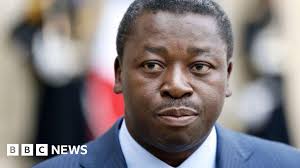
Faure Gnassingbé’s family has ruled Togo for 58 years and his new role has no term limits
The Togolese leader, Faure Gnassingbé, has been sworn in as “President of the Council of Ministers” – a new post which is the highest office in the government’s executive branch and has no official term limits.
This follows constitutional reform that ended presidential elections, and introduced a parliamentary system.
The opposition said the change was in order to allow President Gnassingbé to stay in power indefinitely.
His family has ruled the country for 58 years – Faure Gnassingbé took over in 2005 from his father, Gnassingbé Eyadéma, who had ruled for almost four decades.
This latest change results from a new constitution approved by lawmakers last year, labelled by critics and opposition figures as an “institutional coup d’état”.
Gnassingbé’s government had paused some of the changes following huge backlash, but has moved ahead with his new role.
Togo’s municipal elections in July will be the first under the new constitution, which has replaced the presidential system with a parliamentary one.
In theory, the role of president of the republic is now only an honorary title, but analysts say Gnassingbé’s power is more entrenched than ever with his new post of council president.
His party, the Union for the Republic, won a huge majority in last year’s parliamentary election, taking of 108 out of 113 seats in the National Assembly.
Tunisia jails ex-prime minister on terrorism charges
A court in Tunisia has sentenced former Prime Minister Ali Laarayedh to 34 years in prison on a raft of terrorism charges.
He is the latest high-profile critic of the president to be jailed as campaigners slam “sham trials” in the country.
The 69-year-old is a prominent opponent of President Kais Saied and leader of Ennadha, a moderate Islamist party that holds the largest number of seats in parliament.
Along with seven other people, Laarayedh was charged with setting up a terrorist cell and helping young Tunisians travel abroad to join Islamist fighters in Iraq and Syria.
“I am not a criminal… I am a victim in this case,” he wrote in a letter to the court’s prosecutor last month, according to the AFP news agency.
He was sentenced on Friday.
Laarayedh has consistently denied any wrongdoing and said the case was politically motivated.
In recent weeks, at least 40 critics of Tunisia’s president have been sent to prison – including diplomats, lawyers and journalists.
Rights groups say these trials have highlighted Saied’s authoritarian control over the judiciary, after dissolving parliament in 2021 and ruling by decree.
Since he was first elected six years ago, the former law professor has rewritten the constitution to enhance his powers.
Laarayedh was arrested three years ago and campaigners had called for his release -including Human Rights Watch, who said the affair seemed like “one more example of President Saied’s authorities trying to silence leaders of the Ennahda party and other opponents by tarring them as terrorists”.
Ennahdha governed the North African nation for a short while after a popular uprising dubbed the Arab Spring.
The protest movement originated in Tunisia – where a vegetable-seller called Mohamed Bouazizi set fire to himself in despair of government corruption – and mass demonstrations soon spread across the wider region in 2011.
However many Tunisians say the democratic gains made have since been lost, pointing to the current president’s authoritarian grip on power.
Yet President Saied has rejected criticism from inside and outside the country, saying he is fighting “traitors” and suffering “blatant foreign interference”.
 | ReplyReply allForwardAdd reaction |