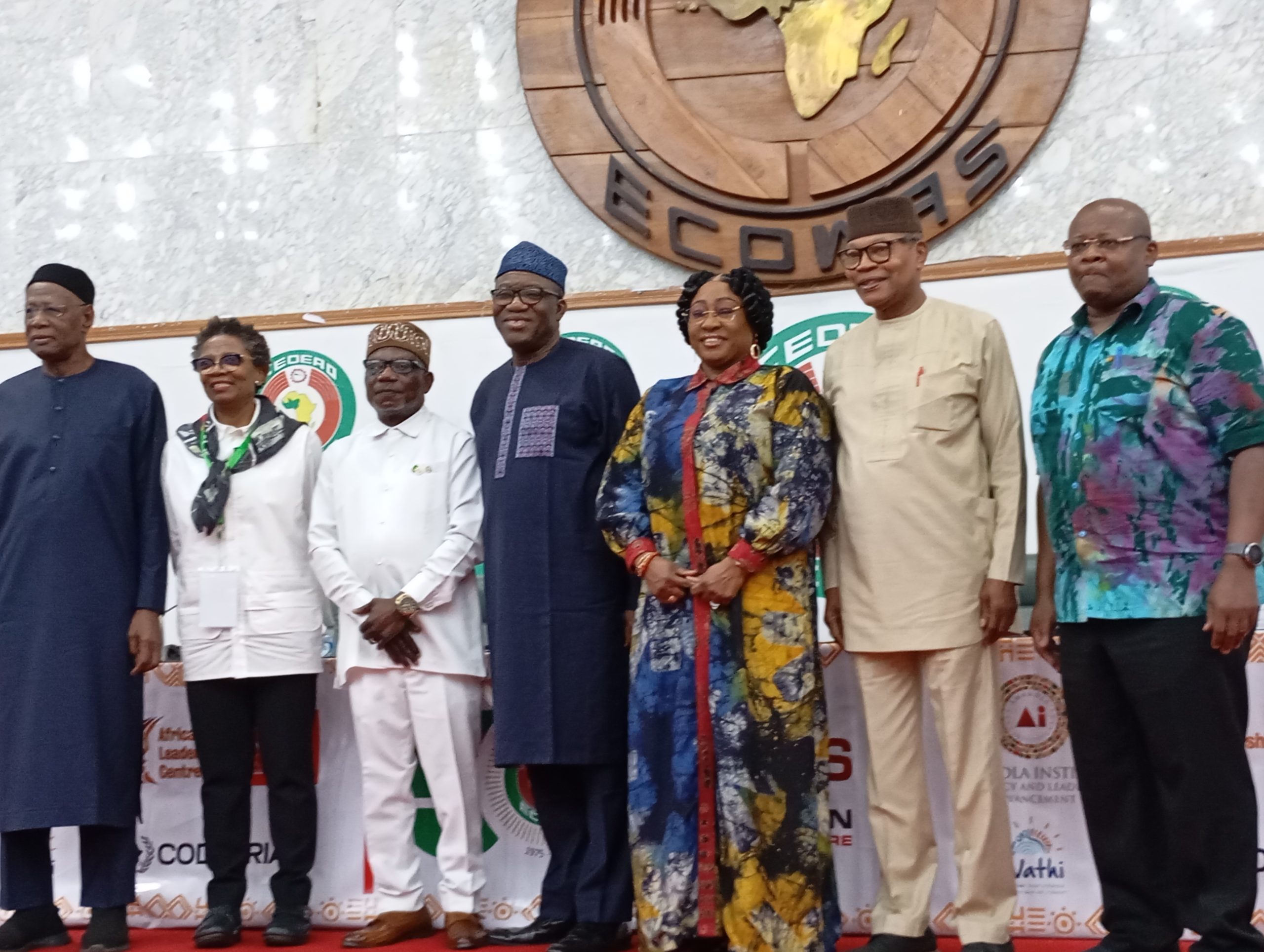
Former Ekiti State Governor, Dr. Kayode Fayemi, has warned that the Economic Community of West African States, ECOWAS, risks sliding into irrelevance if it continues to function as an elite club of rulers detached from the needs of its citizens.
Fayemi, who gave the warning while delivering remarks at the second edition of the African Political Square and Experts Meeting on Alternative Futures for ECOWAS at 50, in Abuja on Friday, called for a fundamental reinvention of the regional body.
He maintained that ECOWAS must urgently transform from a leaders-driven institution into a citizen-centered community capable of addressing poverty, inequality, insecurity, and governance failures.
“Fifty years is a significant milestone in which ECOWAS has accomplished a lot. But it must also serve as a moment of reckoning, a time for deep reflection, bold reforms, and a renewed commitment to the principles of regional integration, security, and inclusive governance,” he said.
Fayemi is also cofounder of the Amandla Institute for Policy and Leadership Advancement, organizers of the event in collaboration with the African Leadership Centre, ALC, CODESRIA, and Wathi.
He lamented that ECOWAS had become remote from the peoples of West Africa it was meant to serve and was in danger of degenerating into a bureaucratic juggernaut.
The former governor cited stalled internal reforms, weak political will, poor funding, and the persistent delay in launching the ECOWAS single currency as evidence of the bloc’s declining vitality.
Fayemi also warned of the dangers of foreign influence, noting that “external donors have not lost any opportunity to embed themselves in its structures and processes.”
On the region’s worsening insecurity, Fayemi stressed the need for a comprehensive human security strategy, saying traditional military strategies alone are inadequate to tackle terrorism and insurgency.
He dismissed military rule as a solution, arguing that “in the three countries that have now exited ECOWAS, terrorism and insecurity have worsened since the military took over.”
Fayemi urged ECOWAS to find creative ways of re-engaging the breakaway Sahelian bloc of Burkina Faso, Mali, and Niger, while preserving regional unity.
Also speaking, the President of the ECOWAS Commission, Dr. Omar Alieu Touray, represented by the Commissioner for Public Affairs, Peace and Security, Dr. Abdel Fattah Al-Nusra, said West Africa stands at a very critical juncture in its evolution, facing twin crises of democracy and security.
Tracing the organization’s evolution since its founding in 1975, Touray said ECOWAS was born out of a complex colonial and linguistic history but succeeded in forging unity where division once reigned.
He credited the regional bloc’s past leadership for stabilizing war-torn nations like Liberia, Sierra Leone, and Côte d’Ivoire, and for developing landmark protocols on democracy, human rights, and conflict prevention.
He, however, warned that democracy in the region was in crisis, with a growing trend of state capture and manipulation of elections.
“The popular method of state capture today is the elimination of dangerous opponents from the electoral process. That is the latest fashion in West Africa,” he said.
Touray disclosed that ECOWAS had begun a citizen-led introspection process that would culminate in a draft act to define the Community’s next 15 years, calling on Africans, especially the youth, to rise to the challenge and choose a path of democratic renewal over military dictatorship.
Earlier, the Executive Secretary of CODESRIA, Dr. Godwin Murunga, said the enduring legacy of colonial borders and the artificial nature of the boundaries across the continent have continued to generate tensions between states and peoples, with profound implications for the ECOWAS project.
Murunga, who heads a pan-African research organization based in Dakar, Senegal, noted that while governments often pursue state-led integration through legal and bureaucratic frameworks, people-led integration driven by movement, trade, culture, and technology is progressing far more rapidly.
“Today, as technology drives interaction and citizens demand greater freedoms across the continent, people’s movements are beginning to exercise more influence on integration than governments,” he said.
He argued that this tension between state-driven and people-driven integration reflects the dynamic of continuity and change in African history.
“State-led initiatives will have to yield ground because at the end of the day, the people’s networks, mobility, and aspirations are already integrating the continent from below, far ahead of the bureaucracies meant to regulate them,” he said.