•Laws, projects and official promises exist but Nigerians with disabilities still face daily commuting barriers
Abuja likes to present itself as a city on the move. New transport projects are announced, rail services are promoted, and officials speak often about decongesting roads and modernising public transport. On paper, the story is one of progress.
On the streets, however, a harder question keeps coming up: progress for whom?
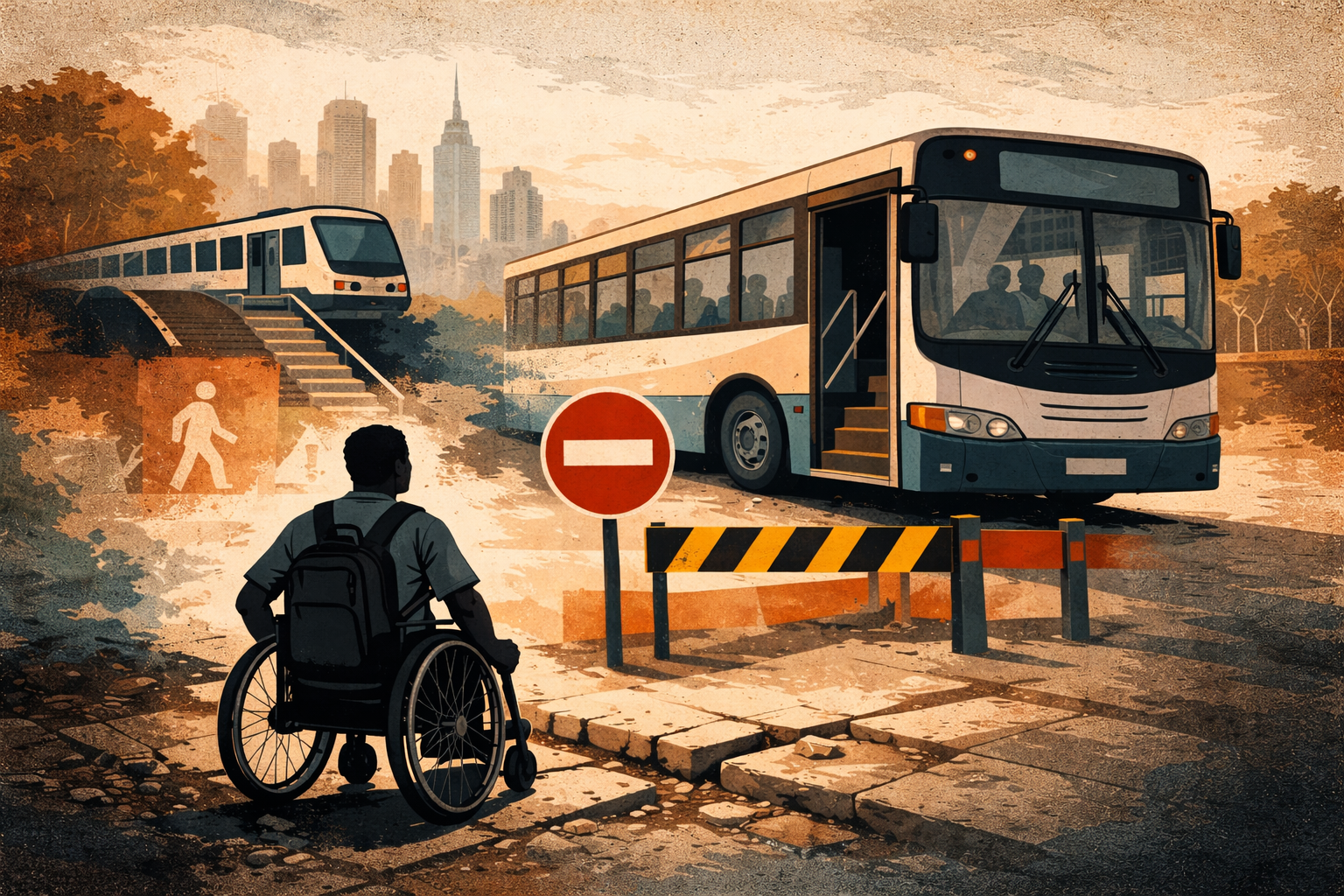
For many Nigerians with disabilities, moving around the Federal Capital Territory, FCT, remains a daily negotiation with barriers uneven pavements, high steps, chaotic roadside boarding points, missing ramps, unclear signage, and systems designed as if everyone can walk, see, hear, and move with ease. The problem is not just that some facilities are inaccessible.
The deeper issue is that Abuja’s transport system, as it is currently organised, is structurally unfriendly to people with disabilities.
Promises without inclusion
Over the past few years, the FCT administration has talked a lot about reforming transport. In early 2024, officials announced that a Bus Rapid Transit, BRT, system for Abuja was being developed as part of efforts to modernise public transport and reduce congestion. The Abuja Light Rail has also been promoted as a flagship project, linking the city to the Nnamdi Azikiwe International Airport and satellite areas like Kubwa.
At the relaunch of the metro rail, the Federal Government announced free train rides to encourage public use and ease commuting costs. That policy especially on the Kubwa–Airport corridor has continued well beyond the initial window, with commuters still reporting free rides into 2025 and 2026. The message from government has been consistent: use public transport; it is cheaper, cleaner, and meant to ease pressure on the roads.
These announcements matter. They show intent. They show investment. But intent, projects, and passenger numbers are not the same thing as access.
Most official communication still focuses on outputs how many passengers were moved, how many terminals were built, how many buses are coming. What is far less visible is a clear, routine accounting of whether these systems are designed so that people with disabilities can use them independently, safely, and with dignity.
The law is clear, but practice is not
In Nigeria, accessibility is not a favour. It is a legal right. The Discrimination Against Persons with Disabilities (Prohibition) Act, 2018 guarantees that persons with disabilities must not be discriminated against in access to public services and infrastructure.
The law is explicit. Section 14(1) prohibits carriers from denying boarding or other transport services to a person on the grounds of disability and requires that accessibility and priority be provided.
Yet, the gap between law and lived reality remains wide.
That gap was publicly acknowledged by the National Commission for Persons with Disabilities, NCPWD, when it recently condemned reports that some airlines were denying boarding to persons with disabilities. In a statement signed by its Head of Media and Publicity, Ishaku Kigbu, the Commission described the practice as unacceptable and unlawful, warning that non-compliance would attract sanctions under the law.
It also cautioned that persistent complaints and distress risk turning the disability law into “a mere paper tiger,” stressing that accessibility must be a priority in both air and land transportation.
This matters because it shows that exclusion is not limited to roads and buses; it cuts across the transport sector. It also shows that even government institutions recognise that the problem is no longer about policy gaps, but about implementation.
When enforcement becomes the real issue
The enforcement problem has also been raised by disability groups themselves. Earlier this year, the National Association of Persons with Physical Disabilities,NAPWPD, visited the NCPWD to demand stronger enforcement of the Accessibility Regulations.
During the engagement, the association’s Vice President, Amb. Mabe Awala Beatrice, called for stricter compliance in public buildings, transportation systems, healthcare facilities, educational institutions, major roads, and other essential services. The Commission’s Director of Compliance and Enforcement, Barr. Nkem Uchebulam, said the agency was pushing for progressive implementation of accessibility standards, while the Executive Secretary, Hon. Ayuba Burki Gufwan, highlighted ongoing enforcement strategies and partnerships.
The exchange was revealing. Nigeria does not lack laws, agencies, or policy language on disability inclusion. What it lacks is consistent, visible enforcement that changes everyday experience.
What the evidence suggests
Research points in the same direction. A recent academic assessment of public transport accessibility in the FCT found poor to very poor accessibility levels along bus route networks in central districts such as Wuse and Garki.
If the heart of the capital struggles to offer inclusive mobility, it is difficult to argue that the wider city is doing much better.
Accessibility is not a single feature; it is a chain. If a commuter cannot reach a boarding point safely, cannot board independently, or cannot navigate the final stretch to their destination, the system has failed them—no matter how modern the terminal looks.
The Abuja people actually use
This is where many policy conversations miss the point. Abuja does not really run on neat, designated terminals. Most residents especially those in Kubwa, Lugbe, Nyanya–Karu, Gwagwalada, Bwari, and Kuje start their journeys at roadside junctions, roundabouts, market edges, and informal pick-up points.
These places have no ramps, no level platforms, no tactile paving, no clear signage, and no organised boarding process. Vehicles stop wherever they can. Passengers climb in however they can.
For someone without a disability, this is messy but manageable. For someone using a wheelchair, someone with low vision, or someone with limited mobility, this is often where the journey ends before it even begins.
Abuja is also a commuter city. Housing keeps spreading outward, while jobs and services remain concentrated toward the centre. Many residents make long, multi-stage trips every day. For a person with a disability, each transfer increases risk, cost, and dependence on strangers. Accessibility is not just about whether a terminal has a ramp. It is about whether the entire journey from home to destination can be completed without humiliation or danger.
The hidden cost of exclusion
Inaccessibility has a price. When buses or trains are unusable, many people with disabilities are forced to rely on taxis or paid lifts, spending more money just to move around the same city as everyone else. Others lose time, miss appointments, or turn down opportunities because getting there is simply too hard.
There is also a cost to dignity and safety. Being lifted into vehicles by strangers, dragged over kerbs, or forced to wait at unsafe roadside stops is not just inconvenient it is degrading and sometimes dangerous. These are everyday consequences of a transport system that was not designed with everyone in mind.
Measuring the wrong things
Transport successes in Abuja are often framed in numbers: buses procured, terminals built, passengers carried, kilometres of rail completed. These figures matter, but they do not answer the most important question: who can actually use these systems safely and independently?
A serious reform agenda would also measure accessibility outcomes: how many routes are fully accessible, how many buses allow level boarding, how many stations can be navigated by a wheelchair user without assistance, and how many corridors have continuous, accessible pedestrian paths. When these things are not measured, they are easily ignored.
From plans to people
Abuja is meant to be a planned capital. A planned city should not only look modern; it should work for all its residents. Transport is not just movement it is access to work, education, healthcare, markets, and public life. When people cannot move, their rights exist only on paper.
If the FCT administration is serious about inclusive development, a few things must change. There should be regular, public accessibility audits of major routes and boarding points. Accessibility features should be mandatory in every transport contract, with clear budget lines. Planning should focus on complete journeys, not just big projects. And compliance with the law should be enforced, not merely encouraged.
Until then, accessible transport in Abuja will remain what it largely is today: a strong promise in laws and policy statements, and a weak reality for many Nigerians who are still struggling just to get from their homes to the city and back.