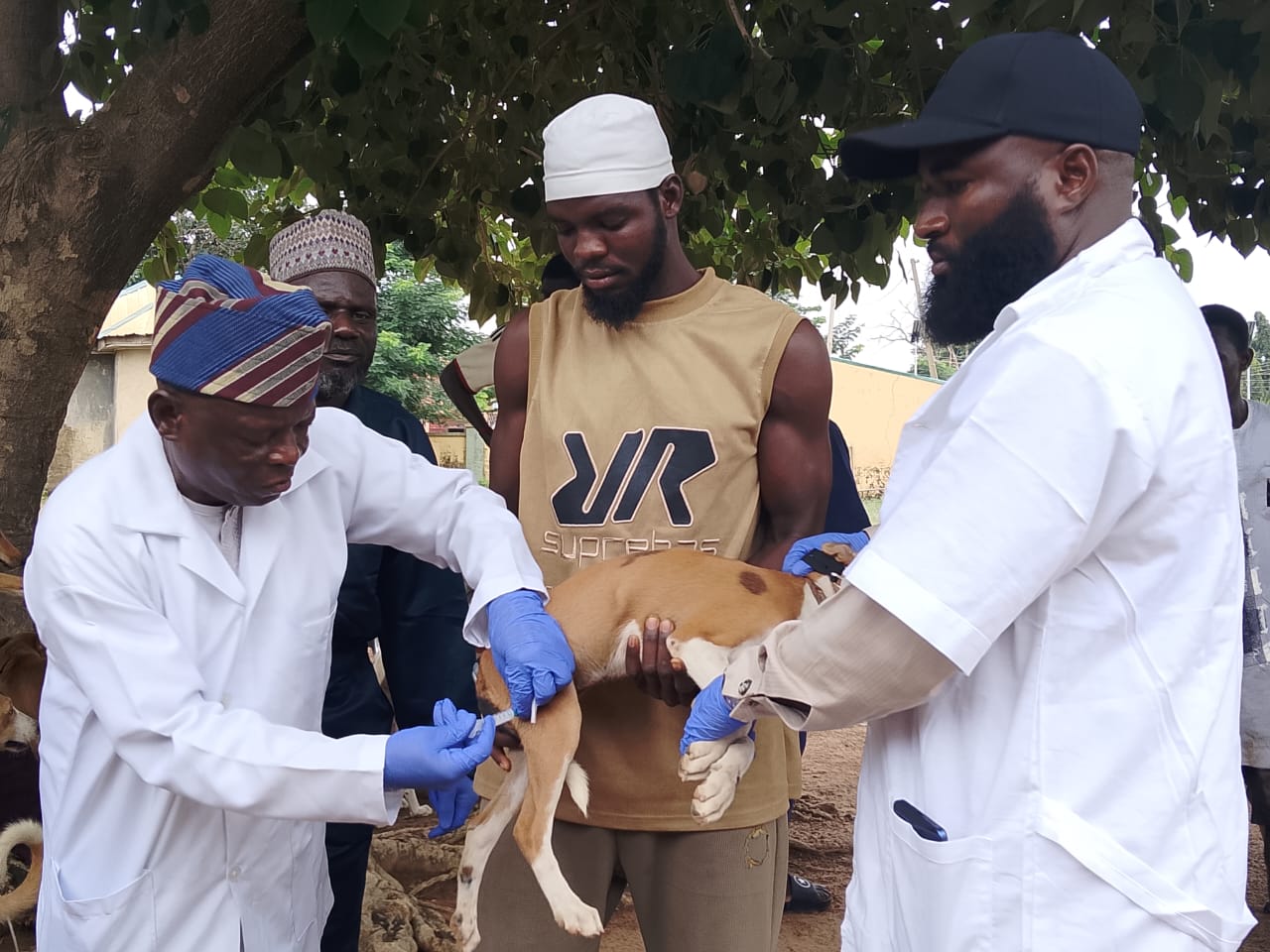
The Federal Capital Territory Administration has mobilised more than 100 veterinary officers for a two-week mass vaccination campaign aimed at immunising between 15,000 and 20,000 dogs against rabies across the Territory.
The exercise, being conducted in all 62 wards of the six area councils, is part of measures to prevent further spread of the deadly disease following cases recorded in parts of the FCT.
Monitoring the exercise in Kuje and Gwagwalada Area Councils on Wednesday, the Mandate Secretary of the Agriculture and Rural Development Secretariat, ARDS, Abdullahi Suleiman Ango, expressed confidence that the target would be achieved within the two-week period.
He said the field monitoring was necessary to assess the effectiveness of the operation and ensure that accurate information was being obtained from the vaccination centres.
“One of the cardinal tenets of efficiency, efficacy, and a result-oriented exercise is supervision and monitoring.
“When you represent the Honourable Minister, you have to be physically present to inspect and see what exactly is being done to report accurately,” Ango said.
Ango said no new cases had been recorded outside the areas where the initial outbreak was detected, attributing the situation to the prompt intervention of the veterinary teams.
“Our target is 15,000 to 20,000 dogs. We have the firm conviction that with this, we are going to stop whatever we are scared or afraid is going to happen.
“We have over 100 experienced veterinary officers on the field, so two weeks is sufficient to cover the FCT,” he stated.
The Director of Veterinary Services, Dr Karnak Dandam, said 12,000 doses of rabies vaccines had initially been deployed for the exercise, with veterinary personnel working across the Territory to reach dog owners and vaccinate animals, including strays.
Dandam warned that rabies remained one of the deadliest diseases but said vaccination of dogs could prevent transmission to humans.
“Rabies is a deadly disease. If a rabid dog bites a human and post-exposure treatment is not administered immediately, death is inevitable once clinical symptoms manifest.
“However, it is 100 percent preventable if the primary vectors—specifically dogs—are vaccinated,” Dr. Dandam stated, adding that vaccinating dogs eliminates the risk of human transmission.
The director said some communities had also taken steps to protect their animals, with local authorities and residents supporting the vaccination teams in affected areas.
At the vaccination centres, dog owners and hunters welcomed the free exercise, with some saying it had provided them with access to veterinary care they previously could not afford or had sought through informal means.
One dog owner, Nation Yusuf, who brought his animals for their first rabies vaccination, expressed satisfaction with the exercise.
A local hunter, Bashir Yusuf, who presented three dogs for vaccination, also commended the FCTA for providing free veterinary services to residents.
The FCTA had earlier confirmed rabies cases in the Territory and subsequently announced the mass vaccination campaign as part of efforts to contain the disease and prevent further infections.