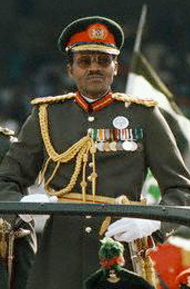
Though he emerged as Head of State after the 1983 coup, the late President Muhammadu Buhari did not mastermind the military takeover that abruptly ended Nigeria’s Second Republic, a new biography of the former Nigerian ruler has confirmed.
The book, Buhari: The Authorised Biography, written by Dr Udu Yakubu, gave accounts of how key conspirators repeatedly pressured General Buhari and eventually threatened to kill him if he refused to lead the new government.
It recounts that the plot to overthrow President Shehu Shagari was conceived and organised primarily by Lagos-based officers led by Major-General Ibrahim Babangida and Colonel Aliyu Mohammed Gusau, who settled on Buhari as the public face of the intervention because of his reputation for integrity and discipline.
The author, quoted the late former leader as recalling the blunt ultimatum issued by the conspirators when he hesitated, saying, “They said to me, either you lead this thing or we will kill you,” in Volume One of the biography titled The Phenomenon.
In Chapter 15 of the book, titled “From Bonanza to Breakdown: The Road to Another Coup,” Dr Yakubu detailed how Nigeria’s sharp economic decline following the collapse of the oil boom, unpaid workers’ salaries, pervasive corruption, and the violent, disputed October 1983 general elections destroyed public faith in the Second Republic.
The biographer noted that for Buhari, then General Officer Commanding the 3rd Armoured Division in Jos, frustration with the civilian administration had already been deepened by what he viewed as the government’s weak handling of the April 1983 border clash with Chad, which convinced him that politicians could not safeguard Nigeria’s security.
Even so, Yakubu wrote that Buhari did not initiate the coup plot, which began quietly among senior officers in Lagos including Babangida, Gusau, Domkat Bali, Mamman Vatsa, Sani Abacha, Ibrahim Bako, Tunde Idiagbon, Mohammed Magoro, Tunde Ogbeha, and David Mark.
When Babangida and Gusau first travelled from Lagos to Jos to broach the subject with Buhari, he immediately rejected the overture and told them plainly, “No, don’t get me involved in this sort of thing.”
Babangida revealed in the book that he and Gusau refused to take no for an answer, making repeated road trips to Jos and mobilising Buhari’s trusted friends, including retired Major-General Shehu Musa Yar’Adua, to persuade him to accept leadership of the movement.
“We needed a man who was good, a man who was honest, a man who could withstand political pressure,” Babangida recalled, adding that Buhari was eventually “dragged into it” because his straightforward character and wide acceptance across the ranks gave the takeover moral credibility.
The biography further disclosed that Buhari had actually planned to retire from the Nigerian Army before the 1983 coup, and remained in uniform only because he needed his regular military salary to finish repaying a bank loan he had taken to build his house in Daura.
According to Buhari’s nephew, Mamman Daura, Buhari was not eager for a coup at all and recognised that removing Shagari’s government would not end Nigeria’s political instability, but could instead trigger an even worse cycle of crises.
Daura noted that shortly before the takeover, the head of the National Security Organisation, Umaru Shinkafi, approached him and begged him to speak with Buhari in a last-ditch effort to calm the rising discontent within the army.
When Daura delivered the message, Buhari agreed that the situation was grave, yet insisted that the momentum toward military intervention had passed the point of reversal, describing the brewing plot as “inexorable.”
Reflecting years later on whether he could have halted the coup, Buhari admitted in the book that he was powerless to stop it and would have been eliminated by the conspirators had he tried to stand in their way.
Yakubu also revealed that before settling on Buhari, some of the coup organisers had first invited former Head of State, General Olusegun Obasanjo, to return to power, an offer Obasanjo turned down on the grounds that it would damage his credibility as a military ruler who had voluntarily handed over to civilians.
Crucially, however, the biographer noted that Obasanjo did not discourage the officers from proceeding with their plot, while Shagari had earlier sent his Secretary to the Federal Government, Alhaji Shehu Musa, to plead with Obasanjo to stop making public criticisms of the government that emboldened restless soldiers.
In addition, one of the conspirators, Mustapha Jokolo, disclosed in the book that retired Chief of Army Staff, Lieutenant General Theophilus Danjuma, was briefed on the plan to topple Shagari and gave the plotters his backing.
When some of the officers suggested that Babangida himself should become Head of State, Babangida declined, explaining in the book that Buhari was his senior and that he did not want anyone to jump ahead of him in the military hierarchy.
Babangida also rejected Mamman Daura’s suggestion that the plotters merely installed Buhari as a transitional figure to absorb the harshness of military rule before Babangida later took over, insisting the choice was straightforward and anchored on Buhari’s integrity.
Following the dawn operation on December 31, 1983, which saw the death of Buhari’s close friend Brigadier Ibrahim Bako during a clash with presidential guards in Abuja and Shagari’s brief flight before surrendering, Buhari assumed office at Dodan Barracks with no illusions about the permanence of power.
The biography noted that almost immediately after taking over, Buhari privately confided in Mamman Daura that he doubted his military administration would survive up to 20 months, telling him, “I don’t think we can last 20 months here, maybe 18 months.”