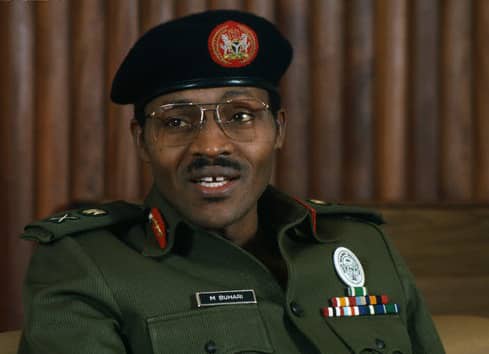
Shortly after assuming office as Nigeria’s military Head of State in January 1984, former President Muhammadu Buhari expressed reservations about the scale of the nation’s economic decline and administrative problems, privately wishing he had known what the military was getting into.
While many Nigerians trooped into the streets in relief following the December 31, 1983 overthrow of President Shehu Shagari, the late leader entered Dodan Barracks weighed down by the burden of office rather than a mood of celebration, a recent biography has stated.
The book, Buhari: The Authorised Biography, written by Dr Udu Yakubu, quoted Buhari in Volume One, of the 3 part biography, as telling his nephew, Mamman Daura, shortly after taking power that, “We are now where we are. The problems are so many. I wish we knew what we were getting into.”
Chapter 16 of the first volume, titled “A Coup’s Logic: The Burden of Correction,” states that Buhari had voiced similar regrets after the July 1975 coup that ousted General Yakubu Gowon, telling Daura at the time that it would have been better if the military had stayed out and let the government do its best.
According to Daura, Buhari understood early on that when a long-standing government is removed, all the unresolved grievances, postponed rivalries, and accumulated failures beneath it come to the surface at once.
Dr Yakubu recorded that Buhari had never nursed a personal ambition to become Head of State, having built his career as a field commander focused on logistics, training, and troop administration rather than politics.
Just over 24 hours before he was announced as Nigeria’s new leader on January 1, 1984, Buhari hosted the then-Plateau State Chairman of the National Party of Nigeria, Abdullahi Adamu, for a 9 p.m. tea meeting at his residence in Jos without giving any hint of what was about to happen.
Adamu recalled in the book that they even agreed to meet again the following day, only for him to be told at the gate that Buhari was not around before hearing martial music on the radio later that night.
In his maiden broadcast to the nation, Buhari attributed the military intervention to financial mismanagement, election rigging, unpaid workers’ salaries, and widespread corruption, alleging that public buildings such as the Republic Building, NET Building, P&T headquarters, and Federal Ministry of Education were set ablaze to cover up fraud.
Yakubu wrote that Buhari agreed to lead the federal military government on one condition, insisting that he must be allowed to select his deputy without interference.
That condition led to the appointment of Brigadier Tunde Idiagbon as Chief of Staff, Supreme Headquarters, a decision Buhari took at his own insistence even though Idiagbon was not part of the inner circle of officers who planned the coup.
Although some military officers expected top positions to go to the main coup planners, Buhari maintained that his choice was based strictly on Idiagbon’s record of uprightness and administrative discipline from their earlier postings as Military Governor of Borno State and Military Secretary.
The appointment nevertheless stirred political controversy outside the barracks because both Buhari and Idiagbon, an Ilorin-born Muslim with Yoruba heritage, were perceived as northern Muslims, breaching Nigeria’s unspoken convention of regional and religious balancing.
Buhari later acknowledged in the book that criticism of the selection was understandable given the country’s sensitivities, yet maintained it was unfair because competence mattered more to him than regional calculations.
Once in office, the two men maintained a steady working relationship in which Buhari directed overall policy while Idiagbon coordinated execution across ministries, ignoring media attempts to cause friction by referring to the administration as the Buhari-Idiagbon government.
“In office, Buhari and Idiagbon worked first class, smooth as clockwork,” Daura said in the book, adding that the pair never quarrelled during their 20 months in power.